Vancouver Weather by Month
Vancouver has a mild oceanic climate, with relatively cool summers, wet winters, and very little snowfall compared with many other Canadian cities. The wettest period is generally from October through January, while July and August are the driest and sunniest months.
Vancouver Weather by Month
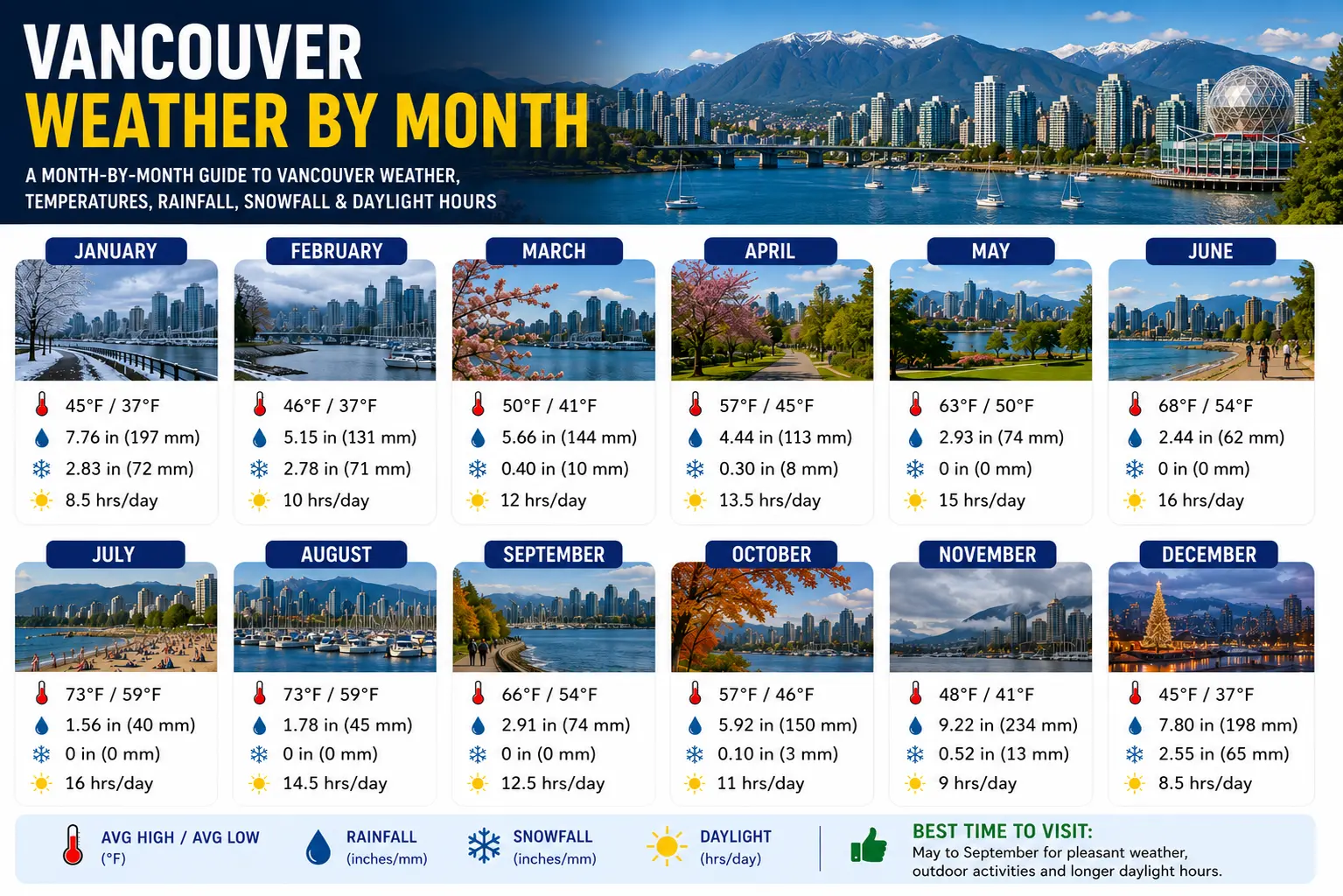
You can click the image below to view the full-size weather chart for Vancouver.
January – Cool, Wet and Snowy
Average high: 7°C (45°F)
Average low: 3°C (37°F)
Rainfall: 7.76 inches
Snowfall: 2.83 inches
Daylight: 8.5 hours
Best for: Winter scenery, city sightseeing and quiet attractions
January is one of the wettest months in Vancouver. Average daytime temperatures reach around 7°C (45°F), while nighttime temperatures remain near 3°C (37°F).
Rainfall averages approximately 197.2 mm (7.76 inches), with about 16 rainy days during the month. Snowfall is relatively limited at around 72 mm (2.83 inches), so snow is possible but does not usually dominate the city.
With only about 8.5 hours of daylight, January is better suited to exploring Vancouver’s museums, restaurants, neighborhoods and other indoor attractions, while nearby mountains can provide snowy winter scenery.
February – Cool and Wet
Average high: 8°C (46°F)
Average low: 3°C (37°F)
Rainfall: 5.15 inches
Snowfall: 2.78 inches
Daylight: 10 hours
Best for: Winter city breaks, mountain views and indoor attractions
February remains cool and wet, although daylight begins to increase. Average highs reach 8°C (46°F), while lows stay around 3°C (37°F).
The city receives approximately 130.9 mm (5.15 inches) of rainfall over about 13 rainy days. Snowfall averages 70.6 mm (2.78 inches), making occasional snow possible, particularly when colder air moves into the region.
With around 10 hours of daylight, February offers slightly more time for sightseeing than January.
March – Cool with Frequent Rain
Average high: 10°C (50°F)
Average low: 5°C (41°F)
Rainfall: 5.66 inches
Snowfall: 0.40 inches
Daylight: 12 hours
Best for: Spring scenery, gardens and city sightseeing
March marks the beginning of a gradual transition toward spring. Average temperatures rise to around 10°C (50°F) during the day and 5°C (41°F) at night.
Rainfall remains significant at approximately 143.7 mm (5.66 inches), with around 14 rainy days. Snowfall drops sharply to about 10.2 mm (0.40 inches).
Daylight increases to about 12 hours, giving visitors more opportunities to explore Vancouver’s parks, waterfront and surrounding attractions.
April – Mild, Green and Rainy
Average high: 14°C (57°F)
Average low: 7°C (45°F)
Rainfall: 4.44 inches
Snowfall: 0.30 inches
Daylight: 13.5 hours
Best for: Spring gardens, hiking and outdoor sightseeing
April brings noticeably milder weather to Vancouver. Average highs reach 14°C (57°F), while nighttime temperatures average 7°C (45°F).
Rainfall decreases to about 112.8 mm (4.44 inches), with approximately 12 rainy days. Snowfall is minimal at around 7.7 mm (0.30 inches).
With 13.5 hours of daylight, April is a good month for enjoying Vancouver’s spring greenery, gardens and outdoor attractions, although rain showers remain common.
May – Mild and Increasingly Dry
Average high: 17°C (63°F)
Average low: 10°C (50°F)
Rainfall: 2.93 inches
Snowfall: 0 inches
Daylight: 15 hours
Best for: Hiking, parks and outdoor sightseeing
May is one of the most pleasant spring months in Vancouver. Daytime temperatures average 17°C (63°F), while nights remain mild at around 10°C (50°F).
Rainfall drops considerably to approximately 74.4 mm (2.93 inches), with about 9 rainy days, and there is essentially no snowfall.
The city enjoys around 15 hours of daylight, making May an excellent time for hiking, visiting parks and exploring Vancouver’s waterfront.
June – Mild, Long Days and Relatively Dry
Average high: 20°C (68°F)
Average low: 12°C (54°F)
Rainfall: 2.44 inches
Snowfall: 0 inches
Daylight: 16 hours
Best for: Hiking, cycling and outdoor activities
June brings the beginning of Vancouver’s summer season. Average daytime temperatures reach 20°C (68°F), while nighttime temperatures average 12°C (54°F).
Rainfall falls to around 62.1 mm (2.44 inches), with approximately 7 rainy days. Snow is absent, and the longer days make outdoor activities much more enjoyable.
With approximately 16 hours of daylight, June is ideal for hiking, cycling, sightseeing and exploring Vancouver’s surrounding natural landscapes.
July – Warm, Dry and Sunny
Average high: 23°C (73°F)
Average low: 15°C (59°F)
Rainfall: 1.56 inches
Snowfall: 0 inches
Daylight: 16 hours
Best for: Beaches, hiking and outdoor sightseeing
July is one of the warmest and driest months in Vancouver. Average highs reach 23°C (73°F), while nighttime temperatures stay around 15°C (59°F).
Rainfall drops to only 39.5 mm (1.56 inches), with approximately 4 rainy days, making July the driest month in the data provided. Snowfall is nonexistent.
The city receives around 16 hours of daylight, creating excellent conditions for beaches, hiking, cycling, sightseeing and other outdoor activities.
August – Warm, Dry and Pleasant
Average high: 23°C (73°F)
Average low: 15°C (59°F)
Rainfall: 1.78 inches
Snowfall: 0 inches
Daylight: 14.5 hours
Best for: Hiking, beaches and exploring the outdoors
August has weather very similar to July. Average highs remain around 23°C (73°F), with average lows of 15°C (59°F).
Rainfall is low at approximately 45.2 mm (1.78 inches), with only about 4 rainy days. Snowfall is absent, and conditions are generally comfortable for spending time outdoors.
There are about 14.5 hours of daylight, giving visitors plenty of time to explore Vancouver’s parks, beaches and surrounding mountains.
September – Mild and Comfortable
Average high: 19°C (66°F)
Average low: 12°C (54°F)
Rainfall: 2.91 inches
Snowfall: 0 inches
Daylight: 12.5 hours
Best for: Hiking, sightseeing and quieter outdoor trips
September brings a gradual return to cooler conditions. Average daytime temperatures fall to around 19°C (66°F), while nighttime temperatures average 12°C (54°F).
Rainfall increases slightly to about 73.9 mm (2.91 inches), with around 6 rainy days. Snowfall remains at zero.
With approximately 12.5 hours of daylight, September can be an excellent time for outdoor activities, particularly for travelers who prefer milder temperatures and fewer summer crowds.
October – Cool, Wet and Autumnal
Average high: 14°C (57°F)
Average low: 8°C (46°F)
Rainfall: 5.92 inches
Snowfall: 0.10 inches
Daylight: 11 hours
Best for: Fall foliage, photography and city sightseeing
October marks the return of Vancouver’s wetter season. Average highs reach 14°C (57°F), while lows fall to around 8°C (46°F).
Rainfall rises sharply to approximately 150.4 mm (5.92 inches), with about 12 rainy days. Snowfall is still extremely limited at only 0.1 inches.
With around 11 hours of daylight, October is a good month for enjoying autumn colors and exploring the city, but visitors should be prepared for frequent rain.
November – Cool, Very Wet and Cloudy
Average high: 9°C (48°F)
Average low: 5°C (41°F)
Rainfall: 9.22 inches
Snowfall: 0.52 inches
Daylight: 9 hours
Best for: Indoor attractions, cozy city breaks and mountain scenery
November is one of the wettest months of the year in Vancouver. Average daytime temperatures reach about 9°C (48°F), while nighttime temperatures average 5°C (41°F).
Rainfall increases to approximately 234.3 mm (9.22 inches), the highest monthly total in the data provided, with around 16 rainy days. Snowfall remains relatively low at 13.2 mm (0.52 inches).
With only about 9 hours of daylight, November is better suited to museums, restaurants, shopping and other indoor experiences, although the nearby mountains may begin developing a winter appearance.
December – Cool, Wet and Wintry
Average high: 7°C (45°F)
Average low: 3°C (37°F)
Rainfall: 7.80 inches
Snowfall: 2.55 inches
Daylight: 8.5 hours
Best for: Winter scenery, holiday activities and indoor attractions
December brings Vancouver back to cool winter conditions. Average highs are around 7°C (45°F), while nighttime temperatures fall to approximately 3°C (37°F).
Rainfall averages about 198 mm (7.80 inches), with around 16 rainy days. Snowfall increases to approximately 64.7 mm (2.55 inches), although Vancouver itself generally remains much milder than many other Canadian destinations.
December has only about 8.5 hours of daylight, making it one of the darkest months of the year. It is a good time for holiday activities, indoor attractions and visiting the snow-covered mountains surrounding the city.
Vancouver Weather by Month
| Month | Avg High °F (°C) | Avg Low °F (°C) | Rainfall (inches) | Sun (hrs/day) | Snowfall (inches) |
|---|---|---|---|---|---|
| January | 45°F (7°C) | 37°F (3°C) | 7.76 | 8.5 | 2.83 |
| February | 46°F (8°C) | 37°F (3°C) | 5.15 | 10 | 2.78 |
| March | 50°F (10°C) | 41°F (5°C) | 5.66 | 12 | 0.40 |
| April | 57°F (14°C) | 45°F (7°C) | 4.44 | 13.5 | 0.30 |
| May | 63°F (17°C) | 50°F (10°C) | 2.93 | 15 | 0 |
| June | 68°F (20°C) | 54°F (12°C) | 2.44 | 16 | 0 |
| July | 73°F (23°C) | 59°F (15°C) | 1.56 | 16 | 0 |
| August | 73°F (23°C) | 59°F (15°C) | 1.78 | 14.5 | 0 |
| September | 66°F (19°C) | 54°F (12°C) | 2.91 | 12.5 | 0 |
| October | 57°F (14°C) | 46°F (8°C) | 5.92 | 11 | 0.00 |
| November | 48°F (9°C) | 41°F (5°C) | 9.22 | 9 | 0.52 |
| December | 45°F (7°C) | 37°F (3°C) | 7.80 | 8.5 | 2.55 |
20 FAQs About Vancouver Weather
1. What is the weather like in Vancouver year-round?
Vancouver has a mild oceanic climate with cool, wet winters and mild to warm summers. Rainfall is highest from October through January, while July and August are the driest months.
2. What is the coldest month in Vancouver?
January and December are among the coldest months. Average highs are around 7°C (45°F), while average lows are about 3°C (37°F).
3. What is the warmest month in Vancouver?
July and August are the warmest months, with average highs of approximately 23°C (73°F) and average lows of 15°C (59°F).
4. Does it snow in Vancouver?
Yes, Vancouver does receive snow, but snowfall is relatively limited compared with many other Canadian cities. The highest amounts in the provided data occur in January, February, and December.
5. How much snow does Vancouver get in January?
January receives approximately 72 mm (2.83 inches) of snowfall, making it one of the snowiest months of the year.
6. Does Vancouver get snow in February?
Yes. February averages about 70.6 mm (2.78 inches) of snowfall. However, snow is not usually a dominant feature of the city throughout the entire month.
7. Which month has the most rainfall in Vancouver?
November is the wettest month in the provided data, with approximately 234.3 mm (9.22 inches) of rainfall and around 16 rainy days.
8. What is the rainiest season in Vancouver?
Late fall and winter are the wettest periods. Rainfall is particularly high from October through January, with November recording the highest monthly total.
9. What is the driest month in Vancouver?
July is the driest month, receiving approximately 39.5 mm (1.56 inches) of rainfall over about 4 rainy days.
10. When is the best time to visit Vancouver for good weather?
July and August are generally the best months for warm, dry weather. Both months have average highs of 23°C (73°F), low rainfall, and long daylight hours.
11. Is Vancouver rainy in January?
Yes. January is very rainy, with approximately 197.2 mm (7.76 inches) of rainfall and 16 rainy days.
12. Is Vancouver rainy in summer?
Summer is considerably drier than winter. July and August have only about 4 rainy days each, making them among the best months for outdoor activities.
13. What is Vancouver weather like in spring?
Spring becomes progressively milder and drier. Average highs increase from 10°C (50°F) in March to 17°C (63°F) in May, while rainfall generally decreases.
14. What is Vancouver weather like in summer?
Vancouver summers are mild and relatively dry. June through August have average highs of 20–23°C (68–73°F), with July and August being particularly dry.
15. What is Vancouver weather like in fall?
Fall starts mild but becomes increasingly cool and wet. September has an average high of 19°C (66°F), while November falls to 9°C (48°F) and becomes the wettest month.
16. What is Vancouver weather like in winter?
Vancouver winters are cool and very wet rather than extremely cold. Average highs range from 7–8°C (45–46°F), while average lows are around 3°C (37°F).
17. How many hours of daylight does Vancouver get in summer?
Vancouver gets approximately 16 hours of daylight per day in June and July, providing plenty of time for hiking, sightseeing, cycling and other outdoor activities.
18. How short are the days in Vancouver in winter?
December and January have approximately 8.5 hours of daylight per day, making them the darkest months in the provided data.
19. What is the best month for outdoor activities in Vancouver?
July is an excellent month for outdoor activities because it combines warm temperatures, only about 1.56 inches of rainfall, approximately 4 rainy days, and 16 hours of daylight.
20. When is the best time to visit Vancouver to avoid rain?
For the lowest chance of rainy weather, July and August are the best choices. They have the lowest rainfall totals and only about 4 rainy days per month, along with warm temperatures and long daylight hours.
Read more: