Alaska Weather by Month: A Complete Guide for Travelers
Alaska is unlike anywhere else on Earth when it comes to weather. From the mild, rain-soaked southeast panhandle to the bone-chilling interior and the windswept Arctic tundra, Alaska’s climate varies dramatically by region — and by season. Whether you’re planning a summer adventure under the midnight sun or braving a winter fishing trip, here’s what you can expect month by month.
Alaska Climate Overview
Alaska has several climate zones:
- Southcentral Alaska (Anchorage, Kenai Peninsula): Cool summers and snowy winters
- Interior Alaska (Fairbanks, Denali): Warm summers and extremely cold winters
- Southeast Alaska (Juneau, Ketchikan): Mild but very rainy
- Arctic Alaska (Utqiaġvik/Barrow): Long polar winters and short cool summers
Summer daylight is another major factor. In June, some areas receive nearly 24 hours of sunlight, while winter brings very short days.
Alaska Temperatures by Month
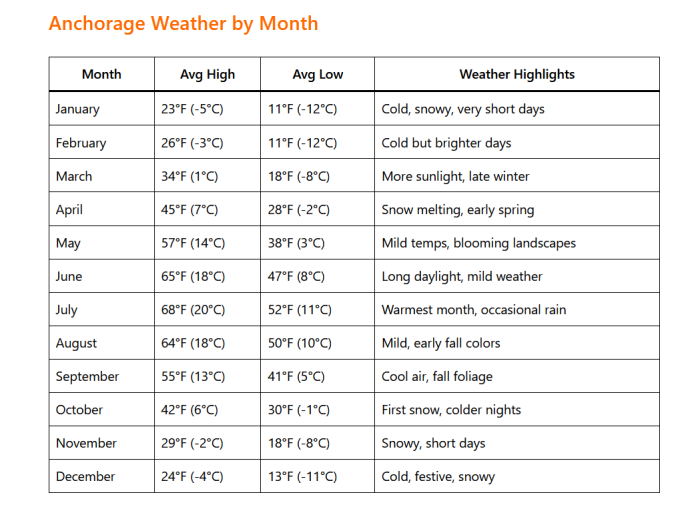
You can click the image below to view the full-size weather chart for Alaska.

Alaska Weather in January
- Anchorage (Southcentral): Highs 23°F (–5°C), Lows 12°F (–11°C)
- Fairbanks (Interior): Highs 0°F (–18°C), Lows –15°F (–26°C)
- Juneau (Southeast): Highs 36°F (2°C), Lows 27°F (–3°C)
January is Alaska’s coldest month across most of the state. In Fairbanks, the interior city known for its extreme continental climate, daily highs average just –18°C (0°F) and lows plunge to –26°C (–15°F) — and on the coldest nights, temperatures can crash well below –40°F. Anchorage is considerably more forgiving, with highs around –5°C (23°F) and lows near –11°C (12°F), moderated by its proximity to Cook Inlet. Juneau, in the southeast, is the mildest of all — highs hover around 2°C (36°F) and lows only dip to –3°C (27°F), though persistent rain and overcast skies define the month. Rainfall in Juneau reaches about 176mm in January, with 17 rainy days.
In Utqiaġvik (formerly Barrow), Alaska’s northernmost city, January is simply brutal. Average temperatures hover around –14°F (–26°C), with wind chills that can make it feel like –50°F or colder. The city is in the depths of polar night — the sun does not rise at all in Utqiaġvik from mid-November through late January, leaving residents in continuous darkness for nearly 65 days.
Daylight is scarce across the state. Fairbanks sees about 5 hours of sunlight, Anchorage around 6.5 hours, and Juneau roughly 7 hours. This is peak season for aurora borealis viewing — the long, dark nights and clear Arctic skies make the northern lights spectacular, and Utqiaġvik is one of the best places on Earth to witness them.
What to expect: Extreme cold inland and across the Arctic, heavy snowpack, polar night in the far north, and excellent aurora viewing.
Alaska Weather in February
- Anchorage (Southcentral): Highs 27°F (–3°C), Lows 14°F (–10°C)
- Fairbanks (Interior): Highs 12°F (–11°C), Lows –9°F (–23°C)
- Juneau (Southeast): Highs 37°F (3°C), Lows 27°F (–3°C)
February holds much of January’s chill but begins to show subtle signs of change. Fairbanks sees highs of –11°C (12°F) and lows of –23°C (–9°F) — snowfall peaks this month at 283.7mm over 10 snow days, the heaviest accumulation of the year. Anchorage warms slightly with highs near –3°C (27°F) and lows around –10°C (14°F), with 316.1mm of snowfall. Juneau remains wet, with 133.9mm of rain across 14 rainy days and occasional snow.
In Utqiaġvik, February is still fiercely cold, averaging around –13°F (–25°C). The big event of the month is the return of the sun — after nearly 65 days of polar night, the sun first appears above the horizon in late January, and by February it climbs a little higher each day. Residents celebrate this return of light with genuine joy. Wind remains a constant factor, and sea ice on the Chukchi and Beaufort seas is at its thickest.
Daylight begins its dramatic return across the state. By the end of February, Anchorage gains nearly an hour of light compared to the winter solstice. The Iditarod Trail Sled Dog Race, one of Alaska’s most iconic events, begins in early March but training and qualifying races heat up in February.
What to expect: Cold, crisp, and increasingly bright. Great for winter sports and dog mushing. In the Arctic, the sun makes its welcome return.
Alaska Weather in March
- Anchorage (Southcentral): Highs 34°F (1°C), Lows 19°F (–7°C)
- Fairbanks (Interior): Highs 27°F (–3°C), Lows 0°F (–18°C)
- Juneau (Southeast): Highs 41°F (5°C), Lows 30°F (–1°C)
March marks a turning point. Longer days arrive quickly — Anchorage climbs from about 11.5 hours of daylight at the start of the month to nearly 13 by the end. Temperatures remain cold but start climbing: Anchorage sees highs of 1°C (34°F) and lows of –7°C (19°F); Fairbanks highs reach –3°C (27°F) with lows still at –18°C (0°F); Juneau warms to highs of 5°C (41°F) with lows near –1°C (30°F). Snowfall remains heavy — Anchorage gets 266.2mm and Fairbanks 148mm this month.
Utqiaġvik averages around –10°F (–23°C) in March — still bitterly cold, but daylight now stretches to 12+ hours and grows rapidly. The frozen Arctic Ocean remains solid, and polar bear activity near the coast peaks as the animals travel across the sea ice. The Nalukataq whaling season preparations begin in the community.
Snowpack is still deep across the state and conditions are excellent for skiing, snowshoeing, and snowmachining. The Iditarod kicks off in Anchorage and winds through the interior toward Nome. Spring skiing at Alaska resorts offers long days and good snow.
What to expect: Cold but brightening fast. Excellent snow conditions for outdoor recreation. In the Arctic, polar bears roam the sea ice.
Alaska Weather in April
- Anchorage (Southcentral): Highs 45°F (7°C), Lows 30°F (–1°C)
- Fairbanks (Interior): Highs 46°F (8°C), Lows 21°F (–6°C)
- Juneau (Southeast): Highs 48°F (9°C), Lows 36°F (2°C)
April is a transitional month that can be deceiving. Snow begins to melt in southern and coastal areas, but the interior remains solidly wintry. Anchorage reaches highs of 7°C (45°F) with lows of –1°C (30°F) — snowfall drops sharply to 115.2mm and rain picks up at 13.2mm. Fairbanks highs climb to 8°C (46°F) but lows linger at –6°C (21°F), with 82.9mm of snowfall still possible over 3 days. Juneau warms to highs of 9°C (48°F) with lows of 2°C (36°F), and rain continues at 116.3mm across 15 days — snow is largely gone from lower elevations.
In Utqiaġvik, April is still firmly winter, with averages around 1°F (–17°C). However, the daylight situation is transforming dramatically — by late April, the city has nearly 18 hours of sun per day, and the midnight sun is only weeks away. Snow remains thick on the tundra and the sea ice is still solid, supporting subsistence whaling and hunting activities that are central to Iñupiat culture.
In the interior, breakup season begins — the dramatic (and sometimes messy) period when rivers thaw and ice jams form. For travelers, April is shoulder season: fewer crowds, lower prices, and a mix of winter and spring activities.
What to expect: Variable and unpredictable statewide. Pack layers. Mud season arrives in the south, while the Arctic stays frozen but increasingly bright.
Alaska Weather in May
- Anchorage (Southcentral): Highs 57°F (14°C), Lows 41°F (5°C)
- Fairbanks (Interior): Highs 64°F (18°C), Lows 37°F (3°C)
- Juneau (Southeast): Highs 57°F (14°C), Lows 43°F (6°C)
May is one of the most beautiful and dramatic months in Alaska. The landscape transforms rapidly: tundra greens up, wildflowers bloom, and wildlife becomes highly active. Brown bears emerge from hibernation, migratory birds flood in by the millions, and salmon begin their first runs in some river systems.
Temperatures are mild and pleasant: Anchorage sees highs of 14°C (57°F) and lows of 5°C (41°F), with 17.5 hours of daylight and only 17.6mm of rain — the driest month of the year. Fairbanks is even warmer, with highs reaching 18°C (64°F) and lows of 3°C (37°F), and an impressive 18.5 hours of daylight. Juneau reaches highs of 14°C (57°F) with lows of 6°C (43°F), and while 112.6mm of rain still falls, it’s the driest month on the southeast coast.
In Utqiaġvik, May is the month of transformation. The midnight sun arrives around May 11 and doesn’t set again until August 2 — nearly three months of continuous daylight. Average temperatures rise to about 19°F (–7°C), still freezing but rapidly warming. Sea ice begins to break up along the coast, and bowhead whale migration brings the community together for the Nalukataq spring whaling festival, one of the most important cultural events in Iñupiat life. Thousands of migratory shorebirds and waterfowl arrive on the tundra.
What to expect: Warm and lively in the south, with the Arctic greeting the return of the midnight sun and the whaling season.
Alaska Weather in June
- Anchorage (Southcentral): Highs 64°F (18°C), Lows 48°F (9°C)
- Fairbanks (Interior): Highs 72°F (22°C), Lows 50°F (10°C)
- Juneau (Southeast): Highs 63°F (17°C), Lows 48°F (9°C)
June is peak Alaska. The midnight sun dominates — Fairbanks sees 21.5 hours of daylight, Anchorage 19 hours, and Juneau 18 hours. Temperatures are warm and comfortable: Anchorage highs reach 18°C (64°F) with lows of 9°C (48°F); Fairbanks peaks at 22°C (72°F) highs and 10°C (50°F) lows; Juneau sits at 17°C (63°F) highs and 9°C (48°F) lows. Rain picks up significantly — Fairbanks gets 50.3mm over 7 rainy days, and Juneau receives 109.1mm across 14 days.
Utqiaġvik is fully bathed in the midnight sun, with 24-hour daylight all month long. Average temperatures reach about 34°F (1°C) — hovering just above freezing. The Arctic Ocean sea ice pulls back from the shore, opening leads of open water. Arctic foxes, caribou herds, polar bears, and vast colonies of seabirds are active across the tundra and coastline. This is also the season for traditional Iñupiat subsistence activities including fishing, hunting, and gathering.
This is the start of the high tourist season statewide. Hikers flock to Denali, kayakers explore the fjords of Kenai, and anglers target king salmon in rivers and coastal waters. Mosquitoes are also at their worst in the interior — bring repellent.
What to expect: Long, warm, luminous days everywhere. In the Arctic, 24-hour sun and a suddenly alive tundra landscape.
Alaska Weather in July
- Anchorage (Southcentral): Highs 66°F (19°C), Lows 51°F (12°C)
- Fairbanks (Interior): Highs 73°F (23°C), Lows 52°F (11°C)
- Juneau (Southeast): Highs 63°F (17°C), Lows 52°F (11°C)
July is Alaska’s warmest month. Anchorage highs average 19°C (66°F) with lows of 12°C (54°F) and 18.5 hours of daylight; rainfall climbs to 49.5mm over 7 days. Fairbanks is the hottest inland, with highs of 23°C (73°F) and lows of 11°C (52°F) — and 20 hours of daylight; July is also the wettest month for Fairbanks at 63mm of rain over 9 days. Juneau peaks at 17°C (63°F) highs and 11°C (52°F) lows, with 119mm of rain across 14 days. Warm spells can push Fairbanks well into the 80s°F (30°C+), and heat waves above 90°F (32°C) occasionally occur — a startling fact for a subarctic city.
Utqiaġvik reaches its annual peak in July, averaging around 40°F (4°C) — the only month where temperatures reliably stay above freezing around the clock. The midnight sun continues uninterrupted. The Arctic Ocean is at its most open, and the coastline becomes accessible for small boat travel and subsistence fishing. Beluga whales and bowhead whales are spotted offshore, and the tundra is thick with wildflowers and buzzing with insects. Despite the warmth, fog is common along the coast and can roll in rapidly.
Wildflowers are everywhere statewide, salmon runs are in full swing, and bears are actively feeding. Tourism is at its absolute peak. Denali National Park, Glacier Bay, and Kenai Fjords are exceptionally busy. Book accommodations well in advance.
What to expect: The warmest month statewide. In the Arctic, the brief but intense summer brings tundra wildflowers, open water, and wildlife abundance.
Alaska Weather in August
- Anchorage (Southcentral): Highs 64°F (18°C), Lows 50°F (10°C)
- Fairbanks (Interior): Highs 66°F (19°C), Lows 46°F (8°C)
- Juneau (Southeast): Highs 63°F (17°C), Lows 50°F (10°C)
August feels like summer but carries the first whispers of fall. Anchorage highs ease to 18°C (64°F) with lows of 10°C (50°F) and 16 hours of daylight; rainfall peaks at 80mm — the wettest month for Anchorage. Fairbanks dips slightly to highs of 19°C (66°F) and lows of 8°C (46°F), with 16.5 hours of daylight and 64.1mm of rain over 10 days — the wettest month for Fairbanks too. Juneau holds steady at 17°C (63°F) highs and 10°C (50°F) lows, with 179.9mm of rain across 16 days.
In Utqiaġvik, August marks the end of the midnight sun — around August 2, the sun finally dips below the horizon again after nearly three months of continuous daylight. Temperatures begin to ease from July’s peak, averaging around 38°F (3°C). Sea ice begins returning from the north, and the first storms of the transitional season can arrive with little warning. Shorebirds begin their southward migration, and the tundra shifts from green to the first hints of russet and gold.
Berries ripen across Alaska’s tundra and forests — blueberries, salmonberries, and crowberries are abundant. Sockeye and silver salmon runs peak, drawing anglers from around the world. The first hints of fall color appear in alpine zones, and aurora sightings become possible again in the interior by late August.
What to expect: Still summerlike in the south, but the Arctic begins its rapid transition. Excellent fishing, foraging, and early fall colors.
Alaska Weather in September
- Anchorage (Southcentral): Highs 55°F (13°C), Lows 43°F (6°C)
- Fairbanks (Interior): Highs 55°F (13°C), Lows 36°F (2°C)
- Juneau (Southeast): Highs 57°F (14°C), Lows 46°F (8°C)
September is arguably Alaska’s most visually stunning month. Birch and aspen forests turn brilliant gold, tundra blazes in reds and oranges, and the aurora borealis returns in force. Temperatures cool significantly: Anchorage drops to highs of 13°C (55°F) and lows of 6°C (43°F) with 13 hours of daylight; Fairbanks cools to highs of 13°C (55°F) and lows of 2°C (36°F); Juneau sees highs of 14°C (57°F) and lows of 8°C (46°F), but rainfall surges to 258.4mm over 19 rainy days — one of the wettest months of the year on the southeast coast. First snow returns to Fairbanks (27.2mm) and Anchorage (7.6mm) by late September.
In Utqiaġvik, September is the beginning of the long freeze. Average temperatures drop to around 25°F (–4°C), and sea ice begins forming along the coast by late September. Snowstorms become frequent and the tundra browns and freezes. Daylight hours are shrinking fast — by month’s end, Utqiaġvik has only about 12 hours of sun, and the polar night is approaching. This is the last realistic window for visitors to experience the Arctic before winter fully closes in.
The first frosts arrive in the interior by mid-month. Rain increases in coastal areas. Crowds thin out dramatically after Labor Day, making it a wonderful time for independent travelers who prefer solitude. Moose are in rut, making wildlife viewing particularly exciting.
What to expect: Spectacular fall color and returning auroras in the south. In the Arctic, freeze-up begins in earnest.
Alaska Weather in October
- Anchorage (Southcentral): Highs 43°F (6°C), Lows 30°F (–1°C)
- Fairbanks (Interior): Highs 36°F (2°C), Lows 19°F (–7°C)
- Juneau (Southeast): Highs 48°F (9°C), Lows 39°F (4°C)
October brings the cold back with authority to the interior and north, while coastal areas remain relatively mild but wet. Anchorage drops to highs of 6°C (43°F) and lows of –1°C (30°F), with snowfall returning at 166.8mm over 3 snow days and 10 hours of daylight. Fairbanks turns wintry: highs of 2°C (36°F) and lows of –7°C (19°F), snowfall of 149.2mm over 7 days, and only 10 hours of daylight. Juneau stays mild with highs of 9°C (48°F) and lows of 4°C (39°F), but October is the wettest month of the year there — 276.3mm of rain across 21 days, with just 8.4mm of early snow.
Utqiaġvik is deep into autumn freeze by October, averaging around 14°F (–10°C). Polar night is approaching — the sun sets for the last time until late January around November 18, and October already sees dramatically short days. The Chukchi and Beaufort seas are rapidly icing over, and the community shifts into winter mode. Storms can be intense, with strong Arctic winds driving wind chills to dangerous extremes.
Daylight drops to around 10–11 hours in Anchorage and just 9 in Fairbanks. For those who love moody, atmospheric landscapes and fewer crowds, October is an underrated time to visit the rest of Alaska. Bear viewing at places like Katmai wraps up as bears enter pre-hibernation hyperphagia.
What to expect: Cold and increasingly dark across the state. The Arctic enters its long polar night season.
Alaska Weather in November
- Anchorage (Southcentral): Highs 28°F (–2°C), Lows 18°F (–8°C)
- Fairbanks (Interior): Highs 10°F (–12°C), Lows –2°F (–19°C)
- Juneau (Southeast): Highs 41°F (5°C), Lows 32°F (0°C)
November is a quiet month in Alaska. Fairbanks plunges to highs of –12°C (10°F) and lows of –19°C (–2°F), with 303mm of snowfall over 13 days — the second snowiest month — and only 6.5 hours of daylight. Anchorage sees highs of –2°C (28°F) and lows of –8°C (18°F), with 317.3mm of heavy snowfall over 7 days and just 7.5 hours of daylight. Juneau, with its maritime influence, stays relatively warmer — highs of 5°C (41°F) and lows of 0°C (32°F) — with 202.5mm of rain, 200.5mm of snow, and 8 hours of daylight.
Utqiaġvik enters polar night around November 18, when the sun disappears below the horizon for the last time until late January. Average temperatures drop to around –5°F (–21°C), and the sea ice thickens rapidly. Wind is relentless and wind chills are routinely dangerous. For the Iñupiat people, this darkness is not unusual — it is a time for community, storytelling, and preparation for the deep winter ahead.
Daylight is short and shrinking everywhere. Anchorage has fewer than 8 hours of sun by month’s end. Aurora season is in full swing across interior and Arctic Alaska, and Fairbanks becomes a prime destination for those chasing the northern lights. Tourism infrastructure is largely in off-season mode.
What to expect: Cold, dark, and quiet. Polar night descends on the Arctic. Perfect for aurora hunting inland.
Alaska Weather in December
- Anchorage (Southcentral): Highs 25°F (–4°C), Lows 12°F (–11°C)
- Fairbanks (Interior): Highs 5°F (–15°C), Lows –9°F (–23°C)
- Juneau (Southeast): Highs 36°F (2°C), Lows 28°F (–2°C)
December is the darkest month. Fairbanks sees highs of –15°C (5°F) and lows of –23°C (–9°F), with just 4 hours of daylight and 325.7mm of snowfall over 12 days — the snowiest month of the year. Anchorage averages highs of –4°C (25°F) and lows of –11°C (12°F), with 6 hours of daylight and 443.8mm of snowfall over 10 days — also the snowiest month for Anchorage. Juneau sits at highs of 2°C (36°F) and lows of –2°C (28°F), with 6.5 hours of daylight, 197.9mm of rain, and 289.8mm of snow over 6 days.
In Utqiaġvik, December sits at the heart of polar night — the sun won’t rise again until late January. Average temperatures are around –14°F (–26°C), and blizzards driven by Arctic winds are common. Despite the harsh conditions, the community remains active. Traditional Iñupiat celebrations, including the midwinter festival of Kivgiq (the Messenger Feast), bring music, drumming, and dancing that have been passed down for generations. The aurora borealis blazes overhead on clear nights, framed by an endless Arctic darkness.
Despite the cold and darkness across Alaska, December has its own magic. Fresh snowfall transforms the landscape into a serene white world. Christmas in Fairbanks, with its colorful lights glowing against the dark, is uniquely beautiful. The aurora is at its most reliable, and dog mushing and ice skating are popular local activities.
What to expect: Peak darkness and deep cold everywhere. In Utqiaġvik, polar night and community traditions define the month. Aurora season is at its best inland.
Regional Climate Quick Reference
Alaska’s vast size means no single description fits the whole state. Keep these regional differences in mind:
Southeast Panhandle (Juneau, Ketchikan, Sitka): Maritime climate. Mild, wet, and heavily overcast year-round. Heavy annual rainfall — Ketchikan is one of the wettest cities in the US. Mild winters, cool summers.
Southcentral (Anchorage, Kenai Peninsula): Modified continental climate with maritime influence. Four distinct seasons, moderate snowfall, and warm summers. The most temperate part of the state for most visitors.
Interior (Fairbanks, Denali region): Extreme continental climate. Bitterly cold winters and surprisingly warm summers. Low precipitation. The widest temperature range of any region.
Southwest and Alaska Peninsula (Kodiak, Dutch Harbor): Maritime and subarctic. Cold, wet, and very windy. Fog is common year-round. Fishing dominates the culture and economy.
Arctic Slope (Utqiaġvik/Barrow, Prudhoe Bay): Tundra and polar climate. Permafrost year-round to depths of over 1,000 feet. Utqiaġvik is the northernmost city in the United States, sitting just 330 miles from the North Pole. Winters are extreme, with average January temperatures around –14°F (–26°C) and wind chills far colder. The city experiences polar night — no sunrise — for roughly 65 consecutive days (mid-November to late January), and conversely, the midnight sun for about 82 days (mid-May to early August). Annual precipitation is very low (around 5 inches), making it technically a cold desert, but wind-driven snow creates near-whiteout conditions regularly. Summer is brief and cool, with July averaging only 40°F (4°C). Climate change is having a profound and visible impact here: sea ice is forming later, melting earlier, and shrinking in extent each decade, threatening traditional subsistence ways of life and the physical stability of the coastline.
Tips for Traveling in Alaska by Season
Summer (June–August): Book everything early. Bring layers even for warm days — evenings cool quickly. Pack bug spray for interior travel. Expect crowds at major parks. If visiting Utqiaġvik in summer, prepare for fog, cool temperatures, and 24-hour daylight — bring a sleep mask.
Fall (September–October): Shoulder season offers lower prices and stunning scenery. Dress warmly and expect variable weather. Check road conditions if driving. September is the last practical month to visit Utqiaġvik before polar conditions set in.
Winter (November–March): Cold-weather gear is essential inland and critical in the Arctic. Rent or buy proper boots and outerwear rated for at least –40°F if traveling to Utqiaġvik or Fairbanks. Roads can be icy; four-wheel drive recommended. Aurora forecasting apps are your friend. In Utqiaġvik, all travel is by air — there are no roads connecting the city to the rest of Alaska.
Spring (April–May): Be prepared for mud season in the interior. Wildlife activity ramps up quickly. Layering is key as conditions shift rapidly day to day. May is a remarkable time to visit Utqiaġvik for the Nalukataq whaling festival and the return of the midnight sun.
Alaska rewards those who embrace its rhythms rather than fight them. Whatever month you visit, the state’s sheer scale and wildness will leave a lasting impression.
Alaska Weather FAQs
1. What is the best month to visit Alaska?
The best month depends on your interests. June and July are best for warm weather and sightseeing, while February–March and September are ideal for Northern Lights.
2. What is the warmest month in Alaska?
July is typically the warmest month, with average temperatures between 50°F and 70°F (10°C–21°C).
3. What is the coldest month in Alaska?
January is usually the coldest month, especially in interior regions like Fairbanks.
4. Does it snow all year in Alaska?
No. Snow is common from October through April, but summer months usually have little to no snowfall.
5. When can you see the Northern Lights in Alaska?
Northern Lights are best seen from late August through April, when nights are dark and skies are clear.
6. How much daylight does Alaska get in summer?
During June, some areas experience up to 24 hours of daylight due to the Midnight Sun.
7. How dark does Alaska get in winter?
In December, northern Alaska can have as little as 2–4 hours of daylight, with extended twilight.
8. Is Alaska rainy in summer?
Yes, July and August can be rainy, especially in coastal areas like Southeast Alaska.
9. What should I pack for Alaska weather?
Pack layers, a waterproof jacket, warm clothing, sturdy shoes, and seasonal gear like gloves or mosquito repellent.
10. Which month has the least tourists in Alaska?
April, October, and November are considered shoulder or low seasons with fewer visitors.
11. Is May a good time to visit Alaska?
Yes. May offers longer daylight, fewer crowds, lower prices, and emerging wildlife.
12. Is September too cold to visit Alaska?
No. September is cool but comfortable and offers fall colors and aurora viewing.
13. Can you cruise to Alaska year-round?
No. Most Alaska cruises operate from May through September.
14. Which month is best for wildlife viewing?
June through August are best for spotting bears, whales, and other wildlife.
15. Are mosquitoes bad in Alaska?
Mosquitoes can be heavy in June and July, especially near lakes and wetlands.
16. Does Alaska have different climates?
Yes. Alaska has coastal, interior, and Arctic climates, which vary significantly by region.
17. Is winter travel in Alaska safe?
Yes, with proper preparation. Winter travel requires cold-weather gear and planning.
18. What month is best for photography in Alaska?
September is excellent for photography due to fall colors and dramatic lighting.
19. Does Alaska have extreme weather?
Alaska can experience extreme cold, heavy snow, and strong winds, particularly in winter.
20. When is the cheapest time to visit Alaska?
The cheapest times are April, early May, and October, outside peak tourist season.
Final Tips for Travelers
- Always pack layers, regardless of season.
- Weather varies greatly between coastal, interior, and northern Alaska.
- Check daylight hours carefully when planning activities.
No matter when you visit, Alaska’s weather adds to its wild beauty. With the right planning, every month offers something unforgettable.