National Park of American Samoa Weather by Month
National Park of American Samoa offers a tropical climate throughout the year, with warm temperatures, abundant rainfall, and lush rainforest scenery. Located in the South Pacific Ocean, the park experiences only small changes in temperature between seasons, while rainfall varies significantly across the year. Visitors can enjoy tropical weather year-round, although some months are wetter than others.
National Park of American Samoa Weather by Month
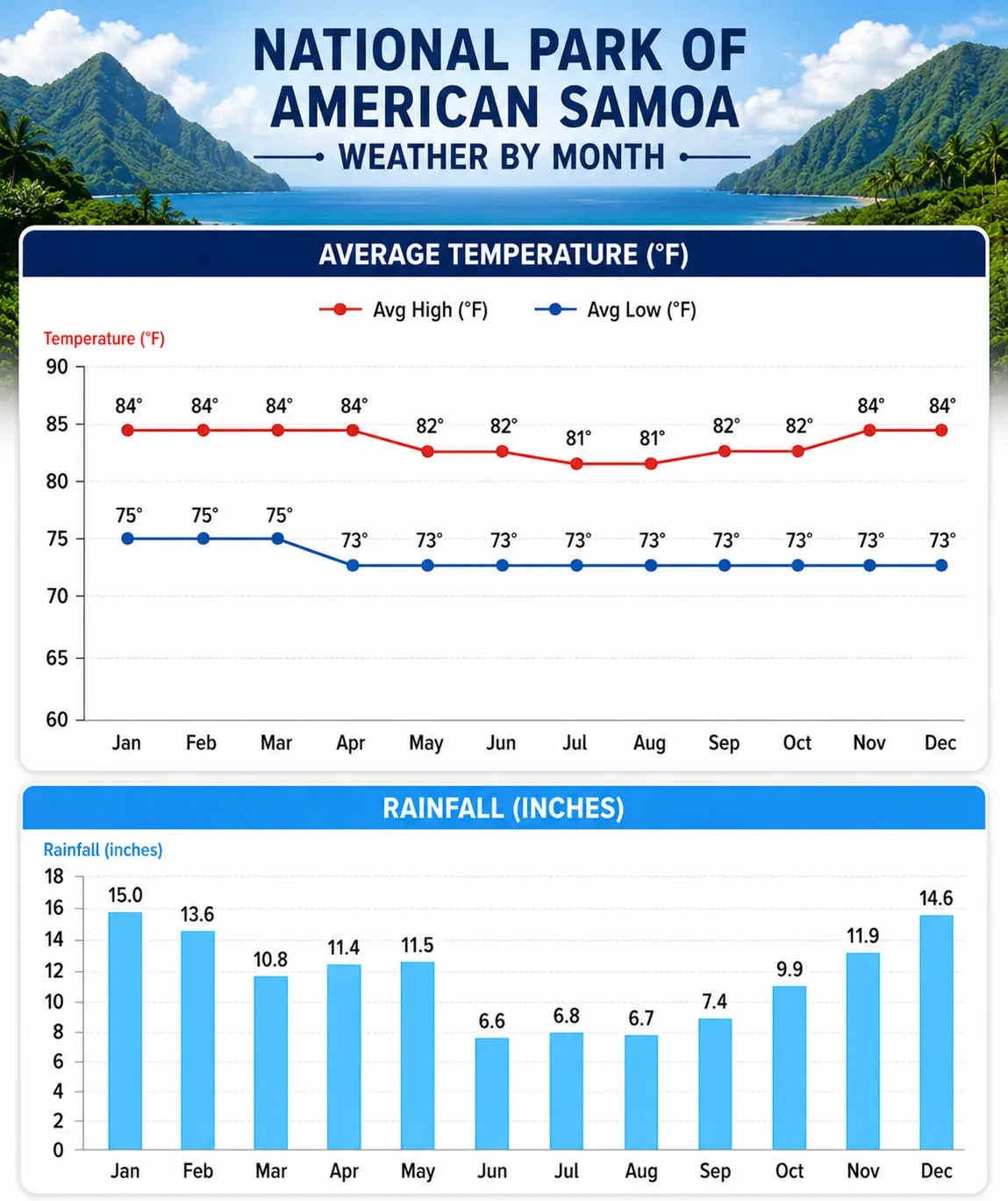
You can click the image below to view the full-size weather chart for National Park of American Samoa.
January
January is one of the wettest months in the park. Average daytime temperatures reach 29°C (84°F), while nighttime temperatures stay around 24°C (75°F). Rainfall is extremely heavy at approximately 381 mm (15 inches) over 20 rainy days. Despite frequent rain, the park enjoys around 13 hours of daylight daily.
February
February continues the hot and humid tropical conditions. Temperatures remain stable at 29°C (84°F) during the day and 24°C (75°F) at night. Rainfall decreases slightly to about 347 mm (13.7 inches) across 17 rainy days. The rainforest remains lush and vibrant during this period.
March
March brings similar temperatures with highs of 29°C (84°F) and lows of 24°C (75°F). Rainfall drops further to approximately 275 mm (10.8 inches), making outdoor exploration slightly more comfortable. Daylight averages around 12 hours per day.
April
April marks the beginning of a transition toward a somewhat drier season. Daytime temperatures remain at 29°C (84°F), while nighttime temperatures fall slightly to 23°C (73°F). Rainfall rises to around 290 mm (11.4 inches) spread across 17 rainy days.
May
May offers balanced tropical weather conditions. Average highs are around 28°C (82°F), while lows remain near 23°C (73°F). Rainfall totals approximately 291 mm (11.5 inches) over 16 rainy days. With about 11.5 hours of daylight, May is a pleasant month for hiking and sightseeing.
June
June is noticeably drier compared to earlier months. Temperatures average 28°C (82°F) during the day and 23°C (73°F) at night. Rainfall drops significantly to about 168 mm (6.6 inches), making June one of the better months for outdoor activities.
July
July is among the coolest months of the year, though temperatures are still tropical. Average daytime temperatures reach 27°C (81°F), while nighttime temperatures remain around 23°C (73°F). Rainfall averages approximately 173 mm (6.8 inches) over 14 rainy days.
August
August continues the relatively dry season. High temperatures stay near 27°C (81°F), while lows remain around 23°C (73°F). Rainfall averages about 170 mm (6.7 inches) with 13 rainy days, creating favorable conditions for hiking and beach visits.
September
September becomes slightly warmer again with daytime temperatures returning to 28°C (82°F). Nighttime temperatures stay around 23°C (73°F). Rainfall increases modestly to approximately 189 mm (7.4 inches).
October
October marks the gradual return of wetter conditions. Temperatures remain tropical at 28°C (82°F) during the day and 23°C (73°F) at night. Rainfall rises to about 251 mm (9.9 inches) across 15 rainy days.
November
November is significantly wetter, with rainfall climbing to around 303 mm (11.9 inches). Daytime temperatures increase slightly to 29°C (84°F), while nighttime temperatures stay at 23°C (73°F). Humidity levels are high, and the rainforest appears especially green and lush.
December
December is another very wet month in the National Park of American Samoa. Rainfall reaches approximately 370 mm (14.6 inches) over 19 rainy days. Temperatures remain warm at 29°C (84°F) during the day and 23°C (73°F) at night, creating classic tropical island weather during the holiday season.
| Month | Avg High (°F) | Avg Low (°F) | Rainfall (inches) | Sun (hrs/day) |
|---|---|---|---|---|
| January | 84°F | 75°F | 15.0 | 13.0 |
| February | 84°F | 75°F | 13.6 | 12.5 |
| March | 84°F | 75°F | 10.8 | 12.0 |
| April | 84°F | 73°F | 11.4 | 12.0 |
| May | 82°F | 73°F | 11.5 | 11.5 |
| June | 82°F | 73°F | 6.6 | 11.5 |
| July | 81°F | 73°F | 6.8 | 11.5 |
| August | 81°F | 73°F | 6.7 | 11.5 |
| September | 82°F | 73°F | 7.4 | 12.0 |
| October | 82°F | 73°F | 9.9 | 12.5 |
| November | 84°F | 73°F | 11.9 | 13.0 |
| December | 84°F | 73°F | 14.6 | 13.0 |
Best Time to Visit
The best time to visit National Park of American Samoa is generally between June and August, when rainfall is lower and temperatures are slightly cooler. These months provide more comfortable conditions for hiking, wildlife viewing, and exploring the park’s beaches and rainforests.
Travelers who enjoy dramatic tropical scenery and lush vegetation may also appreciate visiting during the wetter months from November through February, although heavy rain showers are more frequent during this period.
Overall, the National Park of American Samoa maintains warm tropical weather year-round, making it a unique destination for visitors seeking nature, adventure, and island beauty in every season.
20 FAQs About National Park of American Samoa Weather
- What is the climate like in the National Park of American Samoa?
The park has a tropical rainforest climate with warm temperatures, high humidity, and frequent rainfall year-round. - What is the average temperature in the park?
Average daytime temperatures range from about 81–84°F (27–29°C), while nighttime temperatures stay around 73–75°F (23–24°C). - Does the park have distinct seasons?
The park mainly has a wetter season and a relatively drier season rather than traditional four seasons. - What is the hottest month in the National Park of American Samoa?
January, February, March, November, and December are typically the warmest months, with highs around 84°F (29°C). - What is the coolest month in the park?
July and August are usually the coolest months, with daytime temperatures averaging around 81°F (27°C). - When is the rainy season in American Samoa?
The wettest period generally occurs from November through March. - Which month receives the most rainfall?
January is typically the wettest month, receiving around 15 inches (381 mm) of rain. - What are the driest months to visit?
June, July, and August are generally the driest months. - Does it rain every day in the park?
Rain showers are frequent throughout the year, but they are often brief and followed by sunshine. - Can hurricanes affect the National Park of American Samoa?
Yes, tropical cyclones can occasionally affect the region, mainly during the wet season. - Is the weather humid in American Samoa?
Yes, humidity levels are high year-round because of the tropical ocean climate. - How many hours of daylight does the park receive?
The park typically receives between 11.5 and 13 hours of daylight daily throughout the year. - Does the park ever experience cold weather?
No, temperatures remain warm year-round and rarely feel cold. - Does it ever snow in the National Park of American Samoa?
No, snowfall does not occur due to the tropical climate. - What should visitors wear in the park?
Lightweight, breathable clothing and waterproof gear are recommended because of the heat and rain. - Is summer a good time to visit the park?
Yes, June through August is often considered the best time because rainfall is lower and temperatures are slightly cooler. - How warm is the ocean around American Samoa?
Ocean temperatures stay warm year-round, making swimming and snorkeling enjoyable in every season. - Can heavy rainfall affect hiking conditions?
Yes, trails can become muddy and slippery after heavy rain. - Is the weather suitable for outdoor activities year-round?
Yes, hiking, snorkeling, and sightseeing are possible year-round, although rain may occasionally interrupt plans. - What is the best month to visit the National Park of American Samoa?
July is often considered one of the best months because it combines lower rainfall with comfortable tropical temperatures.