Jasper National Park Weather by Month
Jasper National Park, located in the Canadian Rockies in Alberta, experiences four distinct seasons, with long, snowy winters and short, pleasant summers. Temperatures vary considerably throughout the year, making the timing of your visit important for hiking, sightseeing, wildlife watching, and other outdoor activities.
Winter is cold, with average daytime temperatures remaining below freezing from November through March. January is particularly cold, with an average high of 12°F (-11°C) and an average low of -4°F (-20°C). Summer is much warmer, especially in July and August, when daytime temperatures reach approximately 61°F (16°C) to 59°F (15°C).
Snowfall is a defining feature of Jasper’s winter climate. December and January receive approximately 9.6 and 9.4 inches of snow, respectively. Snow can also occur in spring and fall, while July and August are generally snow-free.
Daylight changes dramatically throughout the year, ranging from approximately 8 hours in January and December to 16.5 hours in June and July. The longer summer days provide plenty of time to explore the park’s lakes, mountains, waterfalls, and hiking trails.
Jasper National Park Weather by Month
You can click the image below to view the full-size weather chart for Jasper National Park.
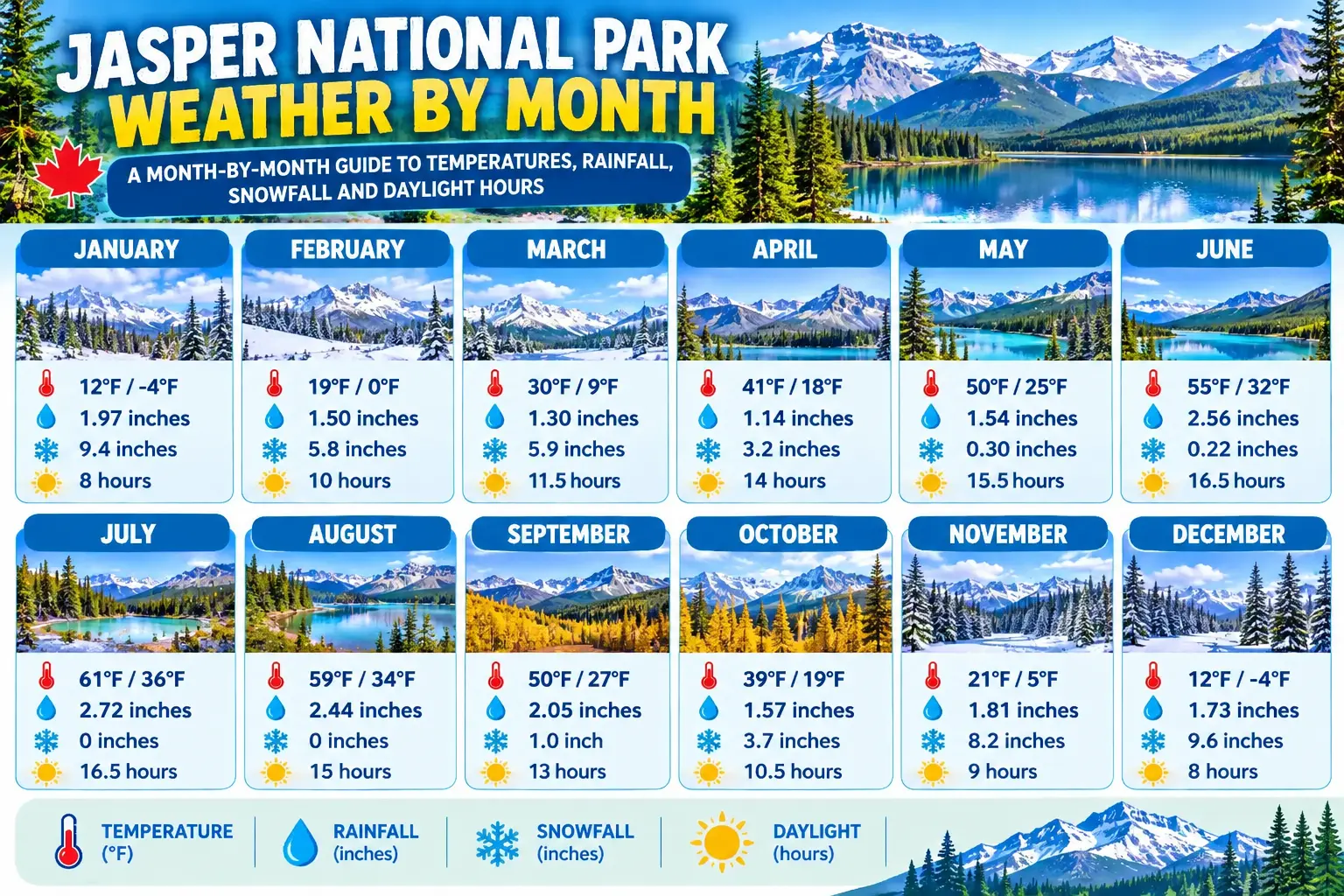
January – Very Cold, Snowy and Short Days
- Average high: 12°F (-11°C)
- Average low: -4°F (-20°C)
- Rainfall: 0.8 inches (20 mm)
- Snowfall: 9.4 inches (23.9 cm)
- Daylight: 8 hours
January is one of the coldest months in Jasper National Park, with freezing temperatures throughout the day and extremely cold nights. Average daytime temperatures reach approximately 12°F (-11°C), while nighttime temperatures drop to around -4°F (-20°C). Snow-covered mountains, frozen lakes, and winter forests create a beautiful alpine landscape.
Rainfall is relatively low, averaging approximately 0.8 inches (20 mm), while snowfall reaches around 9.4 inches (23.9 cm). The park experiences approximately 9.9 snowy days during the month. With only 8 hours of daylight, visitors have limited time for outdoor activities, and warm winter clothing is essential.
Best for:
- Snowshoeing and winter photography
- Cross-country skiing
- Enjoying snow-covered mountain scenery
- Wildlife watching from accessible areas
February – Cold, Snowy and Gradually Longer Days
- Average high: 19°F ( -7°C)
- Average low: 0°F (-18°C)
- Rainfall: 1.50 inches (38 mm)
- Snowfall: 5.8 inches (14.7 cm)
- Daylight: 10 hours
February remains a cold winter month in Jasper National Park, although temperatures begin to improve slightly compared with January. Average daytime temperatures reach approximately 19°F (-7°C), while nighttime temperatures fall to around 0°F (-18°C). Snow continues to cover the mountains, forests, and valleys, creating excellent conditions for winter activities.
Rainfall averages approximately 1.50 inches (38 mm), while snowfall reaches about 5.8 inches (14.7 cm). The park experiences around 7.1 snowy days during February. Daylight increases to approximately 10 hours, giving visitors more time to enjoy the winter scenery.
Best for:
- Downhill and cross-country skiing
- Snowshoeing through winter forests
- Photographing frozen lakes and mountains
- Enjoying quiet winter landscapes
March – Cold, Snowy and Slowly Warming
- Average high: 30°F (-1°C)
- Average low: 9°F (-13°C)
- Rainfall: 1.30 inches (33 mm)
- Snowfall: 5.9 inches (15.0 cm)
- Daylight: 11.5 hours
March marks the beginning of the transition toward spring, but winter conditions remain common throughout Jasper National Park. Average daytime temperatures reach approximately 30°F (-1°C), while nighttime temperatures drop to around 9°F (-13°C). Snow and ice continue to dominate much of the landscape, particularly at higher elevations.
Rainfall averages approximately 1.30 inches (33 mm), and snowfall reaches around 5.9 inches (15.0 cm). Visitors can expect approximately 6.8 snowy days during the month. With 11.5 hours of daylight, there is more time to explore accessible winter trails and enjoy the surrounding mountain scenery.
Best for:
- Late-season skiing and snowboarding
- Snowshoeing and winter hiking
- Wildlife photography
- Exploring quieter park areas
April – Cool, Snowy and Gradually Milder
- Average high: 41°F (5°C)
- Average low: 18°F (-8°C)
- Rainfall: 1.14 inches (29 mm)
- Snowfall: 3.2 inches (8.1 cm)
- Daylight: 14 hours
April brings noticeably milder daytime temperatures to Jasper National Park, although nights remain cold. Average highs reach approximately 41°F (5°C), while average lows fall to around 18°F (-8°C). Snow begins melting in lower elevations, but higher mountain areas generally remain covered in winter snow.
Rainfall averages approximately 1.14 inches (29 mm), while snowfall decreases to around 3.2 inches (8.1 cm). The park receives approximately 4.1 snowy days during April. Longer daylight hours, averaging 14 hours, make this a good month for scenic drives and exploring accessible viewpoints.
Best for:
- Scenic photography and sightseeing
- Watching snowmelt in lower valleys
- Exploring accessible hiking trails
- Enjoying quieter spring landscapes
May – Mild, Cool and Increasingly Green
- Average high: 50°F (10°C)
- Average low: 25°F (-4°C)
- Rainfall: 1.54 inches (39 mm)
- Snowfall: 0.30 inches (0.75 cm)
- Daylight: 15.5 hours
May brings more noticeable signs of spring to Jasper National Park. Average daytime temperatures reach approximately 50°F (10°C), while nighttime temperatures remain cool at around 25°F (-4°C). Snow continues to disappear from lower elevations, and forests, valleys, and lakesides gradually become more accessible.
Rainfall averages approximately 1.54 inches (39 mm), while snowfall drops significantly to just 0.30 inches (0.75 cm). Snow is still possible, particularly at higher elevations. With approximately 15.5 hours of daylight, May offers plenty of time for sightseeing and outdoor exploration.
Best for:
- Scenic drives through the Canadian Rockies
- Photographing spring landscapes
- Visiting lakes and waterfalls
- Wildlife watching in lower valleys
June – Mild, Pleasant and Relatively Wet
- Average high: 55°F (13°C)
- Average low: 32°F (0°C)
- Rainfall: 2.56 inches (65 mm)
- Snowfall: 0.22 inches (0.57 cm)
- Daylight: 16.5 hours
June is an excellent month to experience the transition into summer in Jasper National Park. Average daytime temperatures reach approximately 55°F (13°C), while nighttime temperatures hover around 32°F (0°C). The weather becomes more comfortable for outdoor activities, although mornings and evenings can still feel chilly.
Rainfall increases to approximately 2.56 inches (65 mm), making June one of the wetter months of the year. Snowfall is almost nonexistent, averaging just 0.22 inches (0.57 cm). With around 16.5 hours of daylight, visitors have plenty of time to explore mountain trails, enjoy scenic drives, and photograph the park’s spectacular landscapes.
Best for:
- Hiking on accessible mountain trails
- Exploring lakes and waterfalls
- Wildlife watching and photography
- Enjoying long summer days
July – Mild, Pleasant and Mostly Dry
- Average high: 61°F (16°C)
- Average low: 36°F (2°C)
- Rainfall: 2.72 inches (69 mm)
- Snowfall: 0 inches (0 cm)
- Daylight: 16.5 hours
July is one of the warmest months in Jasper National Park and a popular time for summer sightseeing. Average daytime temperatures reach approximately 61°F (16°C), while nighttime temperatures remain relatively cool at around 36°F (2°C). The comfortable daytime conditions make July particularly suitable for hiking, camping, cycling, and exploring the park’s famous lakes.
Rainfall averages approximately 2.72 inches (69 mm), making July the wettest month according to the rainfall estimates used here. However, rain often arrives as passing showers, and extended periods of sunshine are also common. Snowfall is generally absent, and 16.5 hours of daylight provide excellent opportunities for outdoor adventures.
Best for:
- Hiking and mountain biking
- Visiting Maligne Lake and Medicine Lake
- Camping and outdoor adventures
- Wildlife watching and photography
August – Mild, Pleasant and Moderately Wet
- Average high: 59°F (15°C)
- Average low: 34°F (1°C)
- Rainfall: 2.44 inches (62 mm)
- Snowfall: 0 inches (0 cm)
- Daylight: 15 hours
August continues the pleasant summer weather in Jasper National Park, with comfortable afternoons and cool nights. Average daytime temperatures reach approximately 59°F (15°C), while nighttime temperatures fall to around 34°F (1°C). The relatively mild conditions are ideal for exploring mountain scenery, hiking popular trails, and spending time near alpine lakes.
Rainfall averages approximately 2.44 inches (62 mm), so occasional showers are possible throughout the month. Snowfall is generally absent, making August one of the most reliable months for summer outdoor activities. Daylight averages approximately 15 hours, providing plenty of time to enjoy the park.
Best for:
- Hiking and backpacking
- Canoeing and kayaking on mountain lakes
- Camping and scenic photography
- Exploring waterfalls and mountain viewpoints
September – Mild, Cool and Relatively Dry
- Average high: 50°F (10°C)
- Average low: 27°F (-3°C)
- Rainfall: 2.05 inches (52 mm)
- Snowfall: 1.0 inch (2.5 cm)
- Daylight: 13 hours
September brings the beginning of autumn to Jasper National Park, with cooler temperatures and beautiful seasonal scenery. Average daytime temperatures reach approximately 50°F (10°C), while nighttime temperatures drop to around 27°F (-3°C). Golden autumn colors gradually appear across the forests and valleys, creating excellent opportunities for photography.
Rainfall averages approximately 2.05 inches (52 mm), while snowfall increases slightly to around 1.0 inch (2.5 cm). Early snow is possible, especially at higher elevations. With approximately 13 hours of daylight, September still offers enough time for hiking, wildlife watching, and scenic drives.
Best for:
- Photographing autumn foliage
- Hiking in cooler weather
- Wildlife watching
- Enjoying quieter scenic viewpoints
October – Cold, Snowy and Shorter Days
- Average high: 39°F (4°C)
- Average low: 19°F (-7°C)
- Rainfall: 1.57 inches (40 mm)
- Snowfall: 3.7 inches (9.3 cm)
- Daylight: 10.5 hours
October marks a noticeable shift toward winter in Jasper National Park. Average daytime temperatures reach approximately 39°F (4°C), while nighttime temperatures fall to around 19°F (-7°C). Autumn colors gradually disappear, and snow becomes increasingly common, particularly in the surrounding mountains.
Rainfall averages approximately 1.57 inches (40 mm), while snowfall reaches around 3.7 inches (9.3 cm). The park experiences approximately 2.7 snowy days during the month. Daylight decreases to about 10.5 hours, so visitors should plan outdoor activities carefully and prepare for rapidly changing mountain weather.
Best for:
- Photographing early-season snow
- Enjoying peaceful mountain scenery
- Scenic drives through autumn landscapes
- Wildlife watching in quieter areas
November – Very Cold, Snowy and Short Days
- Average high: 21°F (-6°C)
- Average low: 5°F (-15°C)
- Rainfall: 1.81 inches (46 mm)
- Snowfall: 8.2 inches (20.8 cm)
- Daylight: 9 hours
November brings increasingly harsh winter conditions to Jasper National Park. Average daytime temperatures reach only about 21°F (-6°C), while nighttime temperatures fall to approximately 5°F (-15°C). Snow becomes more frequent, and mountain roads, forests, and valleys increasingly take on a winter appearance.
Rainfall averages approximately 1.81 inches (46 mm), while snowfall reaches around 8.2 inches (20.8 cm). The park experiences approximately 8.4 snowy days during the month. With just 9 hours of daylight, visitors have limited time for sightseeing and should prepare for icy roads and freezing temperatures.
Best for:
- Winter landscape photography
- Enjoying snow-covered mountain scenery
- Early-season winter activities
- Exploring quieter visitor areas
December – Very Cold, Snowy and Short Days
- Average high: 12°F (-11°C)
- Average low: -4°F (-20°C)
- Rainfall: 1.73 inches (44 mm)
- Snowfall: 9.6 inches (24.4 cm)
- Daylight: 8 hours
December is one of the coldest and snowiest months in Jasper National Park. Average daytime temperatures reach approximately 12°F (-11°C), while nighttime temperatures fall to around -4°F (-20°C). Heavy winter conditions create spectacular scenery, with snow-covered forests, frozen waterways, and dramatic mountain peaks.
Rainfall averages approximately 1.73 inches (44 mm), while snowfall reaches around 9.6 inches (24.4 cm), the highest monthly snowfall in the supplied data. The park experiences approximately 9.5 snowy days during December. With only 8 hours of daylight, visitors should plan shorter outdoor excursions and wear suitable winter clothing.
Best for:
- Winter photography and sightseeing
- Skiing and snowshoeing
- Enjoying snowy mountain landscapes
- Experiencing a peaceful winter getaway
Jasper National Park Weather by Month
| Month | Avg High °F (°C) | Avg Low °F (°C) | Rainfall (inches) | Snowfall (inches) | Daylight (hours) |
|---|---|---|---|---|---|
| January | 12°F (-11°C) | -4°F (-20°C) | 1.97 | 9.4 | 8 |
| February | 19°F (-7°C) | 0°F (-18°C) | 1.50 | 5.8 | 10 |
| March | 30°F (-1°C) | 9°F (-13°C) | 1.30 | 5.9 | 11.5 |
| April | 41°F (5°C) | 18°F (-8°C) | 1.14 | 3.2 | 14 |
| May | 50°F (10°C) | 25°F (-4°C) | 1.54 | 0.30 | 15.5 |
| June | 55°F (13°C) | 32°F (0°C) | 2.56 | 0.22 | 16.5 |
| July | 61°F (16°C) | 36°F (2°C) | 2.72 | 0.0 | 16.5 |
| August | 59°F (15°C) | 34°F (1°C) | 2.44 | 0.0 | 15 |
| September | 50°F (10°C) | 27°F (-3°C) | 2.05 | 1.0 | 13 |
| October | 39°F (4°C) | 19°F (-7°C) | 1.57 | 3.7 | 10.5 |
| November | 21°F (-6°C) | 5°F (-15°C) | 1.81 | 8.2 | 9 |
| December | 12°F (-11°C) | -4°F (-20°C) | 1.73 | 9.6 | 8 |
20 FAQs About Jasper National Park Weather
1. What is the best month to visit Jasper National Park?
July and August are generally the best months to visit Jasper National Park. Temperatures are mild, averaging 59°F to 61°F (15°C to 16°C) during the day, and the park offers long daylight hours for hiking, sightseeing, camping, and wildlife watching.
2. What is the weather like in Jasper National Park year-round?
Jasper National Park has four distinct seasons. Winters are very cold and snowy, spring is cool and gradually warming, summers are mild and pleasant, and autumn brings cooler temperatures and occasional snowfall.
3. What is the coldest month in Jasper National Park?
January and December are typically the coldest months. Average daytime temperatures are around 12°F (-11°C), while nighttime temperatures can drop to approximately -4°F (-20°C).
4. What is the warmest month in Jasper National Park?
July is generally the warmest month, with an average high of 61°F (16°C) and an average low of 36°F (2°C).
5. Does it snow in Jasper National Park?
Yes. Jasper receives substantial snowfall during winter, particularly from November through March. Snow can also occur in April, May, September, and October, especially at higher elevations.
6. How much snow does Jasper National Park get?
Based on the monthly averages provided, December receives approximately 9.6 inches (24.4 cm) of snow, followed by January with 9.4 inches (23.9 cm). Total annual snowfall in the supplied data is approximately 47.2 inches (120 cm).
7. When does it snow the most in Jasper National Park?
December is the snowiest month in the supplied data, averaging approximately 9.6 inches (24.4 cm) of snowfall. January and November also receive considerable snow.
8. Does Jasper National Park get rain in the summer?
Yes. Summer rainfall is common, particularly in June, July, and August. July receives approximately 2.72 inches of rainfall, making it the wettest month in the rainfall estimates used in this guide.
9. What is the rainiest month in Jasper National Park?
July is the rainiest month in the monthly estimates, with approximately 2.72 inches of rainfall. June and August are also relatively wet, averaging 2.56 and 2.44 inches, respectively.
10. What is the average temperature in Jasper National Park in June?
June has an average high temperature of 55°F (13°C) and an average low of 32°F (0°C). Days are generally mild, but mornings and evenings can still be chilly.
11. Is July a good time to visit Jasper National Park?
Yes. July is one of the best months to visit. The weather is relatively warm, most major summer attractions and hiking areas are accessible depending on conditions, and daylight lasts approximately 16.5 hours.
12. Is August a good time to visit Jasper National Park?
August is an excellent month for outdoor activities. Average temperatures range from 34°F (1°C) at night to 59°F (15°C) during the day. Visitors can enjoy hiking, camping, canoeing, and sightseeing.
13. What is Jasper National Park like in September?
September brings cooler temperatures and beautiful autumn scenery. Average highs reach 50°F (10°C), while lows fall to 27°F (-3°C). It is a wonderful time for photography, hiking, and wildlife watching.
14. Can you visit Jasper National Park in winter?
Yes. Jasper is a popular winter destination offering skiing, snowshoeing, winter photography, and other cold-weather activities. Visitors should prepare for freezing temperatures, snowy roads, and shorter daylight hours.
15. How cold does Jasper National Park get in winter?
Winter temperatures can be extremely cold. Average nighttime temperatures in January and December are approximately -4°F (-20°C), and temperatures can occasionally fall even lower during cold spells.
16. When does spring start in Jasper National Park?
Spring generally begins in April and becomes more noticeable in May and June. Temperatures gradually increase, snow melts at lower elevations, and hiking and sightseeing opportunities improve as the season progresses.
17. How many hours of daylight does Jasper National Park get in summer?
Jasper receives approximately 16.5 hours of daylight in June and July. These long summer days provide plenty of time for hiking, exploring lakes, taking scenic drives, and enjoying outdoor activities.
18. What should I wear when visiting Jasper National Park?
Clothing depends on the season. In winter, bring insulated jackets, thermal layers, gloves, hats, and waterproof boots. In summer, pack lightweight clothing, a warm jacket, comfortable hiking shoes, and rain protection because mountain weather can change quickly.
19. What is the best time to go hiking in Jasper National Park?
July and August are generally the best months for hiking because temperatures are milder and many trails are accessible. June and September can also be excellent, although snow may remain on higher-elevation trails.
20. Is Jasper National Park worth visiting in October?
Yes. October offers beautiful autumn scenery, cooler temperatures, and fewer summer visitors. Average daytime temperatures are around 39°F (4°C), and early snowfall is possible. Visitors should prepare for cold weather and changing road conditions.
Read more: