Wind Cave National Park Weather by Month
Located in the Black Hills of South Dakota, Wind Cave National Park experiences four distinct seasons with significant temperature variations throughout the year. Winters are cold and snowy, while summers are warm and pleasant. Spring and fall offer changing landscapes, fewer crowds, and excellent wildlife viewing opportunities. The park’s elevation and prairie environment can also bring sudden weather changes, so visitors should be prepared for a variety of conditions year-round.
Wind Cave National Park Weather by Month
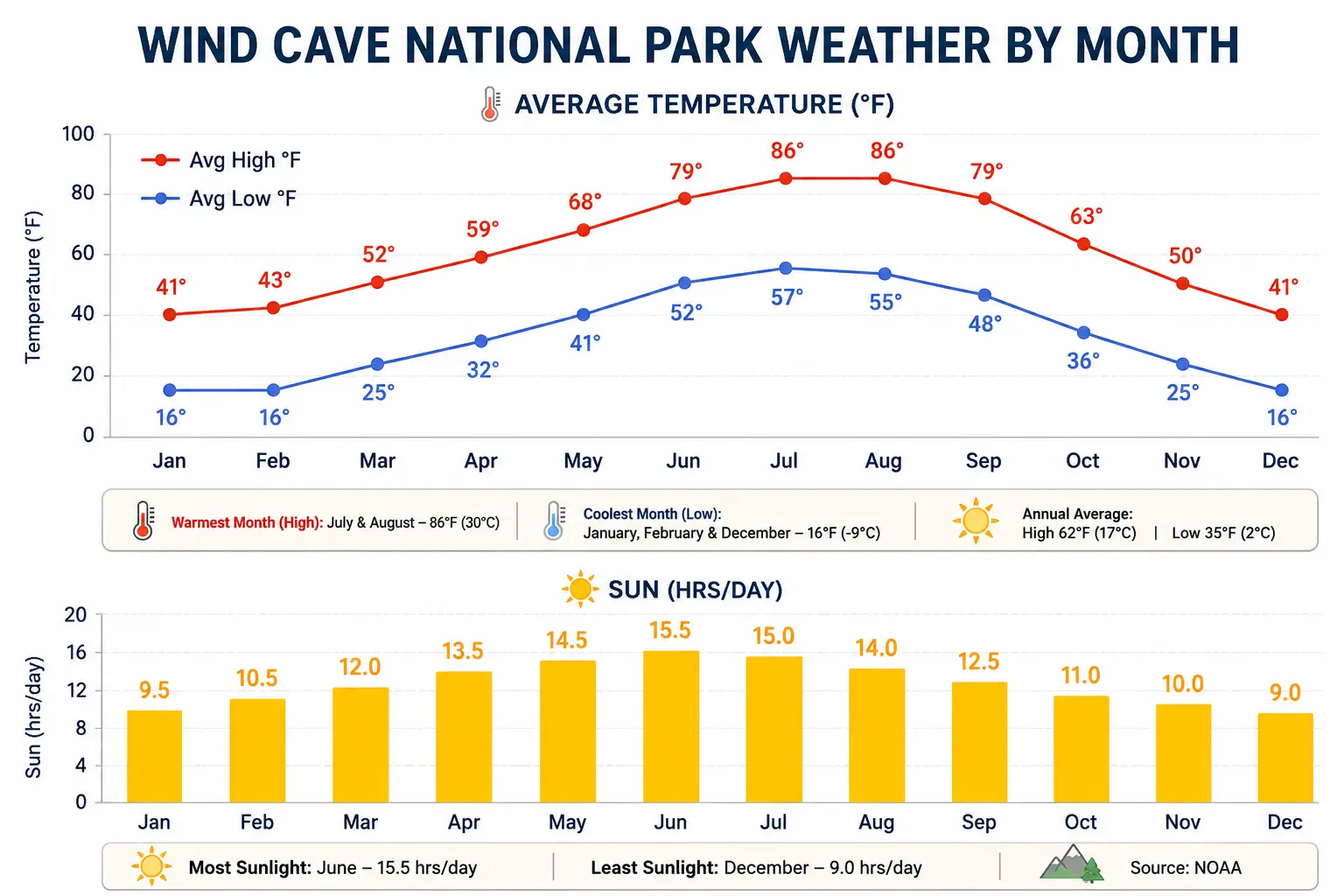
You can click the image below to view the full-size weather chart for Wind Cave NP.
January – Cold and Snowy
- Average high: 41°F (5°C)
- Average low: 16°F (-9°C)
- Rainfall: 0.4 inches (10 mm)
- Daylight: 9.5 hours
January is one of the coldest months in Wind Cave National Park. Snow often covers the prairie, creating beautiful winter scenery across the rolling grasslands and pine forests.
Wildlife such as bison, elk, and pronghorn can still be spotted, though animals may gather in sheltered areas during cold spells. Visitors should expect freezing temperatures and occasional snowstorms.
Best for:
- Winter photography
- Wildlife tracking
- Quiet park experiences
February – Crisp Winter Conditions
- Average high: 43°F (6°C)
- Average low: 16°F (-9°C)
- Rainfall: 0.6 inches (16 mm)
- Daylight: 10.5 hours
February remains cold, but slightly longer days provide more opportunities for exploring the park. Snowfall is common, and winter weather can change quickly.
The park is peaceful during this time, making it a good month for visitors seeking solitude and uncrowded trails.
Best for:
- Scenic winter landscapes
- Wildlife observation
- Peaceful hiking
March – Early Signs of Spring
- Average high: 52°F (11°C)
- Average low: 25°F (-4°C)
- Rainfall: 1.0 inch (24 mm)
- Daylight: 12 hours
March brings gradually warming temperatures, although snowstorms remain possible. Prairie grasses begin showing early signs of growth, and wildlife becomes more active.
Weather can vary dramatically from day to day, so layered clothing is essential.
Best for:
- Wildlife watching
- Early spring hikes
- Photography of changing landscapes
April – Mild Days and Spring Growth
- Average high: 59°F (15°C)
- Average low: 32°F (0°C)
- Rainfall: 2.2 inches (55 mm)
- Daylight: 13.5 hours
April marks the arrival of spring across the Black Hills. Melting snow and increased rainfall help transform the prairie into vibrant shades of green.
Wildflowers begin blooming, and many animals become more visible as temperatures rise.
Best for:
- Wildflower viewing
- Hiking scenic trails
- Wildlife photography
May – Pleasant Weather and Active Wildlife
- Average high: 68°F (20°C)
- Average low: 41°F (5°C)
- Rainfall: 3.3 inches (83 mm)
- Daylight: 14.5 hours
May is one of the best months to visit Wind Cave National Park. Comfortable temperatures and lush prairie conditions create ideal hiking opportunities.
Spring rains help support abundant vegetation, attracting bison, elk, deer, and prairie dogs throughout the park.
Best for:
- Hiking
- Wildlife viewing
- Spring photography
June – Warm and Green
- Average high: 79°F (26°C)
- Average low: 52°F (11°C)
- Rainfall: 3.1 inches (80 mm)
- Daylight: 15.5 hours
June offers warm days and the longest daylight hours of the year. The prairie reaches peak green conditions, and wildflowers can be found throughout the park.
Afternoon thunderstorms occasionally develop but are usually brief.
Best for:
- Scenic drives
- Cave tours
- Long hiking days
July – Warmest Month of the Year
- Average high: 86°F (30°C)
- Average low: 57°F (14°C)
- Rainfall: 2.9 inches (74 mm)
- Daylight: 15 hours
July is typically the warmest month in Wind Cave National Park. Days are sunny and ideal for exploring both above-ground trails and the famous cave system.
Thunderstorms can occur during the afternoon, bringing lightning, gusty winds, and short bursts of rain.
Best for:
- Cave tours
- Wildlife photography
- Family vacations
August – Sunny Summer Weather
- Average high: 86°F (30°C)
- Average low: 55°F (13°C)
- Rainfall: 2.1 inches (53 mm)
- Daylight: 14 hours
August continues the summer pattern with warm temperatures and mostly dry conditions. The prairie begins transitioning from its lush spring appearance to late-summer golden tones.
Morning and evening hikes are particularly comfortable.
Best for:
- Hiking
- Scenic photography
- Camping
September – Comfortable Early Fall Conditions
- Average high: 79°F (26°C)
- Average low: 48°F (9°C)
- Rainfall: 1.3 inches (34 mm)
- Daylight: 12.5 hours
September is one of the most pleasant months in the park. Temperatures become milder, rainfall decreases, and summer crowds begin to fade.
Wildlife remains active, and the cooler weather is excellent for outdoor activities.
Best for:
- Hiking
- Wildlife viewing
- Scenic drives
October – Cool Days and Autumn Colors
- Average high: 63°F (17°C)
- Average low: 36°F (2°C)
- Rainfall: 1.5 inches (37 mm)
- Daylight: 11 hours
October brings crisp autumn weather and changing foliage across parts of the Black Hills. Frost becomes increasingly common, especially during the mornings.
The combination of cool temperatures and beautiful scenery makes October a favorite among photographers.
Best for:
- Fall photography
- Wildlife observation
- Comfortable hiking
November – Chilly and Quiet
- Average high: 50°F (10°C)
- Average low: 25°F (-4°C)
- Rainfall: 0.6 inches (15 mm)
- Daylight: 10 hours
November marks the transition into winter. Snow becomes more frequent, and temperatures drop significantly compared to October.
Visitor numbers decline, providing a peaceful atmosphere throughout the park.
Best for:
- Solitude
- Wildlife photography
- Early winter scenery
December – Winter Returns
- Average high: 41°F (5°C)
- Average low: 16°F (-9°C)
- Rainfall: 0.4 inches (11 mm)
- Daylight: 9 hours
December brings cold temperatures, occasional snowstorms, and shorter days. The prairie often takes on a quiet, frozen beauty during the holiday season.
Visitors should dress warmly and be prepared for changing weather conditions.
Best for:
- Winter landscapes
- Photography
- Peaceful park visits
Wind Cave National Park Weather by Month Table
| Month | Avg High °F (°C) | Avg Low °F (°C) | Rainfall (inches) | Sun (hrs/day) | Snowfall (inches) |
|---|---|---|---|---|---|
| Jan | 41°F (5°C) | 16°F (-9°C) | 0.40 | 9.5 | 6.39 |
| Feb | 43°F (6°C) | 16°F (-9°C) | 0.62 | 10.5 | 8.20 |
| Mar | 52°F (11°C) | 25°F (-4°C) | 0.96 | 12.0 | 9.20 |
| Apr | 59°F (15°C) | 32°F (0°C) | 2.17 | 13.5 | 8.30 |
| May | 68°F (20°C) | 41°F (5°C) | 3.26 | 14.5 | 1.40 |
| Jun | 79°F (26°C) | 52°F (11°C) | 3.15 | 15.5 | 0.00 |
| Jul | 86°F (30°C) | 57°F (14°C) | 2.93 | 15.0 | 0.00 |
| Aug | 86°F (30°C) | 55°F (13°C) | 2.10 | 14.0 | 0.00 |
| Sep | 79°F (26°C) | 48°F (9°C) | 1.32 | 12.5 | 0.24 |
| Oct | 63°F (17°C) | 36°F (2°C) | 1.45 | 11.0 | 2.24 |
| Nov | 50°F (10°C) | 25°F (-4°C) | 0.59 | 10.0 | 4.31 |
| Dec | 41°F (5°C) | 16°F (-9°C) | 0.43 | 9.0 | 6.48 |
Best Time to Visit Wind Cave National Park
The best overall months to visit Wind Cave National Park are May through September, when temperatures are comfortable, wildlife is highly active, and hiking conditions are excellent.
- For wildflowers and green landscapes: May and June
- For warm weather and cave tours: July and August
- For hiking and fewer crowds: September and October
- For winter scenery and solitude: December through February
No matter the season, Wind Cave National Park offers a unique combination of prairie ecosystems, abundant wildlife, and one of the world’s longest cave systems.
20 FAQs About Wind Cave National Park Weather
1. What is the best time to visit Wind Cave National Park?
The best time to visit is from May through September, when temperatures are warm, wildlife is active, and hiking conditions are ideal.
2. Does Wind Cave National Park get snow?
Yes. Snowfall is common from October through April, with the heaviest snow typically occurring between December and March.
3. How cold does Wind Cave National Park get in winter?
Winter temperatures often fall below freezing, with average lows around 16°F (-9°C) in January, February, and December.
4. What is the hottest month in Wind Cave National Park?
July and August are usually the hottest months, with average highs around 86°F (30°C).
5. What is the coldest month in Wind Cave National Park?
January, February, and December are generally the coldest months, with average lows near 16°F (-9°C).
6. Does the park experience thunderstorms?
Yes. Afternoon thunderstorms are common during late spring and summer, especially from May through July.
7. Is summer a good time for hiking?
Yes. Summer offers long daylight hours and warm temperatures, making it one of the most popular seasons for hiking.
8. How much rain does Wind Cave National Park receive?
The park receives about 19 inches (48 cm) of precipitation annually, with the wettest months typically occurring in late spring and early summer.
9. Which month receives the most rainfall?
May is usually the wettest month, averaging approximately 3.3 inches (83 mm) of rainfall.
10. Can weather change quickly in Wind Cave National Park?
Yes. Weather in the Black Hills region can change rapidly, and visitors should be prepared for sudden temperature shifts, wind, and storms.
11. What should I wear when visiting Wind Cave National Park?
Dress in layers. Even during summer, mornings and evenings can be cool, while winter requires warm, insulated clothing.
12. Is spring a good season to visit?
Yes. Spring brings blooming wildflowers, active wildlife, and comfortable temperatures, though occasional snowstorms remain possible.
13. Does Wind Cave National Park experience strong winds?
Yes. Wind is a common feature throughout the year, particularly on exposed prairie landscapes.
14. How many hours of daylight does the park receive in summer?
June has the longest days, with approximately 15.5 hours of daylight.
15. What is the driest month in Wind Cave National Park?
January is typically one of the driest months, receiving less than half an inch of precipitation.
16. Are cave tours affected by weather?
Most cave tours operate regardless of outdoor weather, although severe weather conditions can occasionally affect schedules or access.
17. What is the temperature inside Wind Cave?
The cave maintains a nearly constant temperature of about 54°F (12°C) year-round.
18. Is fall a good time for wildlife viewing?
Yes. September and October offer pleasant temperatures and excellent opportunities to see bison, elk, pronghorn, and other wildlife.
19. What is the snowiest month in Wind Cave National Park?
March generally records the highest average snowfall, with more than 9 inches (23 cm) on average.
20. When are crowds lowest in Wind Cave National Park?
Visitor numbers are usually lowest during the winter months, especially from November through February, offering a quieter experience.