St. John’s Weather by Month
St. John’s, Newfoundland and Labrador, Canada, experiences a cool maritime climate with cold, snowy winters, mild summers, and frequent rainfall throughout the year. The city’s weather is influenced by the North Atlantic Ocean, bringing changing temperatures, cloudy skies, and substantial precipitation in every season.
January and February are among the coldest months, with average high temperatures around 30°F (-1°C) and heavy snowfall. July and August are the warmest months, with average highs reaching 68°F (20°C). October is the wettest month in the supplied data, while June has the longest daylight hours, averaging 16 hours per day.
St. John’s Weather by Month
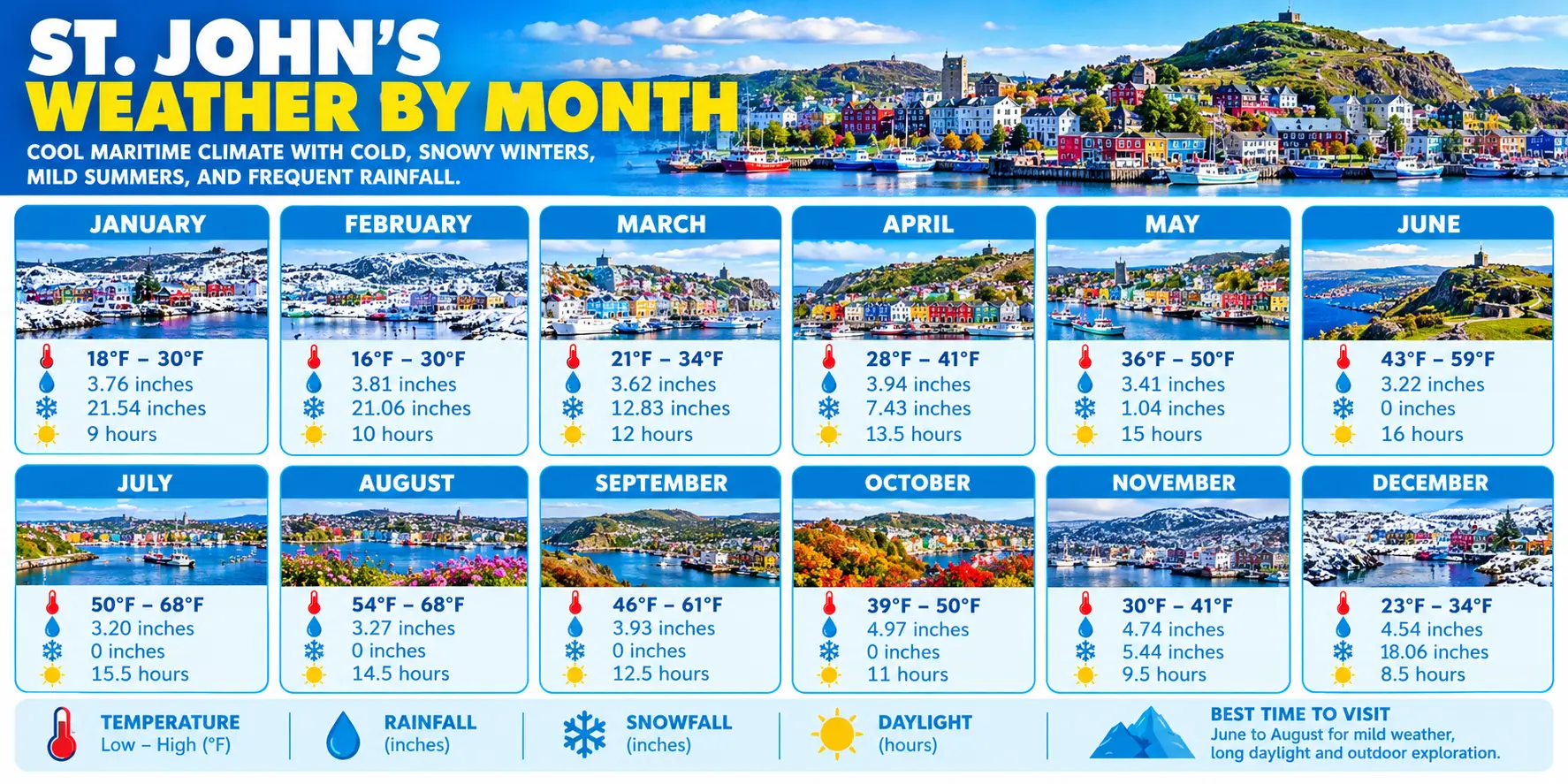
You can click the image below to view the full-size weather chart for St. John’s.
January – Cold Winter Weather and Heavy Snowfall
- Average high: 30°F (-1°C)
- Average low: 18°F (-8°C)
- Rainfall: 3.76 inches
- Snowfall: 21.54 inches
- Daylight: 9 hours
January is one of the coldest months in St. John’s. Average daytime temperatures hover around 30°F (-1°C), while nighttime temperatures drop to approximately 18°F (-8°C).
Snowfall averages about 21.54 inches (547.1 mm), with around 8 snow days during the month. Rainfall reaches 3.76 inches (95.5 mm), and the city receives only about 9 hours of daylight, creating short, wintry days.
With freezing temperatures and frequent snowfall, January is ideal for experiencing St. John’s winter scenery and enjoying cozy indoor activities.
Best for:
- Snow-covered coastal landscapes
- Winter photography
- Snow activities
- Cozy cafés and indoor attractions
February – Freezing Temperatures and Frequent Snowfall
- Average high: 30°F (-1°C)
- Average low: 16°F (-9°C)
- Rainfall: 3.81 inches
- Snowfall: 21.05 inches
- Daylight: 10 hours
February remains cold in St. John’s, with average highs of 30°F (-1°C) and lows around 16°F (-9°C). Freezing conditions are common, especially during the night.
Snowfall averages 21.06 inches (534.8 mm), making February one of the snowiest months of the year. Rainfall reaches 3.81 inches (96.9 mm), while daylight gradually increases to about 10 hours per day.
February is suitable for travelers who enjoy snowy landscapes and a peaceful winter atmosphere, although warm clothing and flexible travel plans are essential.
Best for:
- Winter photography
- Snow-covered scenery
- Quiet city breaks
- Indoor museums and cultural attractions
March – Chilly Spring Weather and Lingering Snow
- Average high: 34°F (1°C)
- Average low: 21°F (-6°C)
- Rainfall: 3.62 inches
- Snowfall: 12.83 inches
- Daylight: 12 hours
March brings slightly milder temperatures to St. John’s, although winter conditions remain common. Average highs reach 34°F (1°C), while nighttime temperatures fall to around 21°F (-6°C).
Snowfall decreases to 12.83 inches (325.9 mm), with approximately 5 snow days during the month. Rainfall averages 3.62 inches (91.9 mm), and daylight increases to about 12 hours per day.
March is a transitional month when snow, rain, and occasional milder days can all occur. Visitors should prepare for cold and changeable weather.
Best for:
- Late-winter photography
- Quiet sightseeing
- Indoor cultural attractions
- Early-season city exploration
April – Cool Spring Days and Occasional Snow
- Average high: 41°F (5°C)
- Average low: 28°F (-2°C)
- Rainfall: 3.94 inches
- Snowfall: 7.43 inches
- Daylight: 13.5 hours
April brings gradually warmer weather to St. John’s, with average daytime temperatures reaching 41°F (5°C) and nighttime lows around 28°F (-2°C).
Rainfall averages 3.94 inches (100.1 mm), while snowfall decreases to 7.43 inches (188.7 mm). The city receives around 13.5 hours of daylight, allowing more time for outdoor exploration.
Although spring begins to emerge, cold spells and occasional snowfall can still occur. A warm, waterproof jacket is useful for sightseeing.
Best for:
- Springtime city walks on milder days
- Coastal photography
- Exploring museums and historic sites
- Quiet travel before the summer season
May – Mild Spring Weather and Longer Days
- Average high: 50°F (10°C)
- Average low: 36°F (2°C)
- Rainfall: 3.41 inches
- Snowfall: 1.04 inches
- Daylight: 15 hours
May brings milder spring weather to St. John’s. Average highs reach 50°F (10°C), while nighttime temperatures remain cool at around 36°F (2°C).
Rainfall averages 3.41 inches (86.7 mm), and the city receives approximately 15 hours of daylight. Snowfall is minimal in the supplied data, with an average of 1.04 inches (26.4 mm).
With longer days and more comfortable temperatures, May is a pleasant time to explore the city’s historic neighborhoods and scenic coastline. However, cool winds and occasional rain can still affect outdoor plans.
Best for:
- Coastal sightseeing
- Historic downtown walks
- Scenic photography
- Exploring local cafés and attractions
June – Mild Summer Weather and Long Daylight Hours
- Average high: 59°F (15°C)
- Average low: 43°F (6°C)
- Rainfall: 3.22 inches
- Snowfall: 0 inches
- Daylight: 16 hours
June marks the beginning of summer in St. John’s, with average daytime temperatures reaching 59°F (15°C) and nighttime lows around 43°F (6°C).
Rainfall averages 3.22 inches (81.8 mm), and the city experiences about 9 rainy days during the month. Snowfall is generally absent, while daylight reaches approximately 16 hours per day, the longest of the year in the supplied data.
The mild temperatures and extended daylight make June a good month for exploring coastal trails, scenic viewpoints, and historic streets. A light jacket is still useful because ocean breezes can make the weather feel cooler.
Best for:
- Coastal hiking and scenic walks
- Long summer sightseeing days
- Photography along the waterfront
- Exploring historic neighborhoods
July – Mild Summer Days and Comfortable Weather
- Average high: 68°F (20°C)
- Average low: 50°F (10°C)
- Rainfall: 3.20 inches
- Snowfall: 0 inches
- Daylight: 15.5 hours
July is one of the warmest months in St. John’s. Average daytime temperatures reach 68°F (20°C), while nighttime temperatures remain relatively mild at around 50°F (10°C).
Rainfall averages 3.20 inches (81.3 mm), with approximately 10 rainy days during the month. Snowfall is absent, and daylight remains generous at about 15.5 hours per day.
July is a popular time for outdoor activities, including coastal walks, sightseeing, and exploring the city’s colorful downtown. Although temperatures are comfortable, fog, wind, and occasional rain can still occur.
Best for:
- Coastal hiking and outdoor exploration
- Scenic photography
- Waterfront sightseeing
- Summer festivals and city walks
August – Warm Summer Weather and Pleasant Coastal Conditions
- Average high: 68°F (20°C)
- Average low: 54°F (12°C)
- Rainfall: 3.27 inches
- Snowfall: 0 inches
- Daylight: 14.5 hours
August remains one of the warmest months in St. John’s, with average highs of 68°F (20°C) and lows around 54°F (12°C).
Rainfall averages 3.27 inches (83 mm), and the city experiences about 9 rainy days. Snowfall is absent, while daylight gradually decreases to approximately 14.5 hours per day.
The mild temperatures make August suitable for exploring coastal scenery, walking through downtown, and enjoying outdoor attractions. Visitors should still bring a light jacket and rain protection for changing coastal conditions.
Best for:
- Coastal sightseeing
- Outdoor photography
- Scenic walks and hiking
- Exploring downtown and waterfront attractions
September – Cool Autumn Weather and Changing Conditions
- Average high: 61°F (16°C)
- Average low: 46°F (8°C)
- Rainfall: 3.93 inches
- Snowfall: 0 inches
- Daylight: 12.5 hours
September brings cooler temperatures to St. John’s as summer transitions into autumn. Average highs reach 61°F (16°C), while nighttime lows fall to around 46°F (8°C).
Rainfall averages 3.93 inches (99.7 mm), with around 11 rainy days during the month. Snowfall is generally absent in the supplied data, and daylight decreases to approximately 12.5 hours per day.
September offers comfortable conditions for sightseeing and coastal exploration, although rain and cooler evenings become more common. It is a good time to enjoy scenic walks and experience the changing autumn atmosphere.
Best for:
- Early autumn photography
- Coastal walks and sightseeing
- Exploring historic neighborhoods
- Quieter outdoor excursions
October – Cool Autumn Days and the Highest Rainfall
- Average high: 50°F (10°C)
- Average low: 39°F (4°C)
- Rainfall: 4.97 inches
- Snowfall: 0 inches
- Daylight: 11 hours
October brings cooler autumn weather to St. John’s, with average daytime temperatures around 50°F (10°C) and nighttime lows near 39°F (4°C).
Rainfall reaches 4.97 inches (126.2 mm), the highest monthly total in the supplied data. The city experiences about 13 rainy days, while daylight decreases to approximately 11 hours per day. Snowfall is negligible.
With frequent rain, cool temperatures, and shorter days, October is a good time for indoor attractions, cozy cafés, and scenic drives when the weather allows. Waterproof clothing is particularly useful.
Best for:
- Autumn photography
- Exploring museums and historic sites
- Cozy cafés and indoor attractions
- Scenic drives on clear days
November – Cold Autumn Weather and Increasing Snowfall
- Average high: 41°F (5°C)
- Average low: 30°F (-1°C)
- Rainfall: 4.74 inches
- Snowfall: 5.44 inches
- Daylight: 9.5 hours
November marks the transition from autumn to winter in St. John’s. Average highs fall to 41°F (5°C), while nighttime temperatures drop to around 30°F (-1°C).
Rainfall averages 4.74 inches (120.4 mm), with approximately 13 rainy days. Snowfall increases to 5.44 inches (138.1 mm), and the city receives around 9.5 hours of daylight.
The weather becomes colder and more changeable, with a mix of rain, wind, and occasional snow. Visitors should prepare for chilly conditions and shorter days.
Best for:
- Late-autumn photography
- Indoor cultural attractions
- Cozy cafés and local dining
- Quiet city breaks
December – Cold Winter Weather and Heavy Snowfall
- Average high: 34°F (1°C)
- Average low: 23°F (-5°C)
- Rainfall: 4.54 inches
- Snowfall: 18.06 inches
- Daylight: 8.5 hours
December brings cold winter weather to St. John’s, with average daytime temperatures around 34°F (1°C) and nighttime lows near 23°F (-5°C).
Snowfall averages 18.06 inches (458.7 mm), with approximately 6 snow days during the month. Rainfall reaches 4.54 inches (115.4 mm), and daylight decreases to around 8.5 hours per day, making December the darkest month in the supplied data.
With frequent precipitation, cold temperatures, and a festive winter atmosphere, December is suitable for travelers who enjoy seasonal scenery and indoor attractions. Warm clothing and waterproof footwear are recommended.
Best for:
- Winter and holiday photography
- Snow-covered landscapes
- Seasonal events and festive city walks
- Cozy cafés and indoor attractions
St. John’s Weather by Month: Summary Table
| Month | Avg High °F (°C) | Avg Low °F (°C) | Rainfall (inches) | Snowfall (inches) | Daylight (hours) |
|---|---|---|---|---|---|
| January | 30 (-1) | 18 (-8) | 3.76 | 21.54 | 9 |
| February | 30 (-1) | 16 (-9) | 3.81 | 21.06 | 10 |
| March | 34 (1) | 21 (-6) | 3.62 | 12.83 | 12 |
| April | 41 (5) | 28 (-2) | 3.94 | 7.43 | 13.5 |
| May | 50 (10) | 36 (2) | 3.41 | 1.04 | 15 |
| June | 59 (15) | 43 (6) | 3.22 | 0 | 16 |
| July | 68 (20) | 50 (10) | 3.20 | 0 | 15.5 |
| August | 68 (20) | 54 (12) | 3.27 | 0 | 14.5 |
| September | 61 (16) | 46 (8) | 3.93 | 0 | 12.5 |
| October | 50 (10) | 39 (4) | 4.97 | 0.00 | 11 |
| November | 41 (5) | 30 (-1) | 4.74 | 5.44 | 9.5 |
| December | 34 (1) | 23 (-5) | 4.54 | 18.06 | 8.5 |
Best Time to Visit St. John’s
The best time to visit St. John’s depends on the activities you have planned and the weather conditions you prefer.
- June to August: These months offer the warmest weather, long daylight hours, and comfortable conditions for coastal walks, sightseeing, and outdoor exploration.
- September: A good option for cooler temperatures, autumn scenery, and exploring the city with fewer summer crowds.
- December to March: Suitable for visitors who enjoy snowy landscapes, winter photography, and a cold-weather atmosphere.
- May and October: These shoulder-season months offer changing seasonal scenery, although visitors should be prepared for cool temperatures and frequent rain.
Overall, July and August provide the warmest conditions in the supplied data, while June offers the longest daylight hours. Winter visitors can expect substantial snowfall, particularly in January, February, and December.
20 FAQs About St. John’s Weather
1. What is the weather like in St. John’s, Newfoundland, throughout the year?
St. John’s has a cool maritime climate with cold, snowy winters and mild summers. Rainfall occurs throughout the year, while fog, wind, and rapidly changing weather conditions are common.
2. What is the best month to visit St. John’s for good weather?
July and August are generally the warmest months, with average highs of 68°F (20°C). These months are suitable for sightseeing, coastal walks, and outdoor activities.
3. What is the coldest month in St. John’s?
February is one of the coldest months, with an average low of 16°F (-9°C). January is also very cold, with average highs around 30°F (-1°C).
4. What is the warmest month in St. John’s?
July and August are the warmest months, with average high temperatures of 68°F (20°C). August has a slightly warmer average low of 54°F (12°C).
5. Does it snow in St. John’s, Newfoundland?
Yes. St. John’s receives significant snowfall during winter. Snow is most common from December through March, with additional snowfall possible in April and November.
6. How much snow does St. John’s get in January?
January receives approximately 21.54 inches (547.1 mm) of snowfall, with around 8 snow days in the supplied data.
7. Which month gets the most snowfall in St. John’s?
January has the highest snowfall in the supplied data, at approximately 21.54 inches (547.1 mm). February follows with about 21.06 inches (534.8 mm).
8. What is the rainiest month in St. John’s?
October is the wettest month in the supplied data, receiving approximately 4.97 inches (126.2 mm) of rainfall and around 13 rainy days.
9. Does it rain a lot in St. John’s?
Yes. St. John’s experiences rainfall throughout the year. Monthly rainfall in the supplied data ranges from about 3.20 inches (81.3 mm) in July to 4.97 inches (126.2 mm) in October.
10. What is the average temperature in St. John’s in January?
January has an average high of 30°F (-1°C) and an average low of 18°F (-8°C), making it one of the coldest months of the year.
11. What is the weather like in St. John’s in summer?
Summer is generally mild, with average highs ranging from 59°F (15°C) in June to 68°F (20°C) in July and August. Cool ocean breezes, fog, and occasional rain are common.
12. How warm is St. John’s in July?
July has an average high of 68°F (20°C) and an average low of 50°F (10°C). It is one of the warmest months and offers long daylight hours.
13. Is St. John’s foggy?
Yes. Fog is common in St. John’s, particularly along the coast, because of the interaction between cool ocean waters and warmer air. Fog can reduce visibility and affect outdoor plans.
14. What is the weather like in St. John’s in spring?
Spring is cool and gradually becomes milder. Average highs rise from 34°F (1°C) in March to 50°F (10°C) in May. Snow may still occur in March and April.
15. What is the weather like in St. John’s in autumn?
Autumn brings cooler temperatures, frequent rainfall, and shorter days. September is relatively mild, while October and November become increasingly cold and wet.
16. How many hours of daylight does St. John’s get in summer?
St. John’s receives approximately 16 hours of daylight in June, the longest daylight period in the supplied data. July has around 15.5 hours of daylight.
17. What is the shortest day of the year in St. John’s?
December has the shortest daylight duration in the supplied data, averaging about 8.5 hours per day.
18. What should I wear in St. John’s in summer?
Pack layers, a light waterproof jacket, comfortable walking shoes, and a sweater. Even in July and August, temperatures can feel cool because of coastal winds and fog.
19. What should I wear in St. John’s in winter?
Wear a warm insulated coat, thermal layers, gloves, a hat, and waterproof winter boots with good traction. Snow, wind, and freezing temperatures are common during winter.
20. When is the best time to visit St. John’s for outdoor activities?
June through September is generally suitable for outdoor activities because of milder temperatures and longer daylight hours. July and August are the warmest months, while September offers cooler conditions for coastal exploration.
Read more: