Lake Louise Weather by Month
Lake Louise experiences a cold mountain climate with long, snowy winters and cool, pleasant summers. Temperatures vary considerably throughout the year, with winter bringing heavy snowfall and very short days, while summer offers mild temperatures, long daylight hours, and much less snow.
Lake Louise Weather by Month
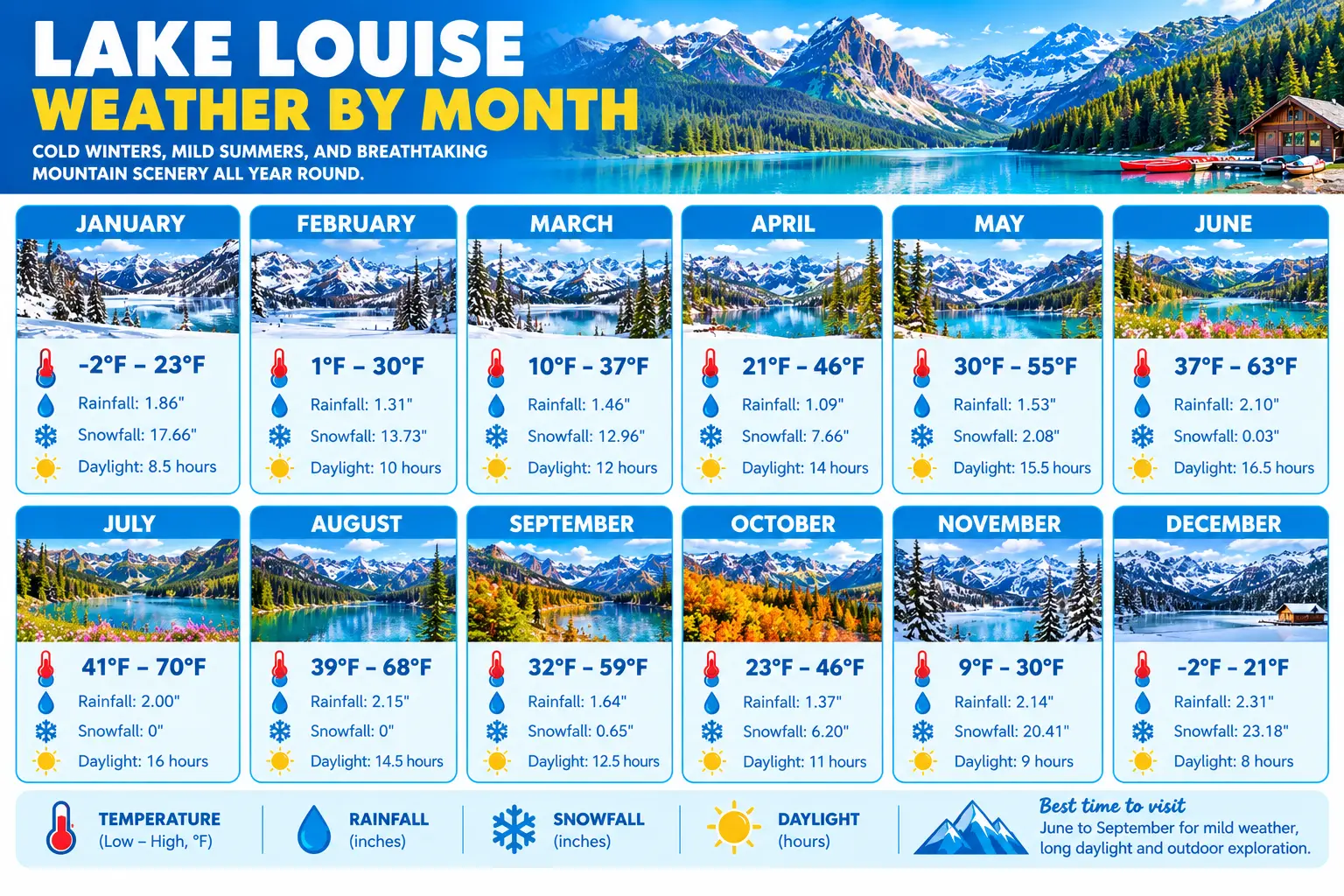
You can click the image below to view the full-size weather chart for Lake Louise.
January – Very Cold, Snowy and Short Days
Average high: 23°F (-5°C)
Average low: -2°F (-19°C)
Rainfall: 1.86 inches (47.3 mm)
Snowfall: 17.66 inches (448.6 mm)
Daylight: 8.5 hours
January is one of the coldest months in Lake Louise. Average daytime temperatures reach only around 23°F (-5°C), while nighttime temperatures can fall to about -2°F (-19°C).
Snowfall averages 17.66 inches (448.6 mm), making January a true winter month. Rainfall is relatively low at 1.86 inches (47.3 mm), with most precipitation occurring as snow.
With short daylight hours and deep snow covering the landscape, January is ideal for winter activities and enjoying the spectacular snowy scenery around Lake Louise.
Best for:
- Skiing and snowboarding
- Winter photography
- Snowshoeing
- Snow-covered mountain scenery
February – Cold and Heavily Snowy
Average high: 30°F (-1°C)
Average low: 1°F (-17°C)
Rainfall: 1.31 inches (33.4 mm)
Snowfall: 13.73 inches (348.8 mm)
Daylight: 10 hours
February remains very cold in Lake Louise, although temperatures begin to rise slightly compared with January. Average highs reach around 30°F (-1°C), while lows remain near 1°F (-17°C).
Snowfall averages 13.73 inches (348.8 mm), keeping the mountains and surrounding forests covered in snow. Rainfall is low at 1.31 inches (33.4 mm).
The longer days provide more time for outdoor winter activities, making February a popular month for experiencing Lake Louise’s snowy mountain environment.
Best for:
- Skiing and snowboarding
- Snowshoeing
- Winter hiking
- Mountain photography
March – Cold with Heavy Snowfall
Average high: 37°F (3°C)
Average low: 10°F (-12°C)
Rainfall: 1.46 inches (37 mm)
Snowfall: 12.96 inches (329.3 mm)
Daylight: 12 hours
March brings slightly warmer daytime temperatures, with an average high of 37°F (3°C). Nights remain cold, with temperatures averaging around 10°F (-12°C).
Snowfall remains substantial at 12.96 inches (329.3 mm), so winter conditions continue across the area. Rainfall averages 1.46 inches (37 mm).
With 12 hours of daylight, March offers considerably more time for outdoor activities while the surrounding mountains remain covered in snow.
Best for:
- Late-season skiing
- Snowshoeing
- Winter photography
- Longer outdoor excursions
April – Cool, Snowy and Longer Days
Average high: 46°F (8°C)
Average low: 21°F (-6°C)
Rainfall: 1.09 inches (27.6 mm)
Snowfall: 7.66 inches (194.5 mm)
Daylight: 14 hours
April marks a transition toward spring in Lake Louise. Average highs reach around 46°F (8°C), while nighttime temperatures remain cool at about 21°F (-6°C).
Snowfall decreases to 7.66 inches (194.5 mm), although winter conditions can still be present in the mountains. Rainfall averages 1.09 inches (27.6 mm).
With 14 hours of daylight, April provides much more time to explore the area during the day.
Best for:
- Spring mountain scenery
- Late-season snow activities
- Photography
- Quiet visits
May – Mild Days and Occasional Snow
Average high: 55°F (13°C)
Average low: 30°F (-1°C)
Rainfall: 1.53 inches (38.9 mm)
Snowfall: 2.08 inches (52.9 mm)
Daylight: 15.5 hours
May brings noticeably milder weather to Lake Louise. Average daytime temperatures reach around 55°F (13°C), while nighttime temperatures are close to 30°F (-1°C).
Rainfall increases slightly to 1.53 inches (38.9 mm), while snowfall drops sharply to just 2.08 inches (52.9 mm). Some snow can still occur, particularly at higher elevations.
With 15.5 hours of daylight, May is a good time to enjoy longer days and the transition from winter to spring.
Best for:
- Spring hiking
- Scenic drives
- Photography
- Quiet mountain visits
June – Mild, Wet and Very Long Days
Average high: 63°F (17°C)
Average low: 37°F (3°C)
Rainfall: 2.10 inches (53.4 mm)
Snowfall: 0.03 inches (0.8 mm)
Daylight: 16.5 hours
June brings mild summer conditions to Lake Louise. Average highs reach around 63°F (17°C), while nighttime temperatures remain cool at approximately 37°F (3°C).
Rainfall averages 2.10 inches (53.4 mm), while snowfall is almost nonexistent at just 0.03 inches (0.8 mm).
With 16.5 hours of daylight, June offers plenty of time for hiking, sightseeing, and exploring the surrounding mountains.
Best for:
- Hiking
- Sightseeing
- Lake photography
- Long mountain days
July – Mild Summer Weather and Long Days
Average high: 70°F (21°C)
Average low: 41°F (5°C)
Rainfall: 2.00 inches (50.9 mm)
Snowfall: 0 inches
Daylight: 16 hours
July is one of the mildest months in Lake Louise. Average daytime temperatures reach around 70°F (21°C), while nights remain comfortable and cool at about 41°F (5°C).
Rainfall averages 2.00 inches (50.9 mm), and there is no measurable snowfall. The combination of mild temperatures and long daylight hours creates excellent conditions for exploring the outdoors.
With around 16 hours of daylight, visitors have plenty of time to enjoy trails, lakes, viewpoints, and mountain scenery.
Best for:
- Hiking
- Canoeing and lake activities
- Sightseeing
- Mountain photography
August – Mild, Pleasant and Mostly Snow-Free
Average high: 68°F (20°C)
Average low: 39°F (4°C)
Rainfall: 2.15 inches (54.6 mm)
Snowfall: 0 inches
Daylight: 14.5 hours
August remains mild and pleasant in Lake Louise. Average highs reach around 68°F (20°C), while nighttime temperatures fall to approximately 39°F (4°C).
Rainfall averages 2.15 inches (54.6 mm), making August slightly wetter than July. Snowfall is absent, allowing most summer outdoor activities to continue without winter conditions.
With 14.5 hours of daylight, August is well suited to hiking and sightseeing around the Canadian Rockies.
Best for:
- Hiking
- Scenic photography
- Lake activities
- Exploring the Canadian Rockies
September – Cool Days and the Start of Snow
Average high: 59°F (15°C)
Average low: 32°F (0°C)
Rainfall: 1.64 inches (41.6 mm)
Snowfall: 0.65 inches (16.4 mm)
Daylight: 12.5 hours
September brings cooler conditions to Lake Louise. Average daytime temperatures reach around 59°F (15°C), while nighttime temperatures fall to around 32°F (0°C).
Rainfall averages 1.64 inches (41.6 mm), while snowfall begins to return with an average of 0.65 inches (16.4 mm).
Daylight decreases to about 12.5 hours, but September can still provide good opportunities for hiking and enjoying the changing mountain scenery.
Best for:
- Fall scenery
- Hiking
- Photography
- Quiet mountain visits
October – Cool, Wet and Increasingly Snowy
Average high: 46°F (8°C)
Average low: 23°F (-5°C)
Rainfall: 1.37 inches (34.8 mm)
Snowfall: 6.20 inches (157.6 mm)
Daylight: 11 hours
October marks a clear return toward winter conditions. Average highs are around 46°F (8°C), while nighttime temperatures drop to about 23°F (-5°C).
Snowfall increases to 6.20 inches (157.6 mm), while rainfall averages 1.37 inches (34.8 mm). Snow becomes increasingly common as temperatures fall.
With only 11 hours of daylight, October offers shorter days but can provide beautiful autumn and early-winter scenery.
Best for:
- Fall photography
- Early winter scenery
- Quiet visits
- Mountain sightseeing
November – Cold and Very Snowy
Average high: 30°F (-1°C)
Average low: 9°F (-13°C)
Rainfall: 2.14 inches (54.4 mm)
Snowfall: 20.41 inches (518.4 mm)
Daylight: 9 hours
November is a cold and snowy month in Lake Louise. Average daytime temperatures reach only around 30°F (-1°C), while nighttime temperatures fall to approximately 9°F (-13°C).
Snowfall rises dramatically to 20.41 inches (518.4 mm), making November one of the snowiest months of the year. Rainfall averages 2.14 inches (54.4 mm).
With just 9 hours of daylight, November has a distinctly wintry atmosphere.
Best for:
- Snowy mountain scenery
- Winter photography
- Early-season winter activities
- Quiet visits
December – Extremely Cold and Snowy
Average high: 21°F (-6°C)
Average low: -2°F (-19°C)
Rainfall: 2.31 inches (58.7 mm)
Snowfall: 23.18 inches (588.8 mm)
Daylight: 8 hours
December is one of the coldest and snowiest months in Lake Louise. Average daytime temperatures reach around 21°F (-6°C), while nighttime temperatures can fall to approximately -2°F (-19°C).
Snowfall averages 23.18 inches (588.8 mm), the highest monthly total in the data. Rainfall averages 2.31 inches (58.7 mm), while daylight drops to just 8 hours.
The combination of heavy snow, freezing temperatures, and short days creates classic winter conditions across Lake Louise.
Best for:
- Skiing and snowboarding
- Winter scenery
- Snowshoeing
- Holiday mountain experiences
Lake Louise Weather by Month
| Month | Avg High °F (°C) | Avg Low °F (°C) | Rainfall (inches) | Snowfall (inches) | Daylight (hours) |
|---|---|---|---|---|---|
| January | 23°F (-5°C) | -2°F (-19°C) | 1.86 | 17.66 | 8.5 |
| February | 30°F (-1°C) | 1°F (-17°C) | 1.31 | 13.73 | 10 |
| March | 37°F (3°C) | 10°F (-12°C) | 1.46 | 12.96 | 12 |
| April | 46°F (8°C) | 21°F (-6°C) | 1.09 | 7.66 | 14 |
| May | 55°F (13°C) | 30°F (-1°C) | 1.53 | 2.08 | 15.5 |
| June | 63°F (17°C) | 37°F (3°C) | 2.10 | 0.03 | 16.5 |
| July | 70°F (21°C) | 41°F (5°C) | 2.00 | 0.00 | 16 |
| August | 68°F (20°C) | 39°F (4°C) | 2.15 | 0.00 | 14.5 |
| September | 59°F (15°C) | 32°F (0°C) | 1.64 | 0.65 | 12.5 |
| October | 46°F (8°C) | 23°F (-5°C) | 1.37 | 6.20 | 11 |
| November | 30°F (-1°C) | 9°F (-13°C) | 2.14 | 20.41 | 9 |
| December | 21°F (-6°C) | -2°F (-19°C) | 2.31 | 23.18 | 8 |
20 FAQs about Lake Louise Weather
What is the weather like in Lake Louise throughout the year?
Lake Louise has a cold mountain climate, with very snowy winters and cool, mild summers. Winter temperatures can fall well below freezing, while summer daytime highs generally reach around 68–70°F (20–21°C).
What is the coldest month in Lake Louise?
January and December are among the coldest months. Average lows are around -2°F (-19°C), while average highs range from 21°F (-6°C) to 23°F (-5°C).
What is the warmest month in Lake Louise?
July is the warmest month in the provided data, with an average high of 70°F (21°C) and an average low of 41°F (5°C).
Does it snow in Lake Louise?
Yes. Snowfall is a major feature of Lake Louise’s climate. Snow is especially common from November through April, with December averaging about 23.18 inches (588.8 mm).
What month has the most snowfall in Lake Louise?
December has the highest average snowfall in the provided data, at 23.18 inches (588.8 mm), followed by November at 20.41 inches (518.4 mm).
Does Lake Louise get snow in summer?
Snowfall is essentially absent in July and August in the provided data. June averages only 0.03 inches (0.8 mm), although conditions can vary at higher elevations.
What is Lake Louise weather like in January?
January is very cold and snowy, with an average high of 23°F (-5°C), an average low of -2°F (-19°C), and about 17.66 inches (448.6 mm) of snowfall.
What is Lake Louise weather like in July?
July is mild by mountain standards, with an average high of 70°F (21°C) and an average low of 41°F (5°C). There is no average snowfall in July, and daylight lasts about 16 hours.
What is Lake Louise weather like in August?
August remains mild, with an average high of 68°F (20°C) and a low of 39°F (4°C). It averages about 2.15 inches (54.6 mm) of rainfall and no snowfall.
What is Lake Louise weather like in September?
September becomes noticeably cooler, with an average high of 59°F (15°C) and a low of 32°F (0°C). Snowfall begins to return, averaging 0.65 inches (16.4 mm).
What is Lake Louise weather like in October?
October is cool and increasingly snowy. Average temperatures range from 23°F (-5°C) at night to 46°F (8°C) during the day, with about 6.20 inches (157.6 mm) of snowfall.
What is Lake Louise weather like in November?
November is cold and very snowy. The average high is 30°F (-1°C), the average low is 9°F (-13°C), and snowfall averages 20.41 inches (518.4 mm).
How much daylight does Lake Louise get in winter?
Daylight is limited during winter. December averages about 8 hours of daylight, while January averages 8.5 hours.
How much daylight does Lake Louise get in summer?
Summer has very long days. June averages 16.5 hours of daylight, July about 16 hours, and August about 14.5 hours.
Is Lake Louise rainy?
Lake Louise receives precipitation throughout the year, but much of the winter precipitation falls as snow. Monthly rainfall in the provided data ranges from about 1.09 inches (27.6 mm) in April to 2.31 inches (58.7 mm) in December.
What is the best month for hiking in Lake Louise weather-wise?
June through September generally offers the mildest temperatures and longest daylight hours. Summer also has no average snowfall in July and August, while September is cooler and begins to see some snow.
What should I wear in Lake Louise in summer?
Even during summer, temperatures can be cool, particularly in the morning and evening. Layers, a warm jacket, rain protection, and comfortable hiking clothing are useful for changing mountain conditions.
What should I wear in Lake Louise in winter?
Winter visitors should prepare for freezing temperatures and heavy snow. Warm insulated clothing, winter boots, gloves, a hat, and multiple layers are appropriate for outdoor activities.
When is Lake Louise the snowiest?
The heaviest snowfall occurs from November through March, with December averaging the highest monthly total at 23.18 inches (588.8 mm).
Read more: