Victoria Weather by Month
Victoria, British Columbia, has a mild oceanic climate with relatively cool summers, wet winters, and much less snow than many other Canadian cities. Temperatures generally range from the low 40s°F (around 4–8°C) in winter to the upper 60s°F (around 20°C) in summer.
Rainfall is concentrated from October through January, while July and August are the driest months. Snowfall is limited and mostly occurs in December, January, February, and November. Daylight varies considerably through the year, from about 8.5 hours in December to 16 hours in June.
Victoria Weather by Month
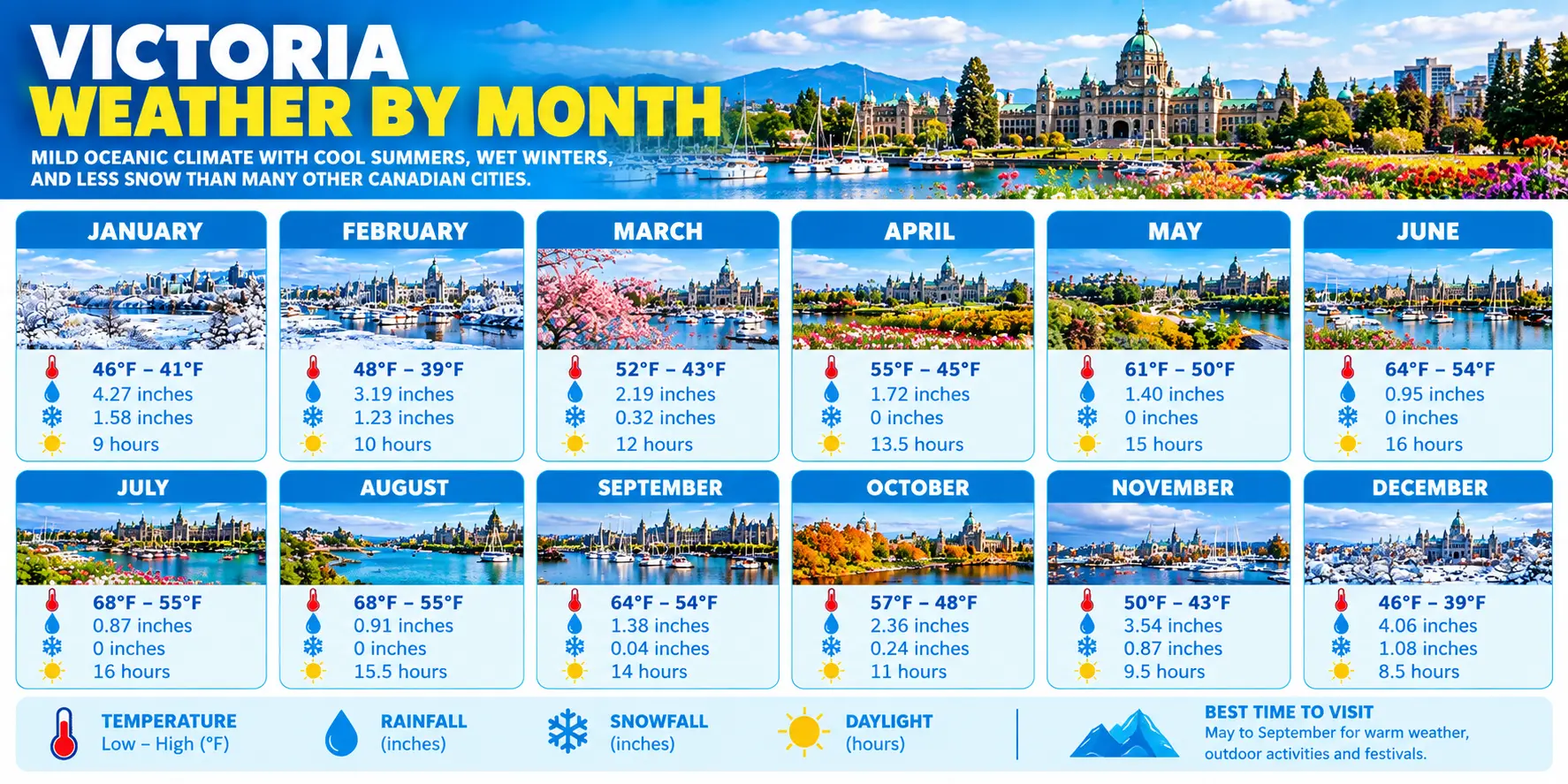
You can click the image below to view the full-size weather chart for Victoria.
January – Cool, Wet and Occasionally Snowy
Average high: 46°F (8°C)
Average low: 41°F (5°C)
Rainfall: 4.27 inches (108.5 mm)
Snowfall: 1.58 inches (40.1 mm)
Daylight: 9 hours
January is one of the coolest and wettest months in Victoria. Average daytime temperatures reach around 46°F (8°C), while nighttime temperatures remain near 41°F (5°C).
Rainfall averages about 4.27 inches (108.5 mm), making January a noticeably wet month. Snowfall averages 1.58 inches (40.1 mm), although snow is generally limited compared with much of Canada.
With short days and frequent rain, January is a good time for enjoying Victoria’s museums, restaurants, historic buildings, and cozy indoor attractions.
Best for:
- Indoor attractions
- Quiet city visits
- Winter photography
- Cozy cafes and restaurants
February – Cool and Wet Winter Weather
Average high: 48°F (9°C)
Average low: 39°F (4°C)
Rainfall: 3.19 inches (81.1 mm)
Snowfall: 1.23 inches (31.2 mm)
Daylight: 10 hours
February remains cool and fairly wet in Victoria. Average high temperatures reach 48°F (9°C), while lows average around 39°F (4°C).
The city receives about 3.19 inches (81.1 mm) of rain, while snowfall averages 1.23 inches (31.2 mm). Although snow can occur, winter conditions are generally mild.
With daylight increasing to about 10 hours, February offers slightly more opportunity for outdoor sightseeing compared with January.
Best for:
- City sightseeing
- Museums and galleries
- Historic attractions
- Quiet winter travel
March – Cool Spring with Occasional Snow
Average high: 52°F (11°C)
Average low: 43°F (6°C)
Rainfall: 2.19 inches (55.7 mm)
Snowfall: 0.32 inches (8.1 mm)
Daylight: 12 hours
March brings the first signs of spring to Victoria. Average temperatures rise to around 52°F (11°C) during the day and 43°F (6°C) at night.
Rainfall decreases to about 2.19 inches (55.7 mm), while snowfall falls to just 0.32 inches (8.1 mm). With approximately 12 hours of daylight, outdoor activities become increasingly comfortable.
March is a good month for exploring Victoria’s parks, gardens, waterfront, and historic neighborhoods.
Best for:
- Spring walks
- Gardens and parks
- Waterfront sightseeing
- Exploring the city
April – Mild Spring and Light Rain
Average high: 55°F (13°C)
Average low: 45°F (7°C)
Rainfall: 1.72 inches (43.6 mm)
Snowfall: 0 inches
Daylight: 13.5 hours
April is a mild and increasingly pleasant month in Victoria. Average highs reach 55°F (13°C), while nighttime temperatures remain around 45°F (7°C).
Rainfall drops to approximately 1.72 inches (43.6 mm), and snowfall is essentially absent. With 13.5 hours of daylight, there is plenty of time for sightseeing and outdoor exploration.
The combination of mild temperatures, longer days, and relatively moderate rainfall makes April a comfortable month for exploring the city.
Best for:
- Walking tours
- Parks and gardens
- Outdoor sightseeing
- Spring photography
May – Mild and Pleasant Spring Weather
Average high: 61°F (16°C)
Average low: 50°F (10°C)
Rainfall: 1.40 inches (35.5 mm)
Snowfall: 0 inches
Daylight: 15 hours
May brings warmer and drier conditions to Victoria. Average daytime temperatures reach about 61°F (16°C), while nighttime temperatures stay near 50°F (10°C).
Rainfall averages only 1.40 inches (35.5 mm), and there is no significant snowfall. Daylight increases to about 15 hours, giving visitors long days for outdoor activities.
May is an excellent time to enjoy Victoria’s gardens, coastal scenery, parks, and walking trails.
Best for:
- Gardens and flowers
- Hiking and walking
- Outdoor sightseeing
- Coastal exploration
June – Mild Summer Weather and Long Days
Average high: 64°F (18°C)
Average low: 54°F (12°C)
Rainfall: 0.95 inches (24.1 mm)
Snowfall: 0 inches
Daylight: 16 hours
June marks the beginning of summer in Victoria, with mild temperatures and very long days. Average highs reach 64°F (18°C), while lows remain around 54°F (12°C).
Rainfall falls to less than 1 inch, averaging about 0.95 inches (24.1 mm). There is no snowfall, and the city enjoys approximately 16 hours of daylight.
These conditions are ideal for spending extended periods outdoors, from exploring gardens and parks to walking along the waterfront.
Best for:
- Outdoor activities
- Hiking and walking
- Waterfront sightseeing
- Long summer days
July – Warm, Dry and Sunny Summer Weather
Average high: 68°F (20°C)
Average low: 55°F (13°C)
Rainfall: 0.58 inches (14.7 mm)
Snowfall: 0 inches
Daylight: 15.5 hours
July is one of the warmest and driest months in Victoria. Average daytime temperatures reach about 68°F (20°C), while nighttime temperatures stay around 55°F (13°C).
Rainfall averages only 0.58 inches (14.7 mm), making July the driest month of the year. With approximately 15.5 hours of daylight, visitors have plenty of time to enjoy outdoor attractions.
July is particularly suitable for exploring Victoria’s coastline, gardens, parks, and nearby natural areas.
Best for:
- Outdoor sightseeing
- Hiking and walking
- Beaches and waterfront areas
- Gardens and photography
August – Warm and Mostly Dry Summer Weather
Average high: 68°F (20°C)
Average low: 55°F (13°C)
Rainfall: 1.13 inches (28.7 mm)
Snowfall: 0 inches
Daylight: 14.5 hours
August has very similar temperatures to July, with average highs of 68°F (20°C) and lows around 55°F (13°C).
Rainfall increases slightly to 1.13 inches (28.7 mm), but August remains relatively dry compared with the wetter months of the year. There is no snowfall, and daylight remains generous at about 14.5 hours.
The warm but comfortable temperatures make August a popular month for outdoor exploration and sightseeing.
Best for:
- Hiking and nature walks
- Waterfront activities
- Gardens
- Summer sightseeing
September – Mild Weather and Comfortable Days
Average high: 64°F (18°C)
Average low: 54°F (12°C)
Rainfall: 0.96 inches (24.4 mm)
Snowfall: 0 inches
Daylight: 12.5 hours
September brings slightly cooler temperatures while retaining relatively dry conditions. Average highs reach 64°F (18°C), with nighttime temperatures around 54°F (12°C).
Rainfall averages about 0.96 inches (24.4 mm), and there is no snowfall. Daylight decreases to approximately 12.5 hours as autumn approaches.
The mild temperatures and moderate rainfall make September a comfortable month for sightseeing, walking, and exploring Victoria’s natural surroundings.
Best for:
- Comfortable sightseeing
- Hiking and walking
- Parks and gardens
- Early autumn scenery
October – Cooler and Increasingly Wet
Average high: 57°F (14°C)
Average low: 48°F (9°C)
Rainfall: 2.71 inches (68.9 mm)
Snowfall: 0 inches
Daylight: 11 hours
October marks a noticeable shift toward wetter autumn weather. Average daytime temperatures fall to around 57°F (14°C), while nighttime temperatures average 48°F (9°C).
Rainfall increases to approximately 2.71 inches (68.9 mm), although significant snowfall is not typical. Daylight decreases to about 11 hours.
October can still be a pleasant time to explore Victoria, especially for visitors who enjoy cooler temperatures and autumn scenery.
Best for:
- Autumn photography
- City sightseeing
- Gardens and parks
- Indoor attractions
November – Cool, Very Wet and Occasionally Snowy
Average high: 50°F (10°C)
Average low: 43°F (6°C)
Rainfall: 5.89 inches (149.7 mm)
Snowfall: 1.46 inches (37.2 mm)
Daylight: 9.5 hours
November is one of the wettest months in Victoria. Average high temperatures reach about 50°F (10°C), while lows fall to around 43°F (6°C).
Rainfall rises sharply to 5.89 inches (149.7 mm), the highest monthly total in the data. Snowfall averages 1.46 inches (37.2 mm), although Victoria generally experiences much milder winter conditions than many Canadian destinations.
With only about 9.5 hours of daylight, November is well suited to a mix of indoor attractions and shorter outdoor excursions.
Best for:
- Museums and galleries
- Indoor attractions
- Cozy cafes
- Quiet city visits
December – Cool, Wet and Occasionally Snowy
Average high: 46°F (8°C)
Average low: 39°F (4°C)
Rainfall: 4.57 inches (116.1 mm)
Snowfall: 1.96 inches (49.9 mm)
Daylight: 8.5 hours
December brings the shortest days of the year and cool winter conditions to Victoria. Average daytime temperatures remain around 46°F (8°C), while nighttime temperatures fall to approximately 39°F (4°C).
Rainfall averages about 4.57 inches (116.1 mm), while snowfall reaches around 1.96 inches (49.9 mm), the highest snowfall total in the data. Even so, Victoria’s winter remains relatively mild compared with many other Canadian cities.
With only about 8.5 hours of daylight, December is a good month for enjoying Victoria’s holiday atmosphere, museums, historic sites, restaurants, and other indoor attractions.
Best for:
- Holiday events
- Indoor attractions
- Winter photography
- Cozy cafes and restaurants
Victoria Weather by Month
| Month | Avg High °F (°C) | Avg Low °F (°C) | Rainfall (inches) | Snowfall (inches) | Daylight (hours) |
|---|---|---|---|---|---|
| January | 46°F (8°C) | 41°F (5°C) | 4.27 | 1.58 | 9 |
| February | 48°F (9°C) | 39°F (4°C) | 3.19 | 1.23 | 10 |
| March | 52°F (11°C) | 43°F (6°C) | 2.19 | 0.32 | 12 |
| April | 55°F (13°C) | 45°F (7°C) | 1.72 | 0.00 | 13.5 |
| May | 61°F (16°C) | 50°F (10°C) | 1.40 | 0.00 | 15 |
| June | 64°F (18°C) | 54°F (12°C) | 0.95 | 0.00 | 16 |
| July | 68°F (20°C) | 55°F (13°C) | 0.58 | 0.00 | 15.5 |
| August | 68°F (20°C) | 55°F (13°C) | 1.13 | 0.00 | 14.5 |
| September | 64°F (18°C) | 54°F (12°C) | 0.96 | 0.00 | 12.5 |
| October | 57°F (14°C) | 48°F (9°C) | 2.71 | 0.00 | 11 |
| November | 50°F (10°C) | 43°F (6°C) | 5.89 | 1.46 | 9.5 |
| December | 46°F (8°C) | 39°F (4°C) | 4.57 | 1.96 | 8.5 |
20 faqs about Victoria Weather
1. What is the weather like in Victoria, BC?
Victoria has a mild oceanic climate, with cool, wet winters and mild, relatively dry summers. Snowfall is limited compared with many other Canadian cities.
2. What is the best month to visit Victoria, BC?
May through September generally offers mild temperatures, longer daylight hours, and less rainfall than the wetter winter months.
3. What is the warmest month in Victoria?
July and August are typically the warmest months, with average highs around 68°F (20°C).
4. What is the coldest month in Victoria?
January and December are among the coolest months, with average highs around 46°F (8°C).
5. Does it snow in Victoria, BC?
Yes, but snowfall is generally limited. The highest average snowfall in the data occurs in December, at about 1.96 inches (49.9 mm).
6. When does it snow in Victoria?
Snow is most likely from November through February, although significant snow is relatively uncommon compared with much of Canada.
7. What is Victoria’s rainiest month?
November is the wettest month, with average rainfall of about 5.89 inches (149.7 mm).
8. What is the driest month in Victoria?
July is the driest month, with average rainfall of only about 0.58 inches (14.7 mm).
9. How much rain does Victoria get in winter?
Winter is relatively wet. December receives about 4.57 inches (116.1 mm) of rain, while January averages about 4.27 inches (108.5 mm).
10. How warm is Victoria in summer?
Summer is mild rather than extremely hot. Average highs are around 64°F (18°C) in June and September and about 68°F (20°C) in July and August.
11. How cold does Victoria get in winter?
Winter temperatures are generally mild. Average lows range from about 39°F (4°C) to 43°F (6°C) from December through February.
12. Does Victoria have a lot of rain?
Victoria has a pronounced wet season from autumn through winter, but summers are comparatively dry. July averages only 0.58 inches (14.7 mm) of rainfall.
13. How many hours of daylight does Victoria get in summer?
Victoria gets very long summer days, reaching about 16 hours of daylight in June.
14. How many hours of daylight does Victoria get in winter?
Daylight is shortest in December, at approximately 8.5 hours per day.
15. Is Victoria warmer than most Canadian cities?
Victoria has a relatively mild climate for Canada because of its coastal location. Winter temperatures are generally much milder than in many inland Canadian cities.
16. Is Victoria a good place to visit in winter?
Winter can be suitable for visitors who enjoy cooler weather, indoor attractions, historic sites, restaurants, and the city’s quieter atmosphere. Rain is much more common than snow.
17. Is Victoria a good place to visit in spring?
Yes. Spring temperatures gradually become milder, rainfall decreases, and daylight increases from about 10 hours in February to 15 hours in May.
18. Is Victoria a good place to visit in summer?
Summer offers mild temperatures, relatively low rainfall, and long daylight hours, making it well suited to walking, gardens, parks, waterfront activities, and outdoor sightseeing.
19. What is Victoria’s weather like in September?
September remains mild, with an average high of 64°F (18°C), an average low of 54°F (12°C), about 0.96 inches (24.4 mm) of rainfall, and 12.5 hours of daylight.
20. What is the best time of year for outdoor activities in Victoria?
Late spring through early autumn generally provides the most favorable combination of mild temperatures, longer daylight, and lower rainfall, particularly from May through September.
Read more: