Outer Banks Weather by Month
Outer Banks (often called the OBX) is a chain of narrow barrier islands off the coast of North Carolina, USA. Outer Banks has a mild coastal climate with warm summers, relatively cool winters, and rainfall throughout the year. Temperatures range from around 39°F (4°C) on winter nights to about 82°F (28°C) during the warmest summer afternoons. Snowfall is very limited, with only small amounts recorded in winter.
Outer Banks Weather by Month
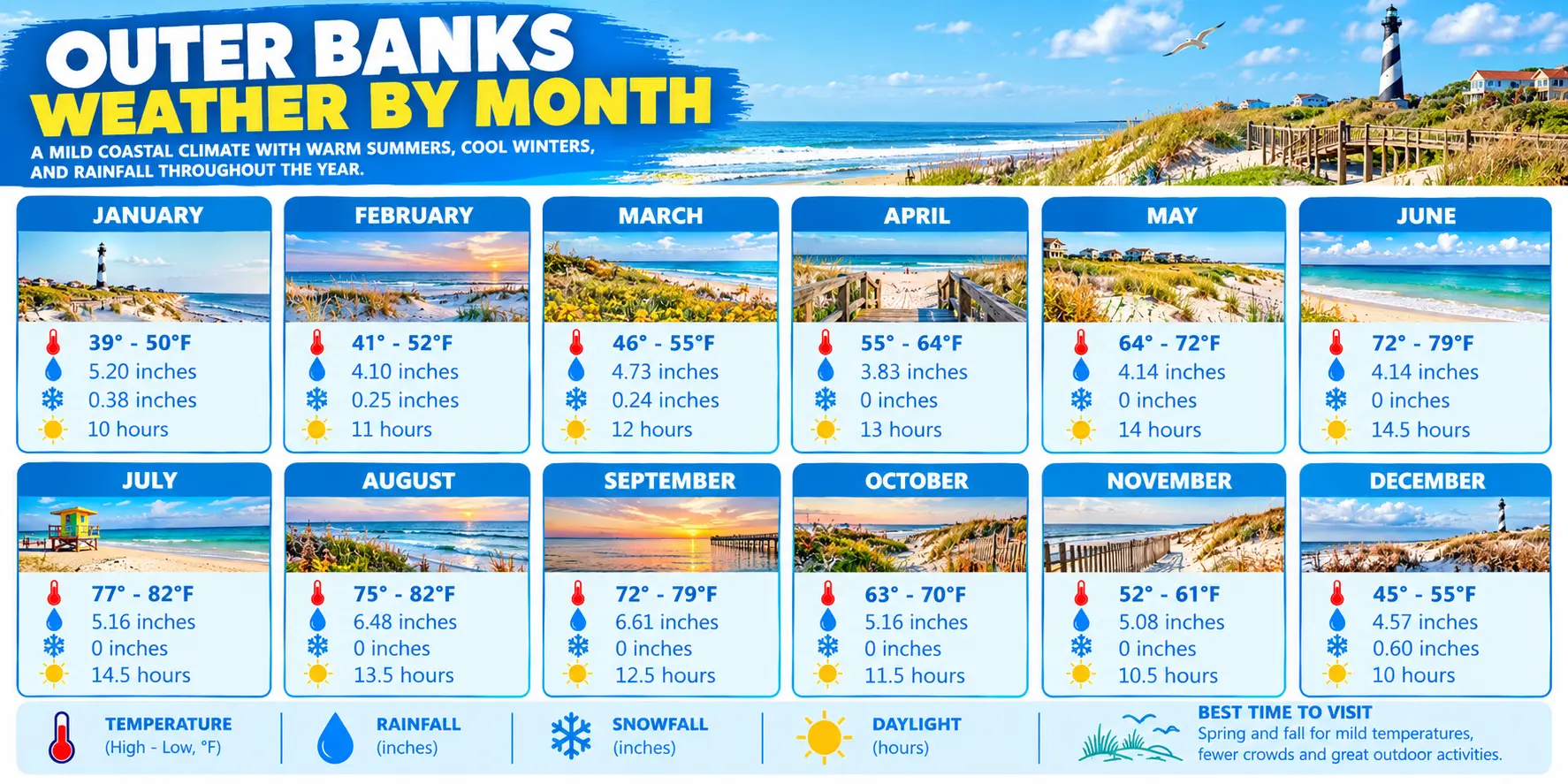
You can click the image below to view the full-size weather chart for Outer Banks.
January – Cool, Wet and Short Days
Average high: 50°F (10°C)
Average low: 39°F (4°C)
Rainfall: 5.20 inches (132 mm)
Snowfall: 0.38 inches (9.6 mm)
Daylight: 10 hours
January is one of the coolest months in the Outer Banks. Average daytime temperatures reach around 50°F (10°C), while nighttime temperatures fall to about 39°F (4°C).
Rainfall averages 5.20 inches (132 mm), making January a fairly wet month. Snowfall is minimal at just 0.38 inches (9.6 mm), so significant snow is uncommon along the coast.
With only 10 hours of daylight, January is best suited to quiet coastal walks, photography, and exploring the Outer Banks without the busy summer crowds.
Best for:
- Quiet beach walks
- Coastal photography
- Exploring without summer crowds
- Off-season visits
February – Cool and Wet Winter Weather
Average high: 52°F (11°C)
Average low: 41°F (5°C)
Rainfall: 4.10 inches (104.2 mm)
Snowfall: 0.25 inches (6.3 mm)
Daylight: 11 hours
February remains cool across the Outer Banks, with average highs of 52°F (11°C) and lows around 41°F (5°C).
Rainfall averages 4.10 inches (104.2 mm), while snowfall is extremely limited at just 0.25 inches (6.3 mm). Cold weather can still occur, but the coastal location generally keeps winter conditions relatively mild.
Daylight increases to 11 hours, giving visitors more time to enjoy the beaches and coastal scenery.
Best for:
- Quiet beach visits
- Coastal sightseeing
- Photography
- Off-season travel
March – Mild Temperatures and Early Spring
Average high: 55°F (13°C)
Average low: 46°F (8°C)
Rainfall: 4.73 inches (120.2 mm)
Snowfall: 0.24 inches (6.2 mm)
Daylight: 12 hours
March brings noticeably milder weather to the Outer Banks. Average daytime temperatures rise to 55°F (13°C), while nights average around 46°F (8°C).
Rainfall averages 4.73 inches (120.2 mm), and snowfall drops to only 0.24 inches (6.2 mm). By this time of year, winter conditions are becoming less common.
With 12 hours of daylight, March offers comfortable conditions for exploring beaches, nature trails, and coastal communities.
Best for:
- Early spring visits
- Beach walks
- Nature photography
- Outdoor sightseeing
April – Mild Spring Weather
Average high: 64°F (18°C)
Average low: 55°F (13°C)
Rainfall: 3.83 inches (97.3 mm)
Snowfall: 0 inches
Daylight: 13 hours
April is a pleasant spring month in the Outer Banks. Average highs reach 64°F (18°C), while nighttime temperatures stay around 55°F (13°C).
Rainfall averages 3.83 inches (97.3 mm), making April one of the drier months of the year. Snowfall is essentially nonexistent.
With 13 hours of daylight, conditions become increasingly favorable for spending time outdoors and exploring the coastline.
Best for:
- Spring beach walks
- Cycling
- Nature trails
- Outdoor sightseeing
May – Warm and Pleasant Spring Weather
Average high: 72°F (22°C)
Average low: 64°F (18°C)
Rainfall: 4.14 inches (105.1 mm)
Snowfall: 0 inches
Daylight: 14 hours
May brings warm and comfortable conditions to the Outer Banks. Average daytime temperatures reach 72°F (22°C), while nights remain mild at around 64°F (18°C).
Rainfall averages 4.14 inches (105.1 mm), and there is no measurable snowfall. The combination of warm temperatures and 14 hours of daylight makes May a good month for outdoor activities.
The beaches are becoming increasingly attractive for swimming, walking, and other coastal activities as summer approaches.
Best for:
- Beach activities
- Swimming
- Cycling
- Outdoor exploration
June – Warm Summer Weather
Average high: 79°F (26°C)
Average low: 72°F (22°C)
Rainfall: 4.14 inches (105.2 mm)
Snowfall: 0 inches
Daylight: 14.5 hours
June marks the beginning of the warm summer season in the Outer Banks. Average highs reach 79°F (26°C), while nighttime temperatures remain warm at around 72°F (22°C).
Rainfall averages 4.14 inches (105.2 mm), but the long 14.5-hour days provide plenty of time for outdoor activities.
The combination of warm temperatures, long daylight hours, and coastal scenery makes June a popular time for beach trips and water-based activities.
Best for:
- Beach vacations
- Swimming
- Water sports
- Long days outdoors
July – Hot, Humid and Ideal for the Beach
Average high: 82°F (28°C)
Average low: 77°F (25°C)
Rainfall: 5.16 inches (131.1 mm)
Snowfall: 0 inches
Daylight: 14.5 hours
July is one of the warmest months in the Outer Banks. Average daytime temperatures reach 82°F (28°C), while nighttime temperatures remain around 77°F (25°C).
Rainfall averages 5.16 inches (131.1 mm), so occasional wet weather is possible throughout the month. There is no snowfall, and daylight lasts around 14.5 hours.
Warm ocean temperatures and long summer days make July particularly suitable for traditional beach vacations and water activities.
Best for:
- Beach vacations
- Swimming
- Surfing and water sports
- Summer activities
August – Warmest and Wettest Month
Average high: 82°F (28°C)
Average low: 75°F (24°C)
Rainfall: 6.48 inches (164.7 mm)
Snowfall: 0 inches
Daylight: 13.5 hours
August remains very warm in the Outer Banks, with average highs of 82°F (28°C) and lows around 75°F (24°C).
Rainfall rises to 6.48 inches (164.7 mm), making August the wettest month in the provided data. Despite the increased rainfall, there are still 13.5 hours of daylight for beach and outdoor activities.
Visitors should be prepared for occasional heavy rain while enjoying the warm coastal conditions.
Best for:
- Beach vacations
- Swimming
- Water sports
- Summer coastal activities
September – Warm and Wet Early Fall Weather
Average high: 79°F (26°C)
Average low: 72°F (22°C)
Rainfall: 6.61 inches (167.9 mm)
Snowfall: 0 inches
Daylight: 12.5 hours
September remains warm in the Outer Banks, although temperatures begin to decline from their summer peak. Average highs reach 79°F (26°C), while lows stay around 72°F (22°C).
Rainfall averages 6.61 inches (167.9 mm), the highest monthly total in the provided data. There is no snowfall, and daylight remains relatively long at 12.5 hours.
The warm temperatures continue to support beach activities, while the approach of fall brings somewhat quieter conditions.
Best for:
- Late-summer beach trips
- Swimming
- Coastal photography
- Outdoor activities
October – Mild and Comfortable Fall Weather
Average high: 70°F (21°C)
Average low: 63°F (17°C)
Rainfall: 5.16 inches (131 mm)
Snowfall: 0 inches
Daylight: 11.5 hours
October brings comfortable fall weather to the Outer Banks. Average daytime temperatures reach 70°F (21°C), while nighttime temperatures fall to around 63°F (17°C).
Rainfall averages 5.16 inches (131 mm), but there is no snowfall. With 11.5 hours of daylight, visitors still have plenty of time to explore the beaches and coastal attractions.
The milder temperatures can be more comfortable for walking, cycling, and sightseeing than the hotter summer months.
Best for:
- Fall beach walks
- Cycling
- Coastal sightseeing
- Photography
November – Mild and Quieter Coastal Weather
Average high: 61°F (16°C)
Average low: 52°F (11°C)
Rainfall: 5.08 inches (129.1 mm)
Snowfall: 0 inches
Daylight: 10.5 hours
November is noticeably cooler but still relatively mild compared with many inland destinations. Average highs reach 61°F (16°C), while lows average around 52°F (11°C).
Rainfall averages 5.08 inches (129.1 mm), and snowfall is not recorded in the provided data. Daylight decreases to around 10.5 hours.
The cooler weather and quieter atmosphere make November suitable for relaxed coastal sightseeing and photography.
Best for:
- Quiet coastal visits
- Photography
- Beach walks
- Off-season travel
December – Cool, Wet and Slightly Snowy
Average high: 55°F (13°C)
Average low: 45°F (7°C)
Rainfall: 4.57 inches (116 mm)
Snowfall: 0.60 inches (15.3 mm)
Daylight: 10 hours
December brings cool winter weather back to the Outer Banks. Average daytime temperatures reach around 55°F (13°C), while nighttime temperatures fall to about 45°F (7°C).
Rainfall averages 4.57 inches (116 mm), while snowfall reaches just 0.60 inches (15.3 mm). Snow remains uncommon, but occasional winter precipitation is possible.
With around 10 hours of daylight, December is a quieter time to experience the coastline and enjoy the Outer Banks away from the busy summer season.
Best for:
- Quiet winter visits
- Coastal photography
- Beach walks
- Holiday trips
Outer Banks Weather by Month
| Month | Avg High °F (°C) | Avg Low °F (°C) | Rainfall (inches) | Snowfall (inches) | Daylight (hours) |
|---|---|---|---|---|---|
| January | 50°F (10°C) | 39°F (4°C) | 5.20 | 0.38 | 10 |
| February | 52°F (11°C) | 41°F (5°C) | 4.10 | 0.25 | 11 |
| March | 55°F (13°C) | 46°F (8°C) | 4.73 | 0.24 | 12 |
| April | 64°F (18°C) | 55°F (13°C) | 3.83 | 0 | 13 |
| May | 72°F (22°C) | 64°F (18°C) | 4.14 | 0 | 14 |
| June | 79°F (26°C) | 72°F (22°C) | 4.14 | 0 | 14.5 |
| July | 82°F (28°C) | 77°F (25°C) | 5.16 | 0 | 14.5 |
| August | 82°F (28°C) | 75°F (24°C) | 6.48 | 0 | 13.5 |
| September | 79°F (26°C) | 72°F (22°C) | 6.61 | 0 | 12.5 |
| October | 70°F (21°C) | 63°F (17°C) | 5.16 | 0 | 11.5 |
| November | 61°F (16°C) | 52°F (11°C) | 5.08 | 0 | 10.5 |
| December | 55°F (13°C) | 45°F (7°C) | 4.57 | 0.60 | 10 |
20 FAQs About Outer Banks Weather
1. What is the weather like in the Outer Banks?
Outer Banks has a mild coastal climate with cool winters, warm summers, and rainfall throughout the year. Summer is generally warmest, while winter temperatures are much cooler but usually remain above freezing.
2. What is the hottest month in the Outer Banks?
July and August are the hottest months, with average highs around 82°F (28°C).
3. What is the coldest month in the Outer Banks?
January is the coolest month based on average temperatures, with an average high of 50°F (10°C) and a low of 39°F (4°C).
4. Does it snow in the Outer Banks?
Snow is uncommon in the Outer Banks. The data shows only small amounts in January, February, March, and December, with no snowfall recorded from April through November.
5. How much snow does the Outer Banks get in winter?
Snowfall is generally very limited. The highest monthly amount in the provided data is 0.60 inches (15.3 mm) in December.
6. What is the rainiest month in the Outer Banks?
September is the rainiest month in the provided data, with about 6.61 inches (167.9 mm) of rainfall.
7. What is the driest month in the Outer Banks?
April is the driest month in the provided data, with approximately 3.83 inches (97.3 mm) of rainfall.
8. What is the weather like in Outer Banks in January?
January is cool and relatively wet, with an average high of 50°F (10°C), an average low of 39°F (4°C), and 5.20 inches of rainfall.
9. What is the weather like in Outer Banks in spring?
Spring brings steadily warmer temperatures. Average highs increase from 55°F (13°C) in March to 72°F (22°C) in May, making the season increasingly comfortable for outdoor activities.
10. What is the weather like in Outer Banks in summer?
Summer is warm, with average highs between 79°F and 82°F (26°C–28°C). July and August are the warmest months, while rainfall remains fairly high.
11. What is the weather like in Outer Banks in fall?
Fall starts warm in September and gradually becomes cooler. Average highs decline from 79°F (26°C) in September to 61°F (16°C) in November.
12. What is the weather like in Outer Banks in December?
December is cool, with an average high of 55°F (13°C) and a low of 45°F (7°C). It receives about 4.57 inches of rainfall and 0.60 inches of snowfall.
13. When does the Outer Banks have the longest daylight hours?
June and July have the longest daylight period in the provided data, at about 14.5 hours per day.
14. When does the Outer Banks have the shortest daylight hours?
December and January have the shortest daylight, at around 10 hours per day.
15. Is the Outer Banks warm enough for a beach vacation in May?
May is relatively warm, with an average high of 72°F (22°C) and about 14 hours of daylight. Conditions are suitable for beach walks and many outdoor activities.
16. Is July a good month for beach activities in the Outer Banks?
July has some of the warmest conditions of the year, with an average high of 82°F (28°C) and a low of 77°F (25°C). It also has about 14.5 hours of daylight.
17. Does the Outer Banks get a lot of rain?
Rainfall occurs throughout the year. Monthly averages in the provided data range from 3.83 inches in April to 6.61 inches in September.
18. What month has the most comfortable temperatures in the Outer Banks?
Spring and fall offer milder temperatures than the hottest summer months. April, May, October, and November have average highs ranging from 61°F to 72°F (16°C–22°C).
19. What is the best time to visit the Outer Banks for mild weather?
April, May, October, and November generally have milder temperatures, with average highs from 61°F to 72°F (16°C–22°C). These months can be suitable for visitors who prefer cooler conditions than midsummer.
20. What is the best time to visit the Outer Banks for warm beach weather?
June through September have the warmest conditions, with average highs ranging from 79°F to 82°F (26°C–28°C). These months also provide long daylight hours for beach and outdoor activities.
Read more: