Mackinac Island Weather by Month
Mackinac Island experiences a humid continental climate, with four distinct seasons that offer something unique throughout the year. Located in northern Michigan and surrounded by the cool waters of Lake Huron, the island enjoys pleasantly mild summers, colorful autumns, snowy winters, and refreshing springs.
Mackinac Island Weather by Month
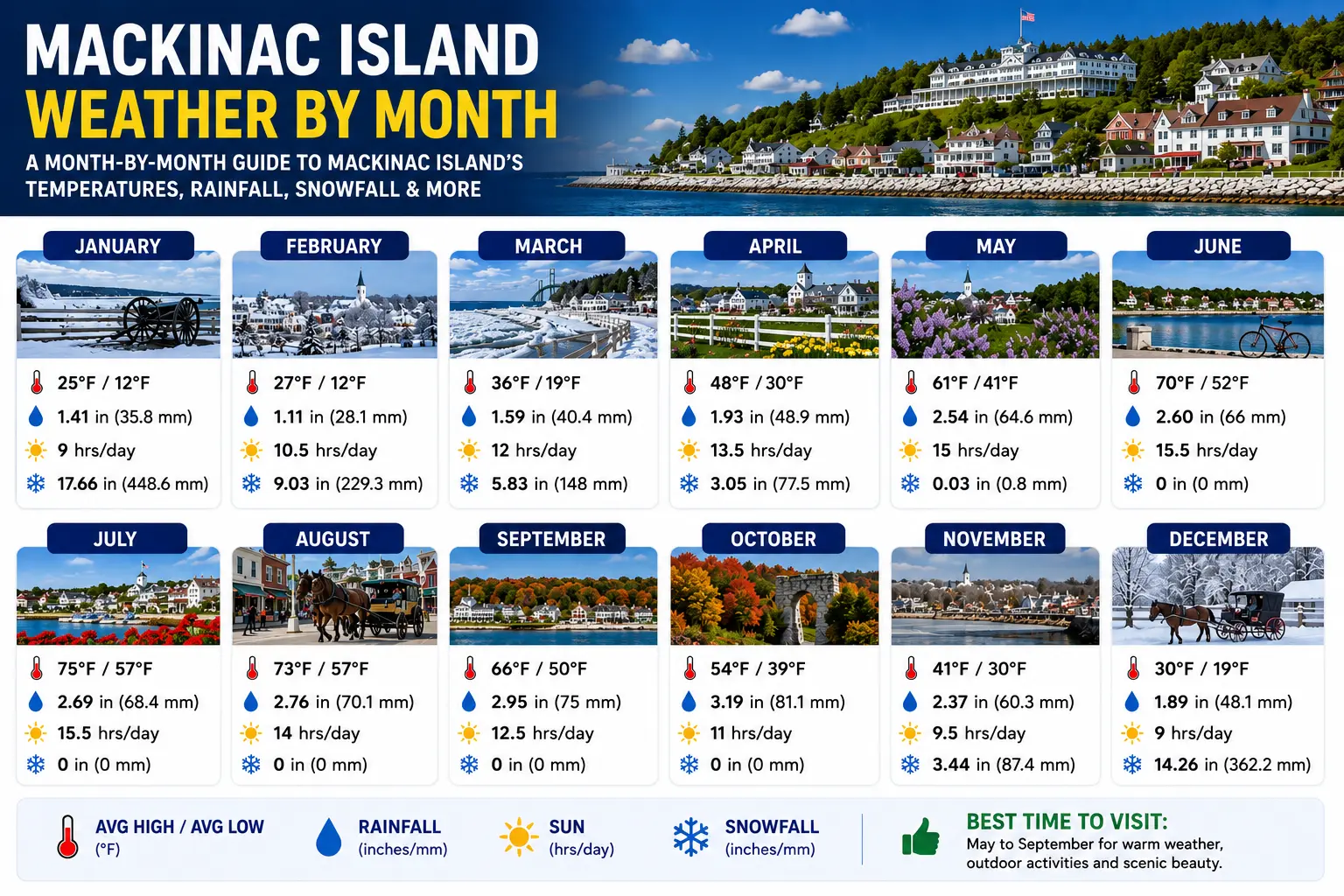
You can click the image below to view the full-size weather chart for Mackinac Island.
January – Cold, Snowy, and Peaceful
- Average high: -4°C (25°F)
- Average low: -11°C (12°F)
- Rainfall: 35.8 mm (1.41 inches)
- Rainy days: 6 days
- Snowfall: 448.6 mm (17.66 inches)
- Daylight: 9 hours
January is the coldest month on Mackinac Island. Heavy lake-effect snow blankets the island, creating a picturesque winter landscape. Ferry service is usually suspended, and visitors often arrive by snowmobile or small aircraft.
The snowy scenery and frozen shoreline make this an excellent month for travelers looking for a quiet winter escape.
Best for:
- Snowmobiling
- Winter photography
- Peaceful getaways
- Snowshoeing
February – Deep Winter with Plenty of Snow
- Average high: -3°C (27°F)
- Average low: -11°C (12°F)
- Rainfall: 28.1 mm (1.11 inches)
- Rainy days: 5 days
- Snowfall: 229.3 mm (9.03 inches)
- Daylight: 10.5 hours
February remains very cold, although daylight gradually increases. Snowfall is still significant, but conditions are generally drier than January.
Visitors can enjoy a peaceful atmosphere and beautiful snow-covered forests without summer crowds.
Best for:
- Winter adventures
- Photography
- Snowshoeing
- Relaxing retreats
March – Chilly with Signs of Spring
- Average high: 2°C (36°F)
- Average low: -7°C (19°F)
- Rainfall: 40.4 mm (1.59 inches)
- Rainy days: 5 days
- Snowfall: 148 mm (5.83 inches)
- Daylight: 12 hours
March brings the first hints of spring, although winter weather often lingers. Snowfall decreases noticeably while temperatures slowly climb above freezing during the day.
Outdoor conditions remain unpredictable, so warm clothing is still essential.
Best for:
- Quiet sightseeing
- Nature photography
- Early spring walks
- Budget travel
April – Cool and Refreshing
- Average high: 9°C (48°F)
- Average low: -1°C (30°F)
- Rainfall: 48.9 mm (1.93 inches)
- Rainy days: 6 days
- Snowfall: 77.5 mm (3.05 inches)
- Daylight: 13.5 hours
April marks the transition into spring. Snow becomes less common, flowers begin appearing, and the island slowly prepares for the tourist season.
Weather can change quickly, so layering clothing is recommended.
Best for:
- Spring photography
- Scenic walks
- Birdwatching
- Exploring before peak season
May – Mild Spring Weather
- Average high: 16°C (61°F)
- Average low: 5°C (41°F)
- Rainfall: 64.6 mm (2.54 inches)
- Rainy days: 6 days
- Snowfall: 0.8 mm (0.03 inches)
- Daylight: 15 hours
May offers pleasant temperatures and blooming landscapes. Snow is virtually gone, and the island comes alive with reopening hotels, restaurants, and attractions.
This is one of the best months to visit before summer crowds arrive.
Best for:
- Cycling
- Hiking
- Horse-drawn carriage tours
- Photography
June – Warm and Comfortable
- Average high: 21°C (70°F)
- Average low: 11°C (52°F)
- Rainfall: 66 mm (2.60 inches)
- Rainy days: 6 days
- Snowfall: 0 mm (0 inches)
- Daylight: 15.5 hours
June brings warm days, cool evenings, and long daylight hours. Outdoor activities become especially enjoyable thanks to comfortable temperatures.
The island is lively but generally less crowded than July and August.
Best for:
- Biking
- Hiking
- Kayaking
- Family vacations
July – Warmest Month of the Year
- Average high: 24°C (75°F)
- Average low: 14°C (57°F)
- Rainfall: 68.4 mm (2.69 inches)
- Rainy days: 6 days
- Snowfall: 0 mm (0 inches)
- Daylight: 15.5 hours
July is the warmest month on Mackinac Island. Despite being midsummer, temperatures remain pleasantly mild compared with many parts of the United States.
Expect vibrant gardens, busy downtown streets, and ideal conditions for exploring outdoors.
Best for:
- Sightseeing
- Cycling
- Boat tours
- Outdoor dining
August – Pleasant Summer Weather
- Average high: 23°C (73°F)
- Average low: 14°C (57°F)
- Rainfall: 70.1 mm (2.76 inches)
- Rainy days: 6 days
- Snowfall: 0 mm (0 inches)
- Daylight: 14 hours
August continues the comfortable summer weather with warm afternoons and cool evenings. Rainfall is moderate but rarely disrupts travel plans for long.
It’s an excellent month for enjoying the island’s parks, shoreline, and historic attractions.
Best for:
- Island tours
- Horseback riding
- Sunset cruises
- Outdoor festivals
September – Cooler with Beautiful Fall Colors
- Average high: 19°C (66°F)
- Average low: 10°C (50°F)
- Rainfall: 75 mm (2.95 inches)
- Rainy days: 8 days
- Snowfall: 0 mm (0 inches)
- Daylight: 12.5 hours
September offers crisp mornings, mild afternoons, and the beginning of autumn foliage. Crowds gradually decrease, making sightseeing more relaxed.
The cooler weather is ideal for spending long hours outdoors.
Best for:
- Fall photography
- Hiking
- Cycling
- Scenic drives
October – Crisp Autumn Days
- Average high: 12°C (54°F)
- Average low: 4°C (39°F)
- Rainfall: 81.1 mm (3.19 inches)
- Rainy days: 9 days
- Snowfall: 0 mm (0 inches)
- Daylight: 11 hours
October brings colorful forests and crisp air. It is the wettest month of the year, but rainfall is usually spread across several light showers.
Brilliant autumn foliage makes this one of the most photogenic months on the island.
Best for:
- Fall foliage
- Photography
- Hiking
- Romantic getaways
November – Cold Weather Returns
- Average high: 5°C (41°F)
- Average low: -1°C (30°F)
- Rainfall: 60.3 mm (2.37 inches)
- Rainy days: 8 days
- Snowfall: 87.4 mm (3.44 inches)
- Daylight: 9.5 hours
November signals the arrival of winter. Temperatures fall quickly, and the first significant snowfall usually appears late in the month.
Tourism slows considerably, creating a peaceful atmosphere.
Best for:
- Quiet vacations
- Photography
- Early winter scenery
- Relaxation
December – Snowy Holiday Season
- Average high: -1°C (30°F)
- Average low: -7°C (19°F)
- Rainfall: 48.1 mm (1.89 inches)
- Rainy days: 7 days
- Snowfall: 362.2 mm (14.26 inches)
- Daylight: 9 hours
December transforms Mackinac Island into a winter wonderland. Heavy snowfall covers the island, while festive decorations create a charming holiday atmosphere.
Travel conditions can be challenging, but the scenery is unforgettable.
Best for:
- Winter photography
- Holiday escapes
- Snow activities
- Cozy weekend trips
Mackinac Island Weather by Month Table
| Month | Avg High °F (°C) | Avg Low °F (°C) | Rainfall (inches) | Sun (hrs/day) | Snowfall (inches) |
|---|---|---|---|---|---|
| January | 25°F (-4°C) | 12°F (-11°C) | 1.41 | 9.0 | 17.66 |
| February | 27°F (-3°C) | 12°F (-11°C) | 1.11 | 10.5 | 9.03 |
| March | 36°F (2°C) | 19°F (-7°C) | 1.59 | 12.0 | 5.83 |
| April | 48°F (9°C) | 30°F (-1°C) | 1.93 | 13.5 | 3.05 |
| May | 61°F (16°C) | 41°F (5°C) | 2.54 | 15.0 | 0.03 |
| June | 70°F (21°C) | 52°F (11°C) | 2.60 | 15.5 | 0.00 |
| July | 75°F (24°C) | 57°F (14°C) | 2.69 | 15.5 | 0.00 |
| August | 73°F (23°C) | 57°F (14°C) | 2.76 | 14.0 | 0.00 |
| September | 66°F (19°C) | 50°F (10°C) | 2.95 | 12.5 | 0.00 |
| October | 54°F (12°C) | 39°F (4°C) | 3.19 | 11.0 | 0.00 |
| November | 41°F (5°C) | 30°F (-1°C) | 2.37 | 9.5 | 3.44 |
| December | 30°F (-1°C) | 19°F (-7°C) | 1.89 | 9.0 | 14.26 |
FAQs about Mackinac Island Weather
1. What is the best month to visit Mackinac Island?
The best time to visit Mackinac Island is from May through September, when temperatures are mild to warm, attractions are fully open, and outdoor activities like biking, hiking, and sightseeing are at their best.
2. What is the warmest month on Mackinac Island?
July is typically the warmest month, with average highs around 75°F (24°C) and average lows near 57°F (14°C).
3. What is the coldest month on Mackinac Island?
January is the coldest month, with average temperatures ranging from 25°F (-4°C) during the day to 12°F (-11°C) at night.
4. Does Mackinac Island get a lot of snow?
Yes. Mackinac Island receives significant lake-effect snowfall, especially from December through March, with January usually recording the highest snowfall totals.
5. When does it snow on Mackinac Island?
Snow typically falls between November and April, with the heaviest snowfall occurring during December, January, and February.
6. Does it rain often on Mackinac Island?
Rainfall is fairly evenly distributed throughout the year. Summer and early fall generally receive the most rainfall, but prolonged heavy rain is uncommon.
7. What is the rainiest month on Mackinac Island?
October is usually the wettest month, averaging about 3.19 inches (81.1 mm) of rainfall.
8. Is Mackinac Island humid during the summer?
Summer humidity is generally moderate. Thanks to breezes from Lake Huron, temperatures usually feel comfortable even during the warmest months.
9. Can you swim at Mackinac Island?
Yes. Swimming is possible during the summer, especially in July and August, although Lake Huron remains cooler than many inland lakes.
10. When is fall foliage at its peak on Mackinac Island?
Peak autumn colors usually occur from late September through mid-October, depending on annual weather conditions.
11. Is Mackinac Island crowded during the summer?
Yes. July and August are the busiest months, attracting the largest number of visitors due to warm weather and school vacations.
12. What should I pack for Mackinac Island?
Pack layers throughout the year. Even in summer, evenings can be cool. A light jacket, comfortable walking shoes, and rain gear are recommended.
13. Does Mackinac Island experience extreme heat?
No. Summer temperatures rarely become excessively hot. Highs generally remain in the 70s°F (20s°C), making the island one of Michigan’s most comfortable summer destinations.
14. Are winters on Mackinac Island harsh?
Winters are cold and snowy, but they are also beautiful. Heavy snowfall and freezing temperatures create excellent conditions for winter recreation.
15. Is Mackinac Island windy?
Yes. Because it is surrounded by Lake Huron, Mackinac Island often experiences moderate breezes, which can make temperatures feel cooler than the thermometer indicates.
16. How many hours of daylight does Mackinac Island receive?
Daylight ranges from approximately 9 hours in winter to 15.5 hours during June and July, providing long days for sightseeing in summer.
17. Is spring a good time to visit Mackinac Island?
Yes. May is one of the best months to visit thanks to blooming flowers, mild temperatures, and smaller crowds before the peak tourist season.
18. Does Mackinac Island have four distinct seasons?
Yes. Visitors experience snowy winters, colorful springs, warm summers, and vibrant autumns, making Mackinac Island a year-round destination.
19. Can I visit Mackinac Island in winter?
Absolutely. While some seasonal businesses close, winter offers peaceful scenery, snow-covered landscapes, and unique activities like snowshoeing and cross-country skiing.
20. What is the overall climate of Mackinac Island?
Mackinac Island has a humid continental climate, characterized by cold, snowy winters and pleasantly warm summers moderated by the waters of Lake Huron.
Read more: