Educational Field Trips Near Los Angeles: Beyond the Free Museum Kids Visit Five Times
If you teach in Greater LA, you’ve likely bused classes to the same free museum on repeat. Students glide past exhibits they could recite by heart, the field-trip box gets ticked, and the learning spark dims.
This guide fixes that. We’ve picked 12 educational field trips near Los Angeles, from coastal science labs and downtown architecture walks to overnight mountain programs, that recharge curiosity. For each destination we outline curriculum fit, what students actually do, the format, and what to confirm with the provider before you book.
Ready to trade déjà vu for fresh discovery and turn the region into your classroom?
Field Trips at a Glance
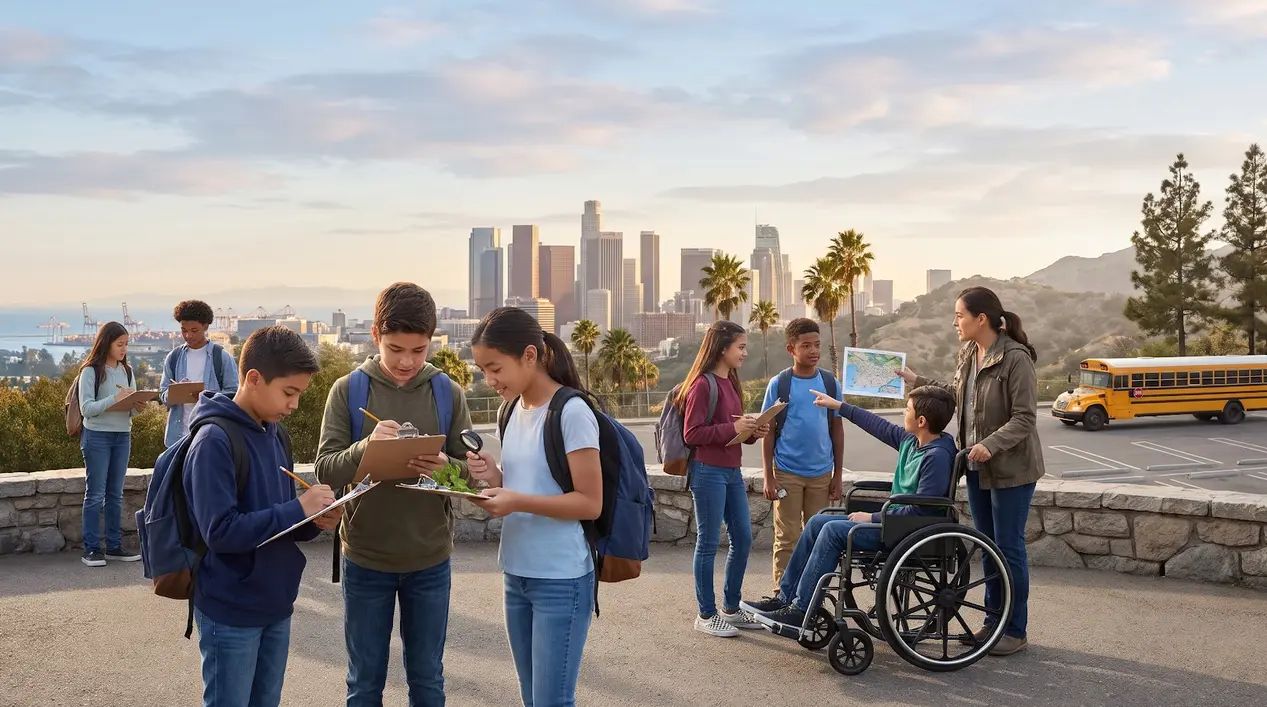
Want the quick version? Use the grid below to match learning goals and formats in seconds. Each option gives students a hands-on role tied to the curriculum, not just a walk past displays.
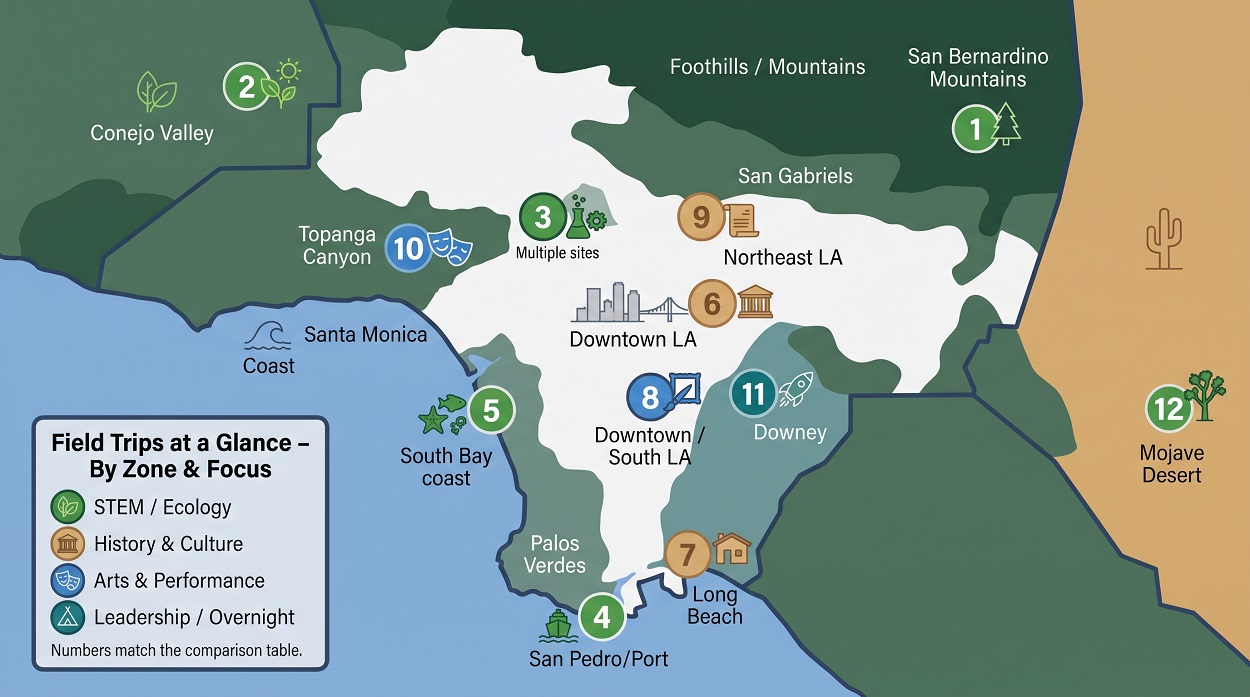
| # | Program | Zone | Format | Core subjects | What students do |
| 1 | Pali Institute | San Bernardino Mountains & Acton high desert | Day trip or multi-day residential | Science/STEM, leadership, outdoor education, arts | Forest-ecology hikes, team building, high-ropes challenges |
| 2 | Santa Monica Mountains NRA (Satwiwa) | Santa Monica Mountains | Ranger-led program | Ecology, Chumash history | Habitat observation, cultural history |
| 3 | LAUSD Outdoor & Environmental Education | Multiple sites | Day, mobile, overnight | Earth systems, life science | Field studies, mobile labs |
| 4 | AltaSea at the Port of Los Angeles | San Pedro | Half-day | Marine STEM, ocean careers | Water testing, ocean-tech demos |
| 5 | Marine-science cruise or beach study | South Bay coast | Half-day | Biology, data collection | Wildlife tallies, tide transects |
| 6 | Los Angeles Conservancy walks | Downtown & neighborhoods | Guided city walk | Architecture, social science | Sketch façades, read the city as a source |
| 7 | Rancho Los Alamitos | Long Beach | Guided visit | Tongva history, California history | Plant use, primary sources |
| 8 | The Broad | Downtown LA | Museum program | Visual arts, identity | Visual analysis, reflective writing |
| 9 | Heritage Square Museum | Northeast LA | Guided visit | Living history | Victorian-era daily life, data from the past |
| 10 | Will Geer Theatricum Botanicum | Topanga Canyon | Outdoor theatre | ELA, performance | Watch live Shakespeare, talk with actors |
| 11 | Columbia Memorial Space Center | Downey | Lab visit | Space science, engineering design | Robotics, simulated space missions |
| 12 | Joshua Tree National Park* | Mojave & Colorado deserts | Day or overnight | Geology, ecology | Map rock formations, night-sky observation |
Joshua Tree stretches “near,” but the long drive pays off for overnight STEM immersion.
1. Pali Institute — Curriculum-Built Outdoor Education
Swap fluorescent lights for mountain air. Pali Institute is an accredited residential outdoor-education provider in Southern California with two campuses: Pali Mountain in the San Bernardino National Forest near Lake Arrowhead, and Pali Acton in the high desert near Acton in north LA County. Trips are built around the school’s curriculum rather than a preset tour.
The program draws on four class categories and 30-plus modules across science, leadership, outdoor education, and art, with NGSS-aligned science taught hands-on: forest ecology, geology, survival skills, and high-ropes team challenges. High-school groups can also book the Advanced Leadership specialty program.
The format flexes with your calendar. Multi-day overnight trips are the flagship, and single-day trips run at both campuses. Younger students start with group games and team building, then hike to learn forest ecology and wilderness skills; older grades can pick an arts day, a build-your-own outdoor day with three classes of the teacher’s choosing, or a leadership day that ends on the high ropes course. Need details on the shorter option? You can learn more about the day-trip options.
Students collaborate, solve problems together, and bring back what they learned, evidence your principal can file, not just memories that fade. Ask the coordinator about access needs and alternatives for any student who cannot do the ropes course.
2. Santa Monica Mountains National Recreation Area – Learning at Satwiwa
Fourth-grade California history often gets one textbook page on Indigenous cultures. A ranger-led National Park Service program in the Santa Monica Mountains can turn that sliver into a learning arc.
- Prepare in class. Introduce Chumash culture, local ecology, and a guiding question before the visit.
- Field day at Satwiwa. Among coastal sage scrub, students observe how water, wildlife, and people shape the landscape.
- Post-visit synthesis. Back on campus, students turn observations into claims-and-evidence writing.
Check the park’s education pages for current grades, dates, and any transportation support, and ask rangers about trail surfaces and restrooms when you plan for mobility needs.
The payoff: students link California history, biodiversity, and stewardship in one scaffolded storyline, far richer than a single “nature walk.”
3. LAUSD Outdoor & Environmental Education – Day, Mobile, and Overnight Options
Teach in LA Unified? The district runs its own outdoor-learning network, so the paperwork stays inside the district systems you already use.
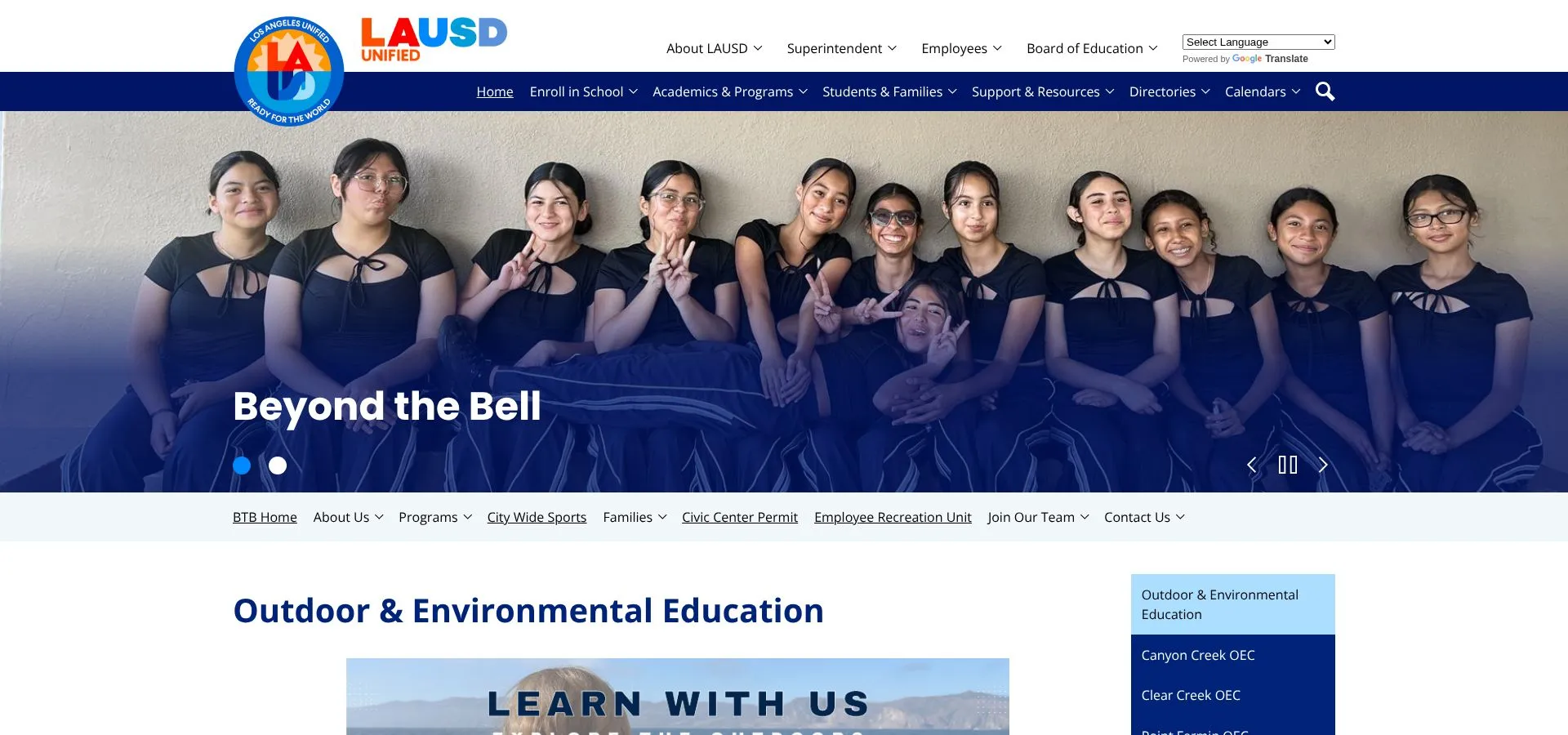
LAUSD Outdoor and Environmental Education official program page screenshot
Picture a three-rung ladder:
- Mobile visit. Science comes to campus and sparks curiosity with mini-labs.
- Single-day field study. Classes travel to coastal or mountain sites for data-rich investigations.
- Overnight stay. Students collect data after dark, share cabin chores, and close the unit with reflection journals.
Spring demand rises after testing, so reserve early, especially if you need adaptive equipment or special-diet meals. Bottom line: you get the depth of an outdoor science program without stepping outside district policy.
4. AltaSea at the Port of Los Angeles – Ocean STEM and Blue-Economy Careers
At AltaSea’s campus on the San Pedro waterfront, the port becomes a working classroom. Students test water quality, see ocean technology up close, and connect each activity to a career, from marine robotics to sustainable aquaculture, so curiosity shifts to possibility.
Popular weeks go first, so reserve early and confirm group size, any visitor list the port site requires, and who pays for the bus. Ask about ramps, seating, and noise if students have mobility or sensory needs. Current trip details and the educator form live on AltaSea’s site.
5. Guided Marine-Science Cruise or Teacher-Led Beach Investigation
Labs are not the only place to meet marine life. A narrated whale-watch or harbor-ecology cruise brings students face to face with marine mammals and plankton. Naturalists handle the narration while you cue clipboards, data tables, and species counts, raw numbers students can graph back on campus.
When budgets tighten, pivot to a self-designed beach study. Check Los Angeles County’s rules for school groups on the beach and file any permit well ahead. Pick a low-tide window, pack quadrats and pH strips, and rotate teams through transects from splash zone to dune.
Accessibility: ask the boat operator about ramp boarding and seating, and ask the county about beach wheelchairs well before the trip.
Either way, the science stays hands-on and the math stays real. Students calculate population density and tidal range while salt spray shows that data lives outside spreadsheets.
6. Los Angeles Conservancy – Architecture, Neighborhoods, and Public Transit
Choose your canvas: downtown Art Deco towers, historic neighborhoods, or the bustle of Union Station. On a guided walk, students do the noticing: tallying architectural styles, mapping how neighborhoods changed, and debating what shaped what they see.
Large grades may need to split into rotating groups, so ask about group size and lead time when you book. Riding Metro there can double as a transit-literacy lesson.
Ask for the route ahead of time if mobility needs apply. By the end, students see Los Angeles not as backdrop but as a primary source ready to be read.
7. Rancho Los Alamitos – Tongva History and Layered California History
California’s story predates missions and gold. This Long Beach historic site sits on land the Tongva call Tovaangar, and its school programs explore plant use, storytelling, and daily life.
- Indigenous history. Hands-on stations explore ethnobotany, tools, and oral tradition.
- Layers of history. A walk traces the site from Indigenous stewardship through ranching and into the modern era, showing how each era reshaped the same ground.
Budget for the bus and ask about any transportation support. Paths can be uneven, so mention mobility needs when you book.
8. The Broad – Art, Place, Identity
Modern art museums can feel like vaults. A school program at The Broad in downtown Los Angeles opens the doors, with works by artists such as Yayoi Kusama and Jean-Michel Basquiat as starting points for conversations about identity and community.
Pair the visit with pre-visit visual-analysis practice and a post-visit writing prompt, such as a personal “block story.” Then, if time allows, walk to nearby public art so students compare what they saw in the gallery with art on the street. Programs follow the exhibition calendar, so reserve early and ask about access services.
Students leave knowing art is not confined to white walls; it mirrors lived experience and invites them into the conversation.
9. Heritage Square Museum – Hands-On Victorian Los Angeles
Step through the gate and restored Victorian-era buildings become time machines. Guides invite students to explore how people lived, worked, and were sold “modern” life in early Los Angeles.
Teachers can choose a lens in advance. Math classes can estimate roof pitch, ELA students can journal like new arrivals, and art groups can sketch architectural details to study form and repetition. Students leave with notes for a follow-up essay or model.
Check current days, group sizes, and any fee support before booking buses, and flag mobility needs early because not every path is paved.
10. Will Geer Theatricum Botanicum – Shakespeare Under the Sycamores
Trade fluorescent stage lights for canyon sun and suddenly iambic pentameter feels fresh. This Topanga Canyon amphitheater lets students hear Shakespeare outdoors, the way it was meant to be heard.
A strong visit has three parts:
- Preparation. Unpack the plot twists and Elizabethan language in class.
- Outdoor performance. Students watch the play live.
- Talk-back. Where offered, students quiz the cast on character choices and why love triangles endure.
Book early, confirm bus drop-off, and remind families that canyon mornings stay cool. Ask about wheelchair seating and assisted listening when you reserve.
Shakespeare, heard under open sky, proves language was written to be spoken, not silently parsed.
11. Columbia Memorial Space Center – Hands-On Missions in Downey
Rocket science loses the scare quotes here. Downey’s space center stands on the site where North American Aviation built Apollo spacecraft, and students do more than circle displays.
- Exhibits and labs. Students explore interactive exhibits and try hands-on engineering and robotics activities.
- Challenger Learning Center. Older students become crew members on a simulated space mission, solving math and science problems in real time.
Every station returns to the engineering-design cycle, so sketches, prototypes, and do-overs feel essential, not abstract homework. Mission programs fill quickly, so book well ahead and ask about group size and access needs.
Students leave asking when they can build their own rockets instead of wondering whether they could.
12. Stretch Option – Joshua Tree National Park Overnight Field Study
East of Los Angeles, the Mojave and Colorado deserts meet in an outdoor lab that never looks the same twice. Ranger-led education programs weave geology, ecology, and human adaptation into a storyline students can touch. To build background before the trip, students can read our Joshua Tree National Park overview, which covers the park’s geology, plants, and wildlife.
Most teachers stay overnight: dusk unlocks night-sky astronomy and predawn temperature readings that show how fast desert climates swing.
Logistics are firm. Bring all the drinking water you need, reserve group campsites early, check the park’s permit rules for groups, and plan for weak cell service. Ask about accessible campsites and trails when you book.
Students who once called deserts “empty” return sketching rock-formation timelines in science journals, evidence that outlasts any souvenir.
When a Familiar Museum Is Still the Right Field Trip
Choose a Program, Not Just Admission
Free admission days are helpful, but if students already know each hall by heart, book a facilitated program instead of another self-guided lap. A docent-led program at the Natural History Museum, a themed tour at the LA Zoo, or a guided visit to La Brea Tar Pits turns a familiar place into a fresh investigation. Students collect data, question experts, and create a product, evidence of growth, not just another souvenir map.
How to Decide Whether a Field Trip Is Truly Educational
Start With the Learning Objective
Write one sentence that completes this prompt: “After the trip, my students will be able to ….” Let that anchor steer every later choice, venue, activity, and assessment, so the outing never drifts into a “nice day out.”
Science and Engineering
Pick experiences that demand observation, data collection, and model building. A tide-pool transect or a campus air-quality walk outranks a silent gallery.
History and Culture
Choose places where primary evidence still lives: documents in an archive, Indigenous history told by the people whose history it is, or murals that trace migration. The site becomes a text students can cite back on campus.
Leadership and Social Learning
Ropes courses, ensemble theatre, or overnight cabins surface teamwork you cannot clone indoors. Draft reflection prompts before you go so students connect those gains to future projects instead of shelving the memory with postcards.
Los Angeles Field-Trip Logistics No Listicle Should Ignore
Build the Planning Calendar Backward
- 8–12 weeks out. Draft the curriculum rationale and request a tentative reservation. Administrators cannot approve what is not in the system. Start bus quotes and flag accessibility needs.
- 4–8 weeks out. Send permission slips, vet chaperones, and run a pre-trip lesson so students arrive curious. Lock transportation early.
- Final 2 weeks. Track weather and air-quality alerts, reconfirm head counts, secure medications, and print emergency contacts. Map restrooms and an indoor fallback in case of heat or a freeway closure.
Meet each checkpoint and the day should run as smoothly as your lesson plan.
Accessibility and Inclusion Checklist
Mobility Access
Map the entire route, from bus lift to lunch spot, before you book. Confirm curb cuts, elevators, path slopes, and restroom access. Ask for photos instead of vague “short walk” promises. When terrain stays rough (for example, beach sand), line up an equivalent learning station or borrow a venue wheelchair so no student swaps discovery for downtime.
Sensory Access
Scout sound and light levels. Ask about quieter times, quiet rooms, or sensory kits. Share a photo schedule with the class and pack earplugs for surprise sirens or amplifiers.
Learning, Language, and Communication
Request bilingual handouts or captioned videos. If none exist, ask for digital files a week early so you can layer translations. Give vocabulary lists to speech-language staff so AAC devices are pre-loaded with terms such as specimen or habitat.
Financial and Transportation Inclusion
List every cost: admission, program fee, chaperone tickets, parking, substitute coverage, meals, and mileage. Then hunt for support: ask each venue and your transit agency whether they offer school-group fares, bus funds, or travel grants. When support runs dry, pick a venue near rail, share a charter with another class, or use family carpools for the last mile, provided insurance rules allow it.
Equitable trips demand creative logistics, but the reward is a bus where every seat holds a curious learner.
Turn One Field Trip Into a Three-Part Learning Sequence
Before the Trip
Begin weeks ahead. Pose a teaser such as “How does coastline shape wildlife?” and ask students to predict or sketch. Introduce key vocabulary, show a short location video, and assign roles: data recorder, photographer, interviewer.
Rehearse observation tools. If you will use transect tapes or decibel meters, practice with schoolyard leaves or cafeteria sound so students focus on phenomena, not buttons.
Lay the access groundwork: share an agenda, review sensory supports, and preview tricky terrain with photos. When every learner knows the route, curiosity beats anxiety before the bus engine starts.
During the Trip
Step off the bus and slip into scientist, historian, or actor mode, whatever the goal requires. Give two minutes for orientation, then launch the first task: tally bird calls, sketch a cornice, or interview a ranger.
Pause for micro-reflections. Ask, “What pattern do you notice?” or “How does this artifact shift your hypothesis?” Quick checkpoints beat end-of-day brain dumps.
Rotate roles midway so everyone takes a photo, records data, and asks a question. Students head home carrying raw evidence, not just memories blurred by snack chatter.
After the Trip
While curiosity still crackles, turn field notes into claims backed by evidence. Chart temperature swings against insect counts, layer photos over map points, or script a two-minute podcast that answers the driving question.
Keep reflection tactile: build a hallway exhibit, write conservation letters, or code an interactive map. Public products push ideas past it was fun.
Close the loop with a teacher note: what surprised you, which logistics worked, and what blocked access? Write it down now; next year’s approval packet will almost draft itself.
Seasonal Planning for Coast, City, Foothills, Desert, and Mountains
Fall
September can still feel like summer, and fall brings wildfire risk to the hills. Check air quality and red-flag warnings; a closure can hit before dawn. Keep an urban or coastal backup and a same-day classroom plan in case buses cannot roll.
Migrating birds and marine life make fall and winter good seasons for wildlife counts. Funding cycles often reset with the school year, so file any bus-fund or grant applications early.
Winter
Rain turns foothill trails slick and can bring chain controls to mountain roads, yet city museums are often quieter. Book indoor labs, architecture walks, or harbor STEM visits.
Snow science? Build a backup day and check road conditions the morning of the trip. Add layered-clothing notes to permission slips and gather outdoor data before early sunsets.
Spring
Spring is field-trip rush hour. Museums open new exhibits, parks bloom, and support funds can run out. Reserve dates early, especially for overnight programs or ranger-led slots.
Wildflowers can be spectacular on foothill and desert edges after a wet winter, perfect for pollination counts. Pad drive time and avoid rush hour to keep energy high.
Late Spring and Summer
After finals, heat rises. Coastal fog can make tide-pool treks comfortable while inland valleys get hot early. Confirm shade and hike length before any June booking, carry plenty of water for every student, and brief adults on the signs of heat illness.
Frequently Asked Questions About Educational Field Trips Near Los Angeles
Are there free educational field trips near Los Angeles?
Some. Several museums and parks offer free admission or free programs for school groups. You will usually still need to fund a bus or transit tickets, so ask early about fare programs and bus support.
How far in advance should I book?
It varies by venue, and district approval can add weeks. Aim to start about eight weeks before a day trip and about twelve weeks before an overnight to stay ahead of paperwork.
Can homeschool groups join these programs?
Eligibility varies. Some providers accept any organized youth group; others serve schools only or require proof of insurance. Email the education office before collecting fees.
Can my class ride public transit to a field trip?
Often, yes. Check your transit agency’s rules for school groups, travel outside rush hour, and plan enough adults to keep the group together.
How do I refresh a museum my students have already visited?
Book a themed lab, docent-led tour, or sensory-friendly session instead of general admission. Frame a new essential question and assign students to collect data such as sketches, specimen counts, or interview quotes so the repeat visit delivers fresh evidence rather than déjà vu.
Are these field trips accessible?
Many venues provide ramps, elevators, and loaner wheelchairs, but trails, boat ramps, and gravel paths vary. Confirm the full route, not just the visitor center, and ask for photos when in doubt.
Wrapping It All Up
Start with the learning goal and let that single sentence steer everything else: student needs, trip format, transportation, and finally the date. Plan in that order and field trips shift from obligation to a living chapter in the curriculum.
Greater Los Angeles puts beaches, mountains, city streets, and desert skies within reach of a school bus. Match the right place to the right season, confirm access for every learner, and your next outing will send students home buzzing with evidence rather than déjà vu.