Toronto Weather by Month
Toronto experiences four distinct seasons, with cold and snowy winters, mild springs, warm summers, and cool autumns. The weather varies significantly throughout the year, especially in terms of temperature, snowfall, rainfall, and daylight hours.
Toronto Weather by Month
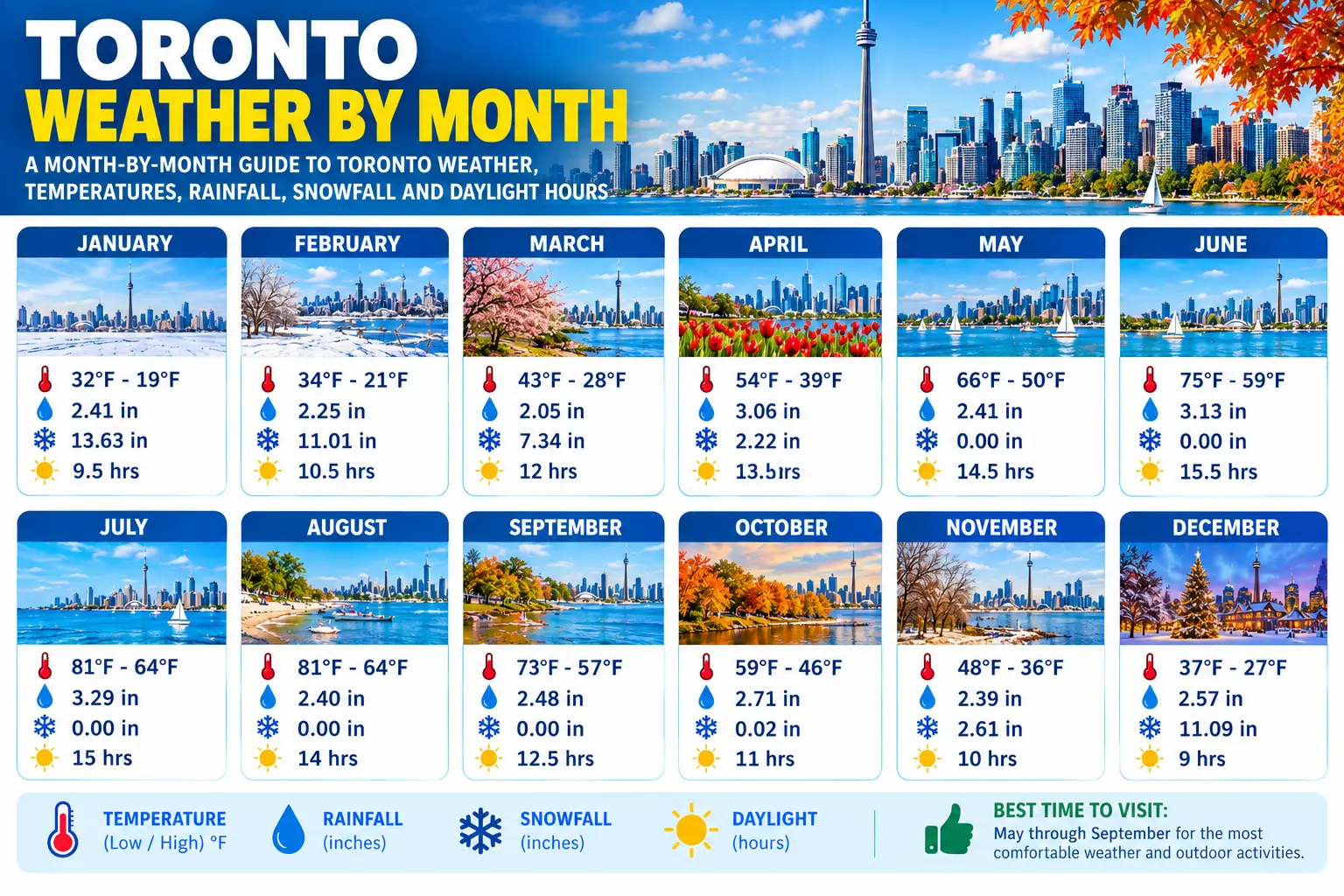
You can click the image below to view the full-size weather chart for Toronto.
January – Cold Winter and Heavy Snowfall
Average high: 32°F (0°C)
Average low: 19°F (-7°C)
Rainfall: 2.41 inches (61.1 mm)
Rainy days: 9
Snowfall: 13.63 inches (346.3 mm)
Snow days: 11
Daylight: 9.5 hours
January is one of the coldest and snowiest months in Toronto. Average daytime temperatures remain around 32°F (0°C), while nighttime temperatures can fall to approximately 19°F (-7°C).
Snowfall averages about 13.6 inches (346.3 mm), with around 11 snow days during the month. January also has only about 9.5 hours of daylight, creating short and cold winter days.
With its frequent snowfall and freezing temperatures, January offers a classic Canadian winter experience.
Best for:
- Snow-covered city scenery
- Winter photography
- Ice skating and snow activities
- Indoor attractions and cozy cafés
February – Cold and Snowy
Average high: 34°F (1°C)
Average low: 21°F (-6°C)
Rainfall: 2.25 inches (57.1 mm)
Rainy days: 8
Snowfall: 11.01 inches (279.6 mm)
Snow days: 8
Daylight: 10.5 hours
February remains cold and snowy in Toronto. Average highs reach about 34°F (1°C), while nighttime temperatures can drop to around 21°F (-6°C).
The city receives approximately 11.0 inches (279.6 mm) of snowfall over about eight snow days. Compared with January, daylight increases slightly to 10.5 hours, signaling the gradual approach of spring.
February is still a good month for experiencing Toronto’s winter atmosphere, although temperatures can remain quite cold.
Best for:
- Winter scenery
- Ice skating
- Snowy photography
- Museums and indoor attractions
March – The Beginning of Spring
Average high: 43°F (6°C)
Average low: 28°F (-2°C)
Rainfall: 2.05 inches (52.1 mm)
Rainy days: 7
Snowfall: 7.34 inches (186.5 mm)
Snow days: 5
Daylight: 12 hours
March brings the first noticeable signs of spring to Toronto. Average daytime temperatures rise to 43°F (6°C), while nighttime temperatures remain cold at around 28°F (-2°C).
Snowfall decreases to approximately 7.3 inches (186.5 mm), with about five snow days. At the same time, daylight increases to 12 hours, giving visitors more time to explore the city.
Weather can be unpredictable in March, with a mixture of cold, snow, rain, and milder days.
Best for:
- Early spring sightseeing
- Exploring Toronto’s neighborhoods
- City photography
- Fewer tourist crowds
April – Mild Temperatures and Spring Rain
Average high: 54°F (12°C)
Average low: 39°F (4°C)
Rainfall: 3.06 inches (77.8 mm)
Rainy days: 9
Snowfall: 2.22 inches (56.3 mm)
Snow days: 2
Daylight: 13.5 hours
April brings noticeably milder weather to Toronto. Average highs reach 54°F (12°C), while nighttime temperatures rise to around 39°F (4°C).
Rainfall increases to about 3.1 inches (77.8 mm), making April one of the wetter months of the year. Snow becomes much less common, averaging only about 2.2 inches (56.3 mm) over two snow days.
With 13.5 hours of daylight, April provides plenty of time for sightseeing and enjoying Toronto’s parks and outdoor spaces.
Best for:
- Spring sightseeing
- Parks and gardens
- Walking tours
- Exploring the city outdoors
May – Comfortable Spring Weather
Average high: 66°F (19°C)
Average low: 50°F (10°C)
Rainfall: 2.41 inches (61.2 mm)
Rainy days: 8
Snowfall: 0 inches
Daylight: 14.5 hours
May is one of the most comfortable months to visit Toronto. Average daytime temperatures reach 66°F (19°C), while nighttime temperatures remain mild at around 50°F (10°C).
Snowfall disappears completely, while rainfall averages about 2.4 inches (61.2 mm). With around 14.5 hours of daylight, May offers excellent conditions for outdoor activities and sightseeing.
The combination of mild temperatures, longer days, and no snow makes May a pleasant time to explore Toronto.
Best for:
- Outdoor sightseeing
- Parks and gardens
- Walking and cycling
- City photography
June – Warm Weather and Long Days
Average high: 75°F (24°C)
Average low: 59°F (15°C)
Rainfall: 3.13 inches (79.4 mm)
Rainy days: 8
Snowfall: 0 inches
Daylight: 15.5 hours
June marks the beginning of Toronto’s warm summer season. Average highs reach 75°F (24°C), while nighttime temperatures stay around 59°F (15°C).
Rainfall averages about 3.1 inches (79.4 mm), but there is no snowfall. June has the longest daylight period in the data, with approximately 15.5 hours of daylight.
The warm temperatures and long days make June an excellent month for outdoor activities, sightseeing, and exploring the waterfront.
Best for:
- Outdoor activities
- Lakefront walks
- Festivals and events
- Long sightseeing days
July – Warmest Month of the Year
Average high: 81°F (27°C)
Average low: 64°F (18°C)
Rainfall: 3.29 inches (83.7 mm)
Rainy days: 7
Snowfall: 0 inches
Daylight: 15 hours
July is one of the warmest months in Toronto, with average highs of 81°F (27°C) and average lows of 64°F (18°C).
Rainfall averages approximately 3.3 inches (83.7 mm), the highest monthly rainfall total shown in the data. However, there is no snowfall during this month.
With around 15 hours of daylight, July provides plenty of time to enjoy Toronto’s outdoor attractions, waterfront areas, parks, and summer events.
Best for:
- Summer vacations
- Beaches and waterfront activities
- Outdoor dining
- Festivals and sightseeing
August – Warm Summer Weather
Average high: 81°F (27°C)
Average low: 64°F (18°C)
Rainfall: 2.40 inches (60.9 mm)
Rainy days: 6
Snowfall: 0 inches
Daylight: 14 hours
August has almost the same temperatures as July, with average highs of 81°F (27°C) and lows of 64°F (18°C).
Rainfall decreases to around 2.4 inches (60.9 mm), while there is no snowfall. The month also has about 14 hours of daylight, providing plenty of time for outdoor activities.
August is a great time to enjoy Toronto’s summer atmosphere before temperatures begin to cool in September.
Best for:
- Summer sightseeing
- Waterfront activities
- Outdoor restaurants
- Parks and attractions
September – Mild Early Fall Weather
Average high: 73°F (23°C)
Average low: 57°F (14°C)
Rainfall: 2.48 inches (62.9 mm)
Rainy days: 6
Snowfall: 0 inches
Daylight: 12.5 hours
September brings a gradual transition from summer to fall. Average daytime temperatures fall to 73°F (23°C), while nighttime temperatures average around 57°F (14°C).
Rainfall is relatively moderate at about 2.5 inches (62.9 mm), and there is no significant snowfall. Daylight decreases to around 12.5 hours, but the days are still long enough for sightseeing and outdoor activities.
September is often a comfortable time to explore Toronto because temperatures are milder than during the peak of summer.
Best for:
- Comfortable city sightseeing
- Walking tours
- Parks and outdoor attractions
- Early fall scenery
October – Cool Fall Weather
Average high: 59°F (15°C)
Average low: 46°F (8°C)
Rainfall: 2.71 inches (68.9 mm)
Rainy days: 9
Snowfall: 0.02 inches (0.4 mm)
Daylight: 11 hours
October brings cooler autumn weather to Toronto. Average highs are around 59°F (15°C), while nighttime temperatures fall to approximately 46°F (8°C).
Rainfall averages about 2.7 inches (68.9 mm), and snowfall remains extremely rare, at only about 0.4 mm. Daylight decreases to approximately 11 hours as the city moves deeper into autumn.
October can be an attractive month for visitors who enjoy cooler temperatures and fall scenery.
Best for:
- Fall foliage
- Photography
- Walking tours
- Cool-weather sightseeing
November – Cool and Increasingly Winter-Like
Average high: 48°F (9°C)
Average low: 36°F (2°C)
Rainfall: 2.39 inches (60.6 mm)
Rainy days: 8
Snowfall: 2.61 inches (66.2 mm)
Snow days: 2
Daylight: 10 hours
November is considerably cooler, with average highs of 48°F (9°C) and lows of around 36°F (2°C).
Snow begins to return during the month, averaging about 2.6 inches (66.2 mm) over two snow days. Rainfall remains moderate at around 2.4 inches (60.6 mm), while daylight decreases to approximately 10 hours.
The weather becomes increasingly winter-like toward the end of the month, so visitors should be prepared for cold and changeable conditions.
Best for:
- Late-fall scenery
- Museums and indoor attractions
- Cozy cafés
- Early winter experiences
December – Cold Winter and Heavy Snowfall
Average high: 37°F (3°C)
Average low: 27°F (-3°C)
Rainfall: 2.57 inches (65.2 mm)
Rainy days: 9
Snowfall: 11.09 inches (281.7 mm)
Snow days: 7
Daylight: 9 hours
December brings Toronto back into full winter conditions. Average highs are around 37°F (3°C), while nighttime temperatures fall to approximately 27°F (-3°C).
Snowfall increases sharply to about 11.1 inches (281.7 mm), with around seven snow days. December also has the shortest daylight period in the data, at approximately 9 hours.
The combination of cold temperatures, snowfall, and the holiday season gives Toronto a distinctive winter atmosphere.
Best for:
- Winter and holiday atmosphere
- Snowy city photography
- Indoor attractions
- Seasonal activities
Toronto Weather Overview
| Month | Avg High °F (°C) | Avg Low °F (°C) | Rainfall (inches) | Snowfall (inches) | Daylight |
|---|---|---|---|---|---|
| January | 32°F (0°C) | 19°F (-7°C) | 2.41 | 13.63 | 9.5 hrs |
| February | 34°F (1°C) | 21°F (-6°C) | 2.25 | 11.01 | 10.5 hrs |
| March | 43°F (6°C) | 28°F (-2°C) | 2.05 | 7.34 | 12 hrs |
| April | 54°F (12°C) | 39°F (4°C) | 3.06 | 2.22 | 13.5 hrs |
| May | 66°F (19°C) | 50°F (10°C) | 2.41 | 0.00 | 14.5 hrs |
| June | 75°F (24°C) | 59°F (15°C) | 3.13 | 0.00 | 15.5 hrs |
| July | 81°F (27°C) | 64°F (18°C) | 3.30 | 0.00 | 15 hrs |
| August | 81°F (27°C) | 64°F (18°C) | 2.40 | 0.00 | 14 hrs |
| September | 73°F (23°C) | 57°F (14°C) | 2.48 | 0.00 | 12.5 hrs |
| October | 59°F (15°C) | 46°F (8°C) | 2.71 | 0.02 | 11 hrs |
| November | 48°F (9°C) | 36°F (2°C) | 2.39 | 2.61 | 10 hrs |
| December | 37°F (3°C) | 27°F (-3°C) | 2.57 | 11.09 | 9 hrs |
Toronto’s weather changes significantly throughout the year. January and February are the coldest and snowiest months, while March and April bring a gradual transition into spring. May and June become increasingly warm and comfortable, followed by the warmest period in July and August.
September and October bring cooler fall temperatures, while November and December mark the return of colder weather and snowfall. July and August have the highest average temperatures, reaching 81°F (27°C), while January has the lowest average nighttime temperature at 19°F (-7°C).
For travelers, May through September generally offers the most comfortable conditions for outdoor sightseeing. If you want to experience Toronto’s snowy Canadian winter, January, February, and December are the most suitable months.
Absolutely. Here are 20 FAQ questions and answers suitable for a “Toronto Weather by Month” article:
Toronto Weather FAQs
1. What is the weather like in Toronto throughout the year?
Toronto has four distinct seasons. Winters are cold and snowy, spring is mild and increasingly rainy, summers are warm, and fall brings cooler temperatures and changing foliage.
2. What is the coldest month in Toronto?
January is typically the coldest month. Average temperatures are around 32°F (0°C) during the day and 19°F (-7°C) at night.
3. What is the warmest month in Toronto?
July and August are the warmest months, with average highs of around 81°F (27°C) and average lows of about 64°F (18°C).
4. Does it snow in Toronto?
Yes. Toronto receives significant snowfall during winter. January has the highest average snowfall in the provided data, at about 13.63 inches.
5. What month gets the most snow in Toronto?
January receives the most snowfall, averaging approximately 13.63 inches (346.3 mm), followed by December and February.
6. When does it start snowing in Toronto?
Snow can begin appearing in November, when the average snowfall is about 2.61 inches. Snowfall increases considerably in December and January.
7. Does Toronto get snow in December?
Yes. December is one of Toronto’s snowiest months, with an average of approximately 11.09 inches of snowfall.
8. What is Toronto like in January?
January is cold and snowy, with average highs of 32°F (0°C) and lows of 19°F (-7°C). It also has relatively short daylight hours, making it a typical Canadian winter month.
9. What is Toronto like in February?
February remains cold and snowy, with average highs of 34°F (1°C) and lows of 21°F (-6°C). Snowfall averages around 11.01 inches.
10. Is March a good time to visit Toronto?
March can be a good time to visit if you don’t mind changeable weather. Temperatures begin to rise, but snow is still possible, and average temperatures remain relatively cool.
11. What is Toronto weather like in April?
April is mild but can be rainy. Average highs reach 54°F (12°C), while lows are around 39°F (4°C). Snowfall becomes much less common.
12. Is May a good month to visit Toronto?
Yes. May offers comfortable spring temperatures, with an average high of 66°F (19°C) and low of 50°F (10°C). Snowfall is essentially absent, and daylight lasts about 14.5 hours.
13. How hot does Toronto get in summer?
Toronto can get quite warm during summer. Average highs reach around 75°F (24°C) in June and 81°F (27°C) in July and August.
14. What is Toronto weather like in July?
July is one of the warmest months of the year. Average highs are around 81°F (27°C), while lows are approximately 64°F (18°C). It also has about 15 hours of daylight.
15. Does Toronto get a lot of rain in summer?
Toronto receives rainfall throughout the summer. Based on the provided data, July has about 3.30 inches of rainfall, while June receives approximately 3.13 inches.
16. What is Toronto weather like in September?
September is generally mild, with average highs of 73°F (23°C) and lows of 57°F (14°C). It is cooler than the summer months but still comfortable for outdoor activities.
17. What is Toronto like in October?
October brings cool fall weather. Average highs are around 59°F (15°C), while lows are approximately 46°F (8°C). It is also a popular time for enjoying autumn scenery.
18. Is November cold in Toronto?
Yes. November is noticeably colder than October, with average highs of 48°F (9°C) and lows of 36°F (2°C). Snowfall also begins to increase toward winter.
19. Which month has the most daylight in Toronto?
June has the longest daylight period in the provided data, at approximately 15.5 hours per day.
20. What is the best month to visit Toronto for good weather?
May through September generally offers the most comfortable weather for outdoor sightseeing. May and September are particularly appealing if you prefer milder temperatures, while July and August are best for warm summer weather.
Read more: