Chimpanzee and Gorilla Trekking in Rwanda and Uganda: The Ultimate Self-Drive Safari Guide
East Africa’s rainforests hold secrets that no other place on earth can offer — the raw, humbling experience of sitting face-to-face with a mountain gorilla or watching wild chimpanzees swing through the forest canopy just metres above your head. For adventurous travellers, combining self-drive and gorilla trekking in Uganda and Rwanda with a self-drive chimpanzee trekking safari is not only possible — it is one of the most rewarding road trips on the continent.
This guide walks you through everything you need to know about planning a self-drive great apes safari in East Africa, from permit costs and road conditions to the best parks, seasons, and practical tips for doing it all independently behind the wheel.
Why Choose a Self-Drive Great Apes Safari in Uganda and Rwanda?
Organised group tours dominate the gorilla and chimp trekking market, but self-drive travellers gain something money rarely buys: freedom. You set your own pace, linger at a viewpoint, explore a roadside market, and tailor each day to your energy and interests. A budget self-drive trip and gorilla trekking in Uganda can cost significantly less than a guided package, and the sense of personal achievement when you navigate forest roads and arrive at a ranger station under your own steam is unmatched.
Both Uganda and Rwanda have invested heavily in their road infrastructure over the last decade, making self-drive safari itineraries for gorilla and chimp tracking increasingly accessible to independent travellers with moderate off-road driving experience.
Mountain Gorilla Trekking in Bwindi Impenetrable Forest, Uganda
The Park and the Primates
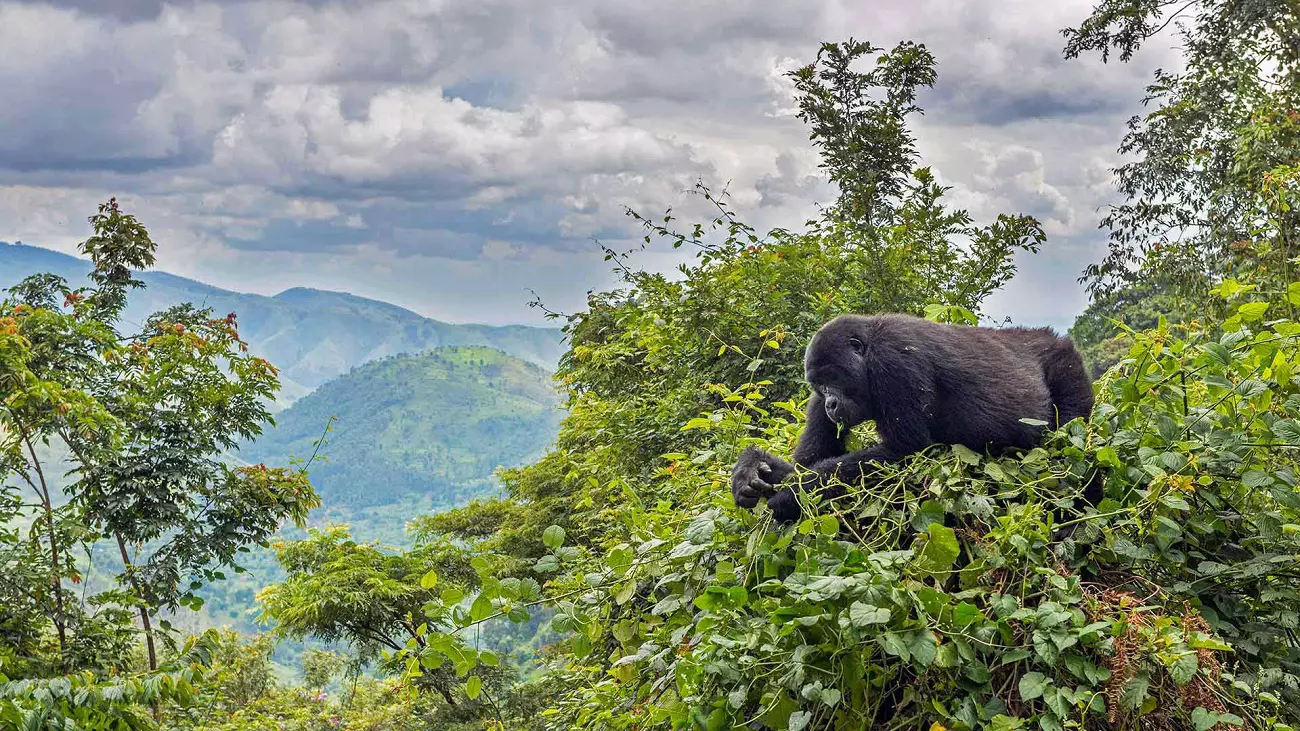
Bwindi Impenetrable National Park in southwestern Uganda is the undisputed capital of mountain gorilla trekking in East Africa. This UNESCO World Heritage Site is home to roughly half of the world’s remaining mountain gorillas — approximately 500 individuals spread across multiple habituated family groups. The park is divided into four sectors: Buhoma, Ruhija, Nkuringo, and Rushaga, each offering a slightly different experience.
For self-drive visitors to Bwindi Impenetrable Forest, the most accessible starting point is Buhoma in the north. The drive from Kampala takes approximately eight to nine hours via Mbarara, though the final stretch into the park on unpaved roads requires a 4WD vehicle. Renting a sturdy 4×4 — a Toyota Land Cruiser or a Rav4 — from Kampala is strongly advised for any gorilla tracking road trip in Uganda.
Gorilla Permits and Booking
Uganda gorilla permits cost USD 800 per person per trek as of 2025, booked through the Uganda Wildlife Authority (UWA). Each trekking group is limited to eight people per gorilla family per day, and treks last between one and eight hours depending on where the gorillas have roamed. Permits should be booked at least three to six months in advance, particularly for the peak seasons of June–September and December–February.
How to get gorilla trekking permits for self-drive tourists in Uganda: You can book directly through the UWA website or through a registered tour operator. Self-drive travellers do not need to go through an operator — direct booking is straightforward and saves on agent commissions.
What to Expect on Trek Day
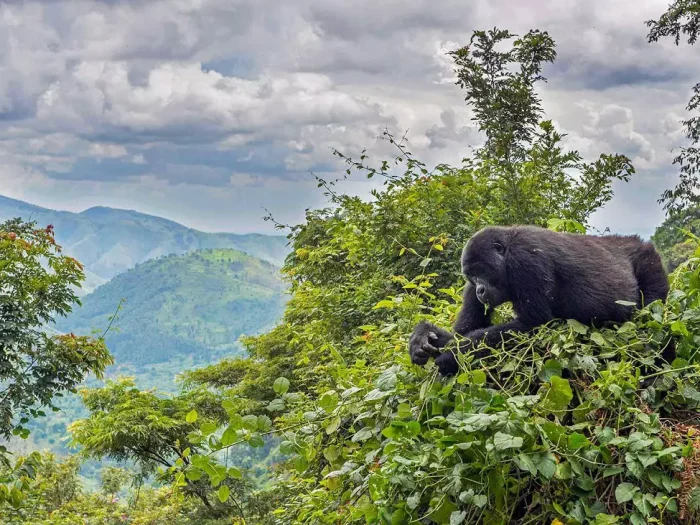
You will meet your ranger guide at the park headquarters early in the morning, typically by 7:30 AM. After a briefing, groups are sorted by fitness level and assigned a gorilla family. The trek through dense jungle — scrambling over roots, ducking under vines, climbing slippery slopes — is part of the adventure. When you finally break through the undergrowth and find a silverback watching you with calm, intelligent eyes, every muddy step is instantly forgotten.
You are allowed one hour with the gorillas. It passes in what feels like minutes.
Gorilla Trekking in Volcanoes National Park, Rwanda
A Different Landscape, the Same Magic
Rwanda’s Volcanoes National Park gorilla trekking experience is often described as more polished than Uganda’s, with shorter average trek times and more infrastructure around Kinigi, the gateway town. The park protects the Virunga Massif — a chain of volcanic mountains shared with the Democratic Republic of Congo — and is home to famous habituated gorilla families including the Susa group, one of the largest in the world.
For Rwanda’s Volcanoes National Park, you will fly into Kigali and drive approximately two and a half to three hours northwest via the RN2 highway — one of Rwanda’s best-maintained roads. A 4WD is recommended once you leave the tarmac near Kinigi, though conditions are generally far less challenging than in Uganda’s remote forest zones.
Permit Costs and Logistics
Rwanda gorilla permits are priced at USD 1,500 per person per trek, making them the most expensive gorilla permits in the world. However, Rwanda markets itself as a premium, low-volume destination, and the country has channelled a significant portion of tourism revenue into local conservation and community development. The Rwanda gorilla trekking permit booking process for self-drive tourists runs through the Rwanda Development Board (RDB), and online booking is available.
The Dian Fossey Experience
Volcanoes National Park is also where the celebrated primatologist Dian Fossey lived and worked for nearly two decades. A trek to the Dian Fossey Research Centre and gorilla grave site on Mount Visoke is a powerful add-on for any cultural and wildlife safari in Rwanda. The hike takes around four to five hours round trip and offers breathtaking views across the Virunga chain.
Chimpanzee Trekking on a Self-Drive Safari in Uganda
Kibale Forest: The Primate Capital of the World
If gorillas are the undisputed highlight of the highlands, then Kibale National Park chimpanzee trekking is the jewel of Uganda’s midlands. Located near Fort Portal in western Uganda, Kibale is home to over 1,500 chimpanzees — the highest density of these primates anywhere on earth — along with 12 other primate species including red colobus monkeys, L’Hoest’s monkeys, and the grey-cheeked mangabey.
Chimpanzee trekking in Kibale Forest National Park is one of the most rewarding and underrated safari experiences in East Africa. The drive from Kampala takes around five to six hours on largely tarmac roads, with only the final approach to Kanyanchu Visitor Centre requiring careful navigation on a murram road.
Chimp trekking permits in Kibale cost USD 250 per person for morning treks and USD 200 for afternoon sessions, booked through the Uganda Wildlife Authority. Groups of up to six people trek per chimpanzee community, and the experience lasts approximately two to three hours. The chimps here are highly habituated and often completely indifferent to human observers, going about their business of feeding, grooming, and socialising with casual ease.
Chimp Habituation Experience in Kibale
For the truly committed primate enthusiast, the Chimpanzee Habituation Experience (CHEX) in Kibale offers a full-day immersion with a semi-habituated community. You join the chimps from dawn to dusk, observing behaviours — including nest-building, hunting, and territorial displays — that standard trekkers never witness. The CHEX permit costs USD 250 per person and must be arranged directly with UWA or a registered agent.
Budongo Forest and Kyambura Gorge: Hidden Chimp Trekking Gems
Beyond Kibale, Uganda rewards the adventurous chimp trekking tourist with two outstanding alternatives.
Budongo Forest Reserve, near Murchison Falls National Park, offers affordable chimp tracking (around USD 80 per person) in a less-visited setting. The mahogany and ironwood forest here is ancient and atmospheric, and the chimps are well habituated. This is an excellent addition to a combined chimp and big game safari in northern Uganda, where Murchison Falls offers elephants, lions, hippos, and the spectacular Nile waterfall.
Kyambura Gorge in Queen Elizabeth National Park is another gem — a forested canyon cutting through the savannah, home to a small but habituate chimp community. Combining chimp trekking in Kyambura Gorge with a game drive in Queen Elizabeth National Park makes for a spectacular single-day itinerary on any self-drive western Uganda circuit.
Planning Your Self-Drive Great Apes Itinerary: Rwanda and Uganda Combined
A combined self-drive Rwanda and Uganda gorilla and chimpanzee trekking itinerary typically runs between 12 and 16 days, depending on how many parks you wish to include. A popular route for independent travellers:
Days 1–2: Arrive Entebbe/Kampala. Pick up 4WD rental. City orientation.
Days 3–4: Drive to Kibale Forest. Chimp trekking. Optional CHEX experience.
Days 5–6: Drive south to Queen Elizabeth National Park. Game drives and Kyambura Gorge chimp trek.
Days 7–9: Drive to Bwindi Impenetrable Forest (Buhoma or Rushaga sector). Gorilla trekking.
Days 10–11: Cross into Rwanda at Katuna/Gatuna border. Drive to Kinigi via Ruhengeri. Gorilla trekking in Volcanoes National Park.
Days 12–13: Drive to Kigali. Visit Genocide Memorial. Optional Nyungwe Forest chimp trekking.
Day 14: Fly out from Kigali.
This loop combines gorilla trekking from Bwindi to Volcanoes National Park and covers both countries efficiently without backtracking.
Essential Tips for Self-Drive Chimp and Gorilla Trekking in East Africa
Vehicle: A 4WD with high clearance is non-negotiable for Uganda. Rwanda’s roads are better, but a 4WD remains strongly advisable for the Volcanoes area in rainy season. Rent from reputable companies in Kampala or Kigali with comprehensive insurance.
Best time to visit: The best season for gorilla trekking in Uganda and Rwanda is during the dry months of June–September and December–February. Trails are drier and less slippery, though these periods are also peak booking times for permits.
Packing essentials: Waterproof hiking boots, rain gear, long-sleeved shirts (to protect from safari ants and nettles), gardening gloves, a light backpack, and insect repellent. Altitude in Bwindi and the Virungas can reach over 2,500 metres, so a warm layer is wise.
Health and safety: Yellow fever vaccination is required to enter Uganda and Rwanda. Malaria prophylaxis is recommended. Gorilla trekkers must be 15 years or older, and anyone with a cold, flu, or stomach illness should not trek — great apes are highly susceptible to human respiratory diseases.
Photography: No flash photography is permitted in the presence of gorillas or chimps. A camera with a fast lens (f/2.8 or wider) performs best in the low light of dense forest. A zoom range of 70–200mm is ideal for primate portraits.
Cross-border logistics: Ensure your rental vehicle is permitted for cross-border travel (most reputable companies allow Rwanda–Uganda crossings). Carry your passport, vehicle logbook, and insurance documents. The Katuna/Gatuna crossing is efficient and straightforward for most travellers.
Why This Safari Will Stay with You Forever
There are wildlife encounters, and then there are experiences that fundamentally alter your perspective on what it means to be human. Looking into the eyes of a mountain gorilla — an animal sharing 98.3% of your DNA — as it calmly peels a wild celery stalk just metres away, is one of those moments. Listening to chimpanzees’ haunting pant-hoot calls echo through Kibale’s ancient trees as a troop crash through the canopy overhead is another.
A gorilla and chimpanzee trekking safari in Uganda and Rwanda is not merely a holiday. It is an act of conservation, a philosophical reckoning, and one of the most extraordinary road trips a human being can take. Plan it carefully, drive it confidently, and let the forest do the rest.