Japan Weather by Month: A Complete Guide
Japan is a country of remarkable climate diversity. Stretching more than 1,800 miles (3,000 km) from north to south, it spans several climate zones, from the snowy landscapes of Hokkaido to the subtropical beaches of Okinawa.
Because of this geographic range, weather conditions can vary dramatically depending on where and when you visit. While Tokyo may experience mild spring temperatures, Hokkaido could still be covered in snow, and Okinawa may already feel like summer.
This guide explains Japan weather by month and highlights the differences between the country’s major regions:
- Northern Japan – Hokkaido
- Eastern and Central Japan – Tokyo, Kyoto, and Osaka
- The Sea of Japan Coast
- Southern Japan – Kyushu
- Southernmost Japan – Okinawa
Japan Weather by Month
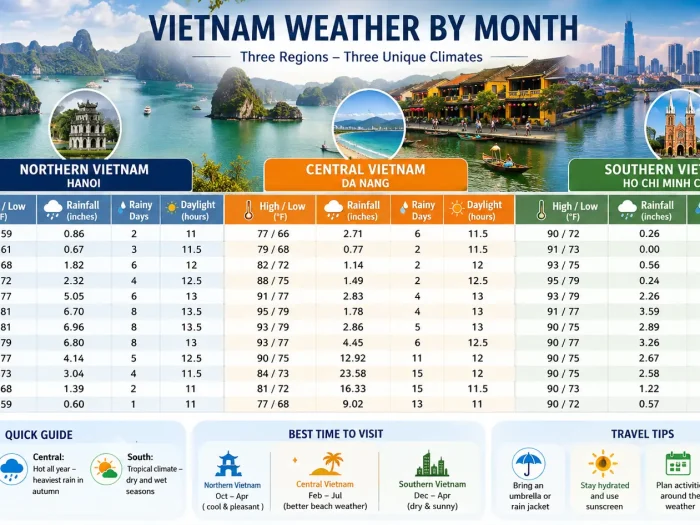
You can click the image below to view the full-size weather chart for Japan.

1. Northern Japan – Hokkaido
Hokkaido has the coldest climate in Japan and is famous for its long, snowy winters.
- Winter typically lasts from November through April.
- Snowfall is extremely heavy, with many areas receiving more than 16–33 feet (5–10 meters) of accumulated snow each year.
- Winter temperatures commonly range from 10°F to 32°F (-12°C to 0°C).
- Summers are pleasantly cool, with temperatures rarely exceeding 86°F (30°C).
Hokkaido is considered a paradise for winter sports enthusiasts, offering world-class skiing, snowboarding, and spectacular snow festivals.
Hokkaido weather by month table
| Month | Avg High °F (°C) | Avg Low °F (°C) | Rainfall (inches) | Sun (hrs/day) | Snowfall (inches) |
|---|---|---|---|---|---|
| January | 28°F (-2°C) | 10°F (-12°C) | 4.5 | 3.2 | 75.0 |
| February | 30°F (-1°C) | 12°F (-11°C) | 3.8 | 4.1 | 62.0 |
| March | 39°F (4°C) | 21°F (-6°C) | 3.2 | 5.0 | 34.0 |
| April | 54°F (12°C) | 34°F (1°C) | 2.4 | 6.0 | 3.0 |
| May | 64°F (18°C) | 45°F (7°C) | 2.2 | 6.7 | 0.0 |
| June | 72°F (22°C) | 54°F (12°C) | 2.5 | 6.3 | 0.0 |
| July | 79°F (26°C) | 63°F (17°C) | 4.0 | 5.5 | 0.0 |
| August | 82°F (28°C) | 66°F (19°C) | 5.6 | 5.4 | 0.0 |
| September | 73°F (23°C) | 55°F (13°C) | 5.0 | 5.1 | 0.0 |
| October | 61°F (16°C) | 41°F (5°C) | 4.3 | 4.8 | 0.1 |
| November | 48°F (9°C) | 28°F (-2°C) | 4.5 | 3.5 | 16.0 |
| December | 34°F (1°C) | 16°F (-9°C) | 4.3 | 2.9 | 58.0 |
2. Eastern and Central Japan – Tokyo, Kyoto, and Osaka
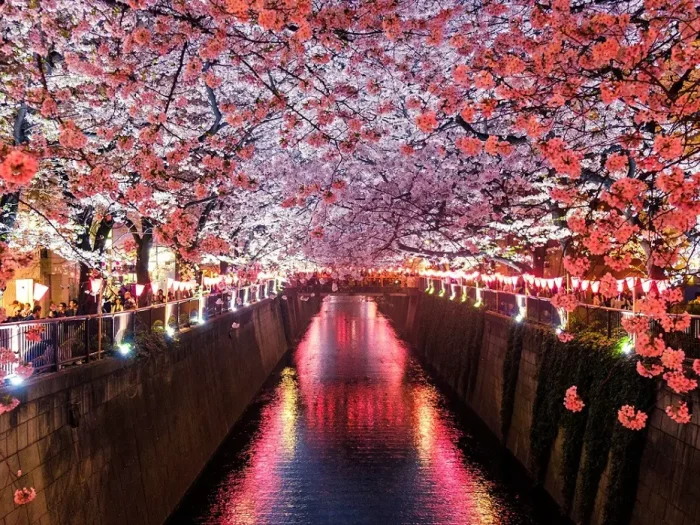
Eastern and Central Japan, including Tokyo, Kyoto, and Osaka, has a temperate climate with four distinct seasons. Spring brings mild temperatures and beautiful cherry blossoms, while summers are hot, humid, and often rainy. Autumn is known for its comfortable weather and colorful foliage, and winters are generally cool with only occasional snowfall in major cities. This region offers the classic Japanese seasonal experience that most visitors expect when traveling to Japan.
Tokyo weather by month table
| Month | Avg High °F (°C) | Avg Low °F (°C) | Rainfall (inches) | Rainy Days | Sun (hrs/day) |
|---|---|---|---|---|---|
| Jan | 50°F (10°C) | 41°F (5°C) | 1.67 | 3 | 10.0 |
| Feb | 50°F (10°C) | 41°F (5°C) | 2.60 | 5 | 11.0 |
| Mar | 57°F (14°C) | 48°F (9°C) | 4.64 | 8 | 12.0 |
| Apr | 64°F (18°C) | 57°F (14°C) | 5.61 | 9 | 13.0 |
| May | 73°F (23°C) | 66°F (19°C) | 5.52 | 8 | 14.0 |
| Jun | 79°F (26°C) | 72°F (22°C) | 7.15 | 12 | 14.5 |
| Jul | 86°F (30°C) | 79°F (26°C) | 5.72 | 11 | 14.5 |
| Aug | 88°F (31°C) | 81°F (27°C) | 6.43 | 8 | 13.5 |
| Sep | 81°F (27°C) | 75°F (24°C) | 8.44 | 12 | 12.5 |
| Oct | 70°F (21°C) | 63°F (17°C) | 8.01 | 8 | 11.5 |
| Nov | 63°F (17°C) | 54°F (12°C) | 3.81 | 6 | 10.5 |
| Dec | 54°F (12°C) | 45°F (7°C) | 1.89 | 3 | 10.0 |
3. The Sea of Japan Coast
Niigata and other coastal prefectures along the western side of Honshu are renowned for their exceptionally heavy snowfall.
- During winter, cold winds from Siberia sweep across the Sea of Japan.
- These winds absorb moisture from the sea before releasing it as snow over the coastal mountains.
- Many areas receive some of the highest annual snowfall totals in the world.
As a result, the Sea of Japan coast is one of Japan’s premier destinations for snow lovers and winter recreation.
Niigata weather by month table
| Month | Avg High °F (°C) | Avg Low °F (°C) | Rainfall (inches) | Rainy Days | Sun (hrs/day) |
|---|---|---|---|---|---|
| January | 41°F (5°C) | 32°F (0°C) | 6.99 | 21 | 10.0 |
| February | 43°F (6°C) | 32°F (0°C) | 4.71 | 16 | 11.0 |
| March | 50°F (10°C) | 36°F (2°C) | 3.82 | 15 | 12.0 |
| April | 61°F (16°C) | 45°F (7°C) | 3.86 | 10 | 13.0 |
| May | 70°F (21°C) | 55°F (13°C) | 3.96 | 9 | 14.0 |
| June | 77°F (25°C) | 64°F (18°C) | 4.81 | 9 | 14.5 |
| July | 84°F (29°C) | 72°F (22°C) | 8.63 | 12 | 14.5 |
| August | 86°F (30°C) | 73°F (23°C) | 5.97 | 9 | 13.5 |
| September | 79°F (26°C) | 66°F (19°C) | 6.03 | 11 | 12.5 |
| October | 68°F (20°C) | 54°F (12°C) | 6.23 | 13 | 11.5 |
| November | 57°F (14°C) | 43°F (6°C) | 7.79 | 18 | 10.0 |
| December | 46°F (8°C) | 36°F (2°C) | 8.46 | 21 | 9.5 |
4. Southern Japan – Kyushu
Kyushu enjoys a noticeably warmer climate than central and northern Japan.
- Winters are generally mild and comfortable.
- Summers are hot, humid, and often rainy.
- The region is home to many famous volcanoes and hot springs.
- Typhoons frequently affect Kyushu during late summer and early autumn.
Its warm weather and natural attractions make Kyushu a popular destination throughout the year.
Kyushu weather by month table
| Month | Avg High °F (°C) | Avg Low °F (°C) | Rainfall (inches) | Rainy Days | Sun (hrs/day) |
|---|---|---|---|---|---|
| January | 52°F (11°C) | 39°F (4°C) | 3.0 | 10 | 5.2 |
| February | 55°F (13°C) | 41°F (5°C) | 3.5 | 10 | 5.7 |
| March | 60°F (16°C) | 47°F (8°C) | 5.0 | 12 | 5.8 |
| April | 68°F (20°C) | 55°F (13°C) | 6.0 | 11 | 6.2 |
| May | 75°F (24°C) | 62°F (17°C) | 6.5 | 11 | 6.5 |
| June | 80°F (27°C) | 69°F (21°C) | 12.0 | 15 | 4.8 |
| July | 87°F (31°C) | 76°F (24°C) | 10.0 | 13 | 6.0 |
| August | 90°F (32°C) | 77°F (25°C) | 8.0 | 12 | 7.0 |
| September | 84°F (29°C) | 71°F (22°C) | 8.5 | 12 | 5.8 |
| October | 75°F (24°C) | 61°F (16°C) | 4.0 | 8 | 6.2 |
| November | 66°F (19°C) | 51°F (11°C) | 3.5 | 8 | 5.7 |
| December | 57°F (14°C) | 43°F (6°C) | 2.5 | 9 | 5.3 |
5. Southernmost Japan – Okinawa
Okinawa has a subtropical climate that is very different from the rest of Japan.
- Temperatures remain warm throughout the year.
- Winter temperatures typically range from 59°F to 68°F (15°C to 20°C).
- Beach activities are possible during much of the year.
- Summers are hot but moderated by surrounding ocean waters.
- Tropical storms and typhoons are common during the warmer months.
Okinawa’s climate is often compared to that of Hawaii, making it Japan’s premier beach destination.
Okinawa weather by month table
| Month | Avg High °F (°C) | Avg Low °F (°C) | Rainfall (inches) | Rainy Days | Sun (hrs/day) |
|---|---|---|---|---|---|
| January | 66°F (19°C) | 54°F (12°C) | 4.49 | 9 | 10.5 |
| February | 68°F (20°C) | 55°F (13°C) | 5.19 | 10 | 11.5 |
| March | 70°F (21°C) | 59°F (15°C) | 7.49 | 12 | 12.0 |
| April | 75°F (24°C) | 64°F (18°C) | 6.91 | 10 | 13.0 |
| May | 81°F (27°C) | 70°F (21°C) | 9.87 | 12 | 13.5 |
| June | 84°F (29°C) | 75°F (24°C) | 8.84 | 10 | 13.5 |
| July | 88°F (31°C) | 79°F (26°C) | 6.69 | 9 | 13.5 |
| August | 88°F (31°C) | 79°F (26°C) | 10.07 | 12 | 13.0 |
| September | 86°F (30°C) | 75°F (24°C) | 9.26 | 10 | 12.5 |
| October | 82°F (28°C) | 70°F (21°C) | 6.95 | 8 | 11.5 |
| November | 75°F (24°C) | 64°F (18°C) | 4.43 | 8 | 11.0 |
| December | 70°F (21°C) | 57°F (14°C) | 3.88 | 8 | 10.5 |
Quick Climate Comparison
| Region | Winter | Summer |
|---|---|---|
| Hokkaido | Very cold, heavy snowfall | Cool and comfortable |
| Tokyo / Kyoto / Osaka | Moderately cold | Hot and humid |
| Sea of Japan Coast | Extremely snowy | Warm |
| Kyushu | Mild | Hot and humid |
| Okinawa | Warm year-round | Tropical heat |
An Interesting Climate Contrast
One of the most fascinating aspects of Japan’s climate is its regional diversity. In January, temperatures in Hokkaido can drop to around 14°F (-10°C), while Okinawa may enjoy temperatures near 68°F (20°C) on the very same day. This temperature difference is comparable to the climatic contrast between northern and southern Europe.
20 FAQs About Japan Weather
1. What is the best time to visit Japan?
The best times to visit Japan are spring (March–May) for cherry blossoms and autumn (October–November) for colorful fall foliage and mild temperatures.
2. Does Japan have four distinct seasons?
Yes. Japan experiences four distinct seasons: spring, summer, autumn, and winter, each offering different weather conditions and landscapes.
3. When is the rainy season in Japan?
The rainy season, known as tsuyu, usually occurs from early June to mid-July in most regions of Japan.
4. How hot does Japan get in summer?
Summer temperatures typically range from 77°F to 95°F (25°C to 35°C), with high humidity, especially in Tokyo, Osaka, and Kyoto.
5. Which part of Japan gets the most snow?
Hokkaido and the Sea of Japan Coast receive the heaviest snowfall, with some areas accumulating several meters of snow each winter.
6. Does it snow in Tokyo?
Yes, but snowfall in Tokyo is usually light and infrequent, occurring mainly between January and February.
7. What is winter like in Hokkaido?
Hokkaido has long, cold winters with temperatures often below freezing and some of the best powder snow conditions in the world.
8. When is cherry blossom season in Japan?
Cherry blossoms typically bloom from late March to early April in central Japan, though timing varies by region and year.
9. What is the weather like in Tokyo throughout the year?
Tokyo experiences cool winters, warm springs, hot and humid summers, and mild autumns, with rainfall occurring year-round.
10. Which region of Japan has the mildest climate?
Okinawa has the warmest and mildest climate, with subtropical weather and comfortable temperatures throughout the year.
11. When is typhoon season in Japan?
Typhoon season generally runs from August through October, with September often being the most active month.
12. How much rain does Japan receive annually?
Annual rainfall varies by region, ranging from about 40 inches (1,000 mm) in some northern areas to over 100 inches (2,500 mm) in wetter southern regions.
13. What is the hottest month in Japan?
August is typically the hottest month across most of Japan, with temperatures frequently exceeding 86°F (30°C).
14. What is the coldest month in Japan?
January is generally the coldest month, especially in northern regions such as Hokkaido.
15. Is autumn a good time to visit Japan?
Yes. Autumn offers comfortable temperatures, lower humidity, and spectacular fall colors throughout much of the country.
16. How does the weather differ between Hokkaido and Kyushu?
Hokkaido has cold, snowy winters and mild summers, while Kyushu experiences warmer winters and hotter, wetter summers.
17. What should I pack for a trip to Japan?
Pack according to the season: warm layers for winter, lightweight clothing for summer, and a rain jacket or umbrella during the rainy season.
18. Does Japan experience extreme weather?
Japan can experience typhoons, heavy snowfall, heat waves, and occasional flooding, depending on the season and region.
19. Which month has the most sunshine in Japan?
May and June generally offer some of the longest daylight hours before the peak of the rainy season.
20. What is the best weather for outdoor sightseeing in Japan?
Spring (March–May) and autumn (October–November) usually provide the most comfortable temperatures and favorable conditions for outdoor activities and sightseeing.