Banff National Park Weather by Month
Banff National Park experiences four distinct seasons, with long snowy winters, mild summers, and dramatic seasonal transitions. Located in the Canadian Rockies, Banff’s weather can change quickly, especially at higher elevations. Visitors can expect cold temperatures and deep snow from late fall through early spring, while summer offers pleasant hiking weather and extended daylight hours.
Banff National Park Weather by Month
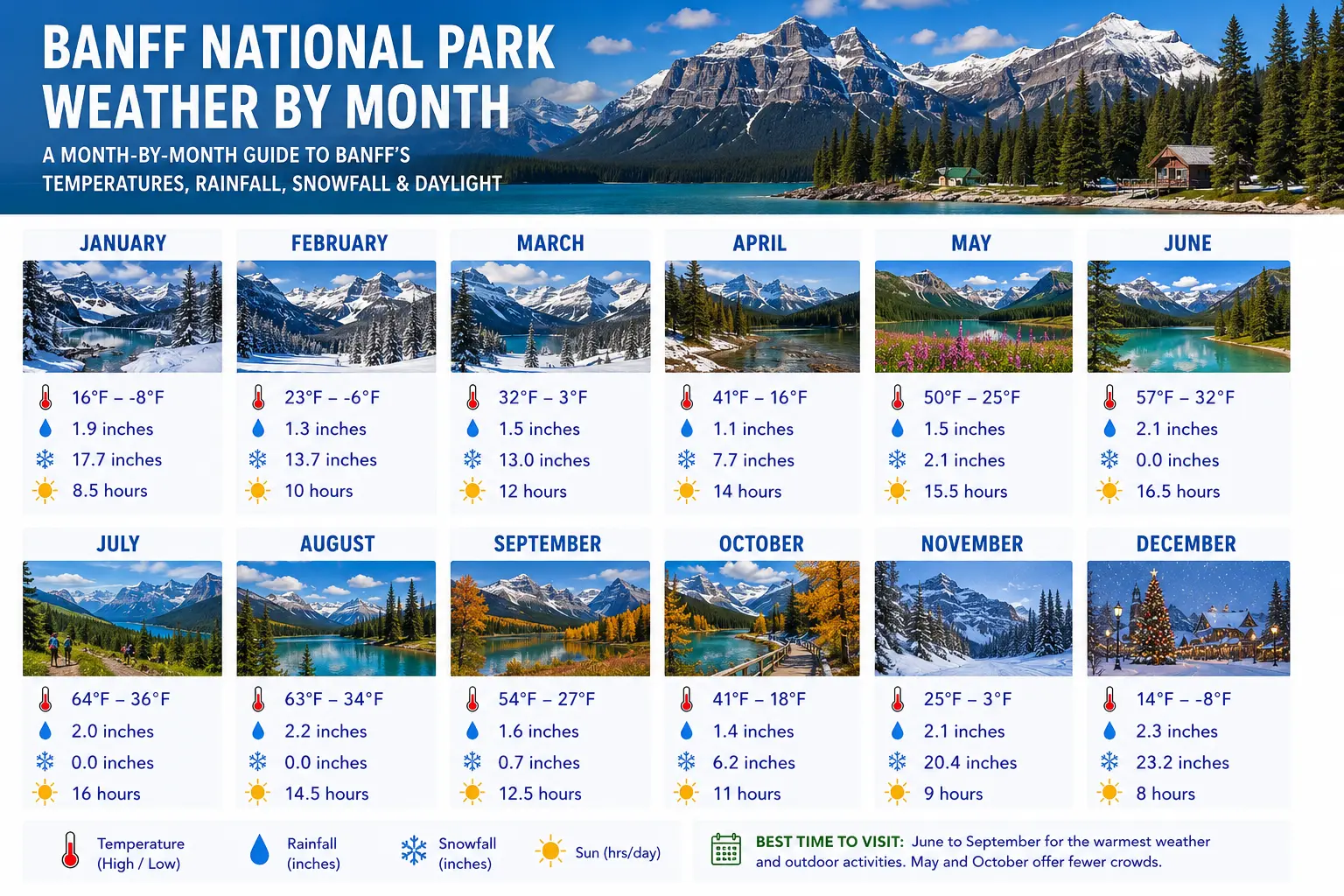
You can click the image below to view the full-size weather chart for Banff National Park.
January – Deep Winter Wonderland
- Average high: 16°F (-9°C)
- Average low: -8°F (-22°C)
- Rainfall: 1.86 inches (47.3 mm)
- Rainy days: 8 days
- Snowfall: 17.7 inches (448.6 mm)
- Daylight: 8.5 hours
January is one of the coldest months in Banff National Park. Snow blankets the mountains, forests, and valleys, creating postcard-perfect winter scenery. Despite the cold temperatures, clear skies and fresh powder attract winter sports enthusiasts from around the world.
Frozen lakes, snow-covered peaks, and fewer crowds make this an excellent time for those seeking a true Canadian winter experience.
Best for:
- Skiing and snowboarding
- Snowshoeing
- Ice skating
- Winter photography
February – Peak Snow Season
- Average high: 23°F (-5°C)
- Average low: -6°F (-21°C)
- Rainfall: 1.31 inches (33.4 mm)
- Rainy days: 6 days
- Snowfall: 13.7 inches (348.8 mm)
- Daylight: 10 hours
February remains firmly in winter, but slightly warmer temperatures and increasing daylight make outdoor activities more comfortable. Snow conditions are often at their best for skiing and snowboarding.
The crisp mountain air and sparkling snow-covered landscapes provide some of the most beautiful scenery of the year.
Best for:
- Downhill skiing
- Cross-country skiing
- Winter festivals
- Wildlife viewing
March – Winter Begins to Ease
- Average high: 32°F (0°C)
- Average low: 3°F (-16°C)
- Rainfall: 1.46 inches (37 mm)
- Rainy days: 7 days
- Snowfall: 13.0 inches (329.3 mm)
- Daylight: 12 hours
March marks the beginning of spring’s slow arrival, although winter conditions still dominate much of the park. Snow remains plentiful at higher elevations, while lower valleys occasionally experience milder afternoons.
Longer days make it easier to enjoy outdoor adventures.
Best for:
- Late-season skiing
- Scenic drives
- Winter hiking
- Photography
April – Spring Transition
- Average high: 41°F (5°C)
- Average low: 16°F (-9°C)
- Rainfall: 1.09 inches (27.6 mm)
- Rainy days: 5 days
- Snowfall: 7.7 inches (194.5 mm)
- Daylight: 14 hours
April is a transitional month when winter gradually loosens its grip. Snow begins melting in lower elevations, revealing forests and hiking trails, while higher mountain areas remain snow-covered.
Weather conditions can vary significantly from day to day.
Best for:
- Early spring hiking
- Wildlife spotting
- Scenic photography
- Fewer crowds
May – Spring Awakens
- Average high: 50°F (10°C)
- Average low: 25°F (-4°C)
- Rainfall: 1.53 inches (38.9 mm)
- Rainy days: 7 days
- Snowfall: 2.1 inches (52.9 mm)
- Daylight: 15.5 hours
May brings noticeable warming temperatures and greener landscapes. Wildlife becomes increasingly active, and many hiking trails start reopening as snow recedes.
While occasional snow showers remain possible, spring is clearly underway.
Best for:
- Wildlife viewing
- Waterfall photography
- Hiking lower-elevation trails
- Spring sightseeing
June – Early Summer Beauty
- Average high: 57°F (14°C)
- Average low: 32°F (0°C)
- Rainfall: 2.10 inches (53.4 mm)
- Rainy days: 10 days
- Snowfall: 0.03 inches (0.8 mm)
- Daylight: 16.5 hours
June marks the start of summer in Banff. Snow largely disappears from valley floors, wildflowers bloom, and long daylight hours provide ample time for exploration.
Popular lakes begin to reveal their famous turquoise waters.
Best for:
- Hiking
- Wildlife photography
- Canoeing
- Scenic drives
July – Warmest Month of the Year
- Average high: 64°F (18°C)
- Average low: 36°F (2°C)
- Rainfall: 2.00 inches (50.9 mm)
- Rainy days: 8 days
- Snowfall: 0 inches (0 mm)
- Daylight: 16 hours
July is typically the warmest month in Banff NP. Comfortable daytime temperatures and long sunny days create ideal conditions for outdoor recreation.
This is also one of the busiest months, with visitors arriving from around the world.
Best for:
- Hiking
- Camping
- Canoeing and kayaking
- Lake Louise visits
August – Peak Summer Adventures
- Average high: 63°F (17°C)
- Average low: 34°F (1°C)
- Rainfall: 2.15 inches (54.6 mm)
- Rainy days: 9 days
- Snowfall: 0 inches (0 mm)
- Daylight: 14.5 hours
August continues the pleasant summer weather, though evenings can feel cool due to the park’s elevation. Trails are fully accessible, and alpine meadows are often filled with wildflowers.
It’s an excellent month for exploring the Rockies.
Best for:
- Backcountry hiking
- Camping
- Wildlife watching
- Photography
September – Colorful Fall Begins
- Average high: 54°F (12°C)
- Average low: 27°F (-3°C)
- Rainfall: 1.64 inches (41.6 mm)
- Rainy days: 7 days
- Snowfall: 0.65 inches (16.4 mm)
- Daylight: 12.5 hours
September offers a beautiful combination of mild temperatures and fall colors. Crowds begin to thin, while golden larch trees create stunning mountain landscapes.
Early snowfall is possible at higher elevations.
Best for:
- Fall hiking
- Photography
- Scenic drives
- Wildlife viewing
October – Crisp Mountain Autumn
- Average high: 41°F (5°C)
- Average low: 18°F (-8°C)
- Rainfall: 1.37 inches (34.8 mm)
- Rainy days: 6 days
- Snowfall: 6.2 inches (157.6 mm)
- Daylight: 11 hours
October brings cooler temperatures and the return of more frequent snowfall. Autumn colors gradually fade as winter begins approaching the Rockies.
Visitors can enjoy peaceful landscapes and fewer tourists.
Best for:
- Fall photography
- Scenic drives
- Wildlife watching
- Quiet getaways
November – Winter Returns
- Average high: 25°F (-4°C)
- Average low: 3°F (-16°C)
- Rainfall: 2.14 inches (54.4 mm)
- Rainy days: 8 days
- Snowfall: 20.4 inches (518.4 mm)
- Daylight: 9 hours
November marks the return of true winter conditions. Snow accumulates rapidly, ski resorts begin operating, and mountain scenery becomes increasingly dramatic.
The park transitions into a winter recreation destination once again.
Best for:
- Early-season skiing
- Snowshoeing
- Winter photography
- Peaceful mountain escapes
December – Magical Holiday Season
- Average high: 14°F (-10°C)
- Average low: -8°F (-22°C)
- Rainfall: 2.31 inches (58.7 mm)
- Rainy days: 8 days
- Snowfall: 23.2 inches (588.8 mm)
- Daylight: 8 hours
December transforms Banff into a festive winter wonderland. Heavy snowfall, frozen landscapes, and holiday events create a magical atmosphere throughout the park and surrounding town.
It’s one of the most picturesque times of year, especially around Christmas.
Best for:
- Christmas vacations
- Skiing and snowboarding
- Winter festivals
- Snow-covered scenery
Banff National Park Weather by Month Table
| Month | Avg High °F (°C) | Avg Low °F (°C) | Rainfall (inches) | Sun (hrs/day) | Snowfall (inches) |
|---|---|---|---|---|---|
| January | 16°F (-9°C) | -8°F (-22°C) | 1.86 | 8.5 | 17.66 |
| February | 23°F (-5°C) | -6°F (-21°C) | 1.31 | 10.0 | 13.73 |
| March | 32°F (0°C) | 3°F (-16°C) | 1.46 | 12.0 | 12.96 |
| April | 41°F (5°C) | 16°F (-9°C) | 1.09 | 14.0 | 7.66 |
| May | 50°F (10°C) | 25°F (-4°C) | 1.53 | 15.5 | 2.08 |
| June | 57°F (14°C) | 32°F (0°C) | 2.10 | 16.5 | 0.03 |
| July | 64°F (18°C) | 36°F (2°C) | 2.00 | 16.0 | 0.00 |
| August | 63°F (17°C) | 34°F (1°C) | 2.15 | 14.5 | 0.00 |
| September | 54°F (12°C) | 27°F (-3°C) | 1.64 | 12.5 | 0.65 |
| October | 41°F (5°C) | 18°F (-8°C) | 1.37 | 11.0 | 6.20 |
| November | 25°F (-4°C) | 3°F (-16°C) | 2.14 | 9.0 | 20.41 |
| December | 14°F (-10°C) | -8°F (-22°C) | 2.31 | 8.0 | 23.18 |
When Is the Best Time to Visit Banff National Park?
- For hiking and lake activities: June to September
- For warmest weather: July and August
- For fall colors: Mid-September to early October
- For skiing and snowboarding: November to April
- For fewer crowds: May and October
Banff NP is a year-round destination, with each season offering unique experiences—from world-class skiing in winter to unforgettable hiking and turquoise lakes in summer.
Read more: