Calgary Weather by Month
Calgary is a city in Alberta, Canada, in the western part of the country. Calgary has a dry continental climate, with cold winters, mild to warm summers, and relatively low rainfall throughout the year. Winter brings frequent snowfall and short daylight hours, while summer offers the warmest temperatures and the longest days.
Calgary Weather by Month
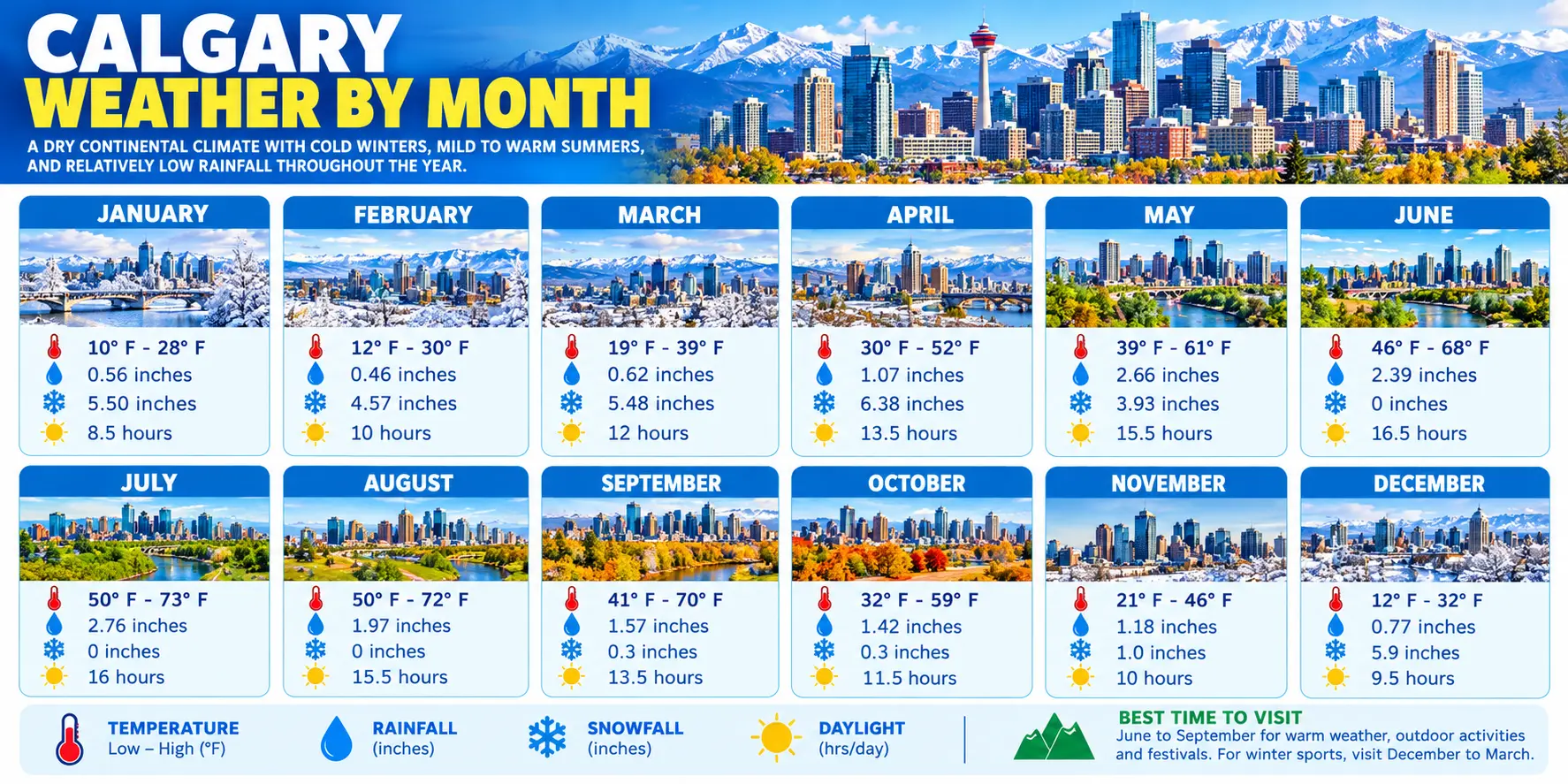
You can click the image below to view the full-size weather chart for Calgary.
January – Cold Winter and Snowy Days
Average high: 28°F (-2°C)
Average low: 10°F (-12°C)
Rainfall: 0.56 inches (14.2 mm)
Snowfall: 5.50 inches (139.7 mm)
Daylight: 8.5 hours
January is one of the coldest months in Calgary. Average daytime temperatures remain around 28°F (-2°C), while nighttime temperatures can fall to approximately 10°F (-12°C).
Snowfall averages about 5.5 inches (139.7 mm), with around 7 snow days during the month. January also has only about 8.5 hours of daylight, making the days short and distinctly wintry.
With freezing temperatures and regular snowfall, January is ideal for experiencing Calgary’s classic winter atmosphere.
Best for:
- Snow-covered landscapes
- Winter photography
- Snow activities
- Indoor attractions and cozy cafés
February – Cold and Snowy Winter Weather
Average high: 30°F (-1°C)
Average low: 12°F (-11°C)
Rainfall: 0.46 inches (11.7 mm)
Snowfall: 4.57 inches (116 mm)
Daylight: 10 hours
February remains firmly in winter, although daylight begins to increase. Average highs reach around 30°F (-1°C), while nighttime temperatures average 12°F (-11°C).
The month receives approximately 4.6 inches (116 mm) of snowfall over about 7 snow days. With around 10 hours of daylight, February feels noticeably brighter than January.
Best for:
- Winter scenery
- Snow activities
- Mountain trips
- Winter photography
March – Chilly with Frequent Snow
Average high: 39°F (4°C)
Average low: 19°F (-7°C)
Rainfall: 0.62 inches (15.8 mm)
Snowfall: 5.48 inches (139.2 mm)
Daylight: 12 hours
March brings the first signs of spring, but Calgary can still experience distinctly winter-like conditions. Average highs rise to 39°F (4°C), while lows remain around 19°F (-7°C).
Snowfall averages about 5.5 inches (139.2 mm), with around 7 snow days. Daylight increases to approximately 12 hours, providing more time for outdoor activities.
Best for:
- Early spring sightseeing
- Winter-to-spring photography
- Mountain excursions
- Quieter attractions
April – Cool Spring with Lingering Snow
Average high: 52°F (11°C)
Average low: 30°F (-1°C)
Rainfall: 1.07 inches (27.1 mm)
Snowfall: 6.38 inches (162 mm)
Daylight: 13.5 hours
April sees a significant warming trend, with average highs reaching 52°F (11°C). Nights are still cool, with average lows around 30°F (-1°C).
Despite the warmer temperatures, April is Calgary’s snowiest month in the provided data, averaging 6.4 inches (162 mm) of snowfall across about 5 snow days. Daylight increases to 13.5 hours.
Best for:
- Spring sightseeing
- Scenic drives
- Photography
- Exploring Calgary before the summer crowds
May – Mild Spring and Increasing Rainfall
Average high: 61°F (16°C)
Average low: 39°F (4°C)
Rainfall: 2.66 inches (67.5 mm)
Snowfall: 3.93 inches (99.8 mm)
Daylight: 15.5 hours
May brings much milder weather to Calgary. Average daytime temperatures reach 61°F (16°C), while nighttime temperatures average 39°F (4°C).
Rainfall increases to about 2.66 inches (67.5 mm), while snowfall decreases to around 3.9 inches (99.8 mm) over approximately 2 snow days. With 15.5 hours of daylight, May is a much more comfortable month for outdoor exploration.
Best for:
- Hiking
- Parks and gardens
- City sightseeing
- Spring photography
June – Warm Days and Long Summer Daylight
Average high: 68°F (20°C)
Average low: 46°F (8°C)
Rainfall: 2.39 inches (60.8 mm)
Snowfall: 0 inches (0 mm)
Daylight: 16.5 hours
June marks the beginning of Calgary’s warm summer season. Average highs reach 68°F (20°C), with comfortable nighttime temperatures around 46°F (8°C).
Rainfall averages about 2.39 inches (60.8 mm), while snowfall drops to zero. With approximately 16.5 hours of daylight, June provides some of the longest days of the year.
Best for:
- Hiking and outdoor activities
- Parks and gardens
- Day trips
- Exploring the Canadian Rockies
July – Warmest Month of the Year
Average high: 73°F (23°C)
Average low: 50°F (10°C)
Rainfall: 2.76 inches (70 mm)
Snowfall: 0 inches (0 mm)
Daylight: 16 hours
July is the warmest month in Calgary, with average daytime temperatures around 73°F (23°C) and nighttime temperatures near 50°F (10°C).
Rainfall averages 2.76 inches (70 mm), but there is no measurable snowfall in the provided data. With around 16 hours of daylight, July offers excellent conditions for spending time outdoors.
Best for:
- Hiking
- Outdoor sightseeing
- National park trips
- Scenic drives
- Summer festivals and events
August – Warm, Pleasant and Mostly Snow-Free
Average high: 70°F (21°C)
Average low: 48°F (9°C)
Rainfall: 2.47 inches (62.7 mm)
Snowfall: 0 inches (0 mm)
Daylight: 14.5 hours
August remains warm and comfortable, with average highs of 70°F (21°C) and lows around 48°F (9°C).
Rainfall averages about 2.47 inches (62.7 mm), while snowfall remains at zero. Daylight decreases slightly to around 14.5 hours, but there is still plenty of time for outdoor adventures.
Best for:
- Hiking
- Rocky Mountain trips
- Scenic photography
- Outdoor sightseeing
September – Mild Early Autumn Weather
Average high: 63°F (17°C)
Average low: 39°F (4°C)
Rainfall: 2.19 inches (55.7 mm)
Snowfall: 1.54 inches (39 mm)
Daylight: 12.5 hours
September brings cooler autumn weather to Calgary. Average highs fall to 63°F (17°C), while lows average around 39°F (4°C).
Rainfall is about 2.19 inches (55.7 mm), and the month can receive around 1.5 inches (39 mm) of snowfall. Daylight decreases to approximately 12.5 hours.
Best for:
- Autumn scenery
- Hiking
- Photography
- Rocky Mountain sightseeing
October – Cool Autumn with Occasional Snow
Average high: 54°F (12°C)
Average low: 32°F (0°C)
Rainfall: 0.54 inches (13.7 mm)
Snowfall: 3.20 inches (81.3 mm)
Daylight: 11 hours
October is noticeably cooler, with average highs around 54°F (12°C) and lows near 32°F (0°C).
Rainfall drops to just 0.54 inches (13.7 mm), while snowfall increases to approximately 3.2 inches (81.3 mm). With about 11 hours of daylight, autumn days become shorter and cooler.
Best for:
- Fall foliage
- Photography
- Scenic drives
- Indoor attractions
November – Cold and Increasingly Snowy
Average high: 37°F (3°C)
Average low: 19°F (-7°C)
Rainfall: 0.51 inches (13 mm)
Snowfall: 4.87 inches (123.6 mm)
Daylight: 9 hours
November marks the return of colder winter conditions. Average highs fall to 37°F (3°C), while nighttime temperatures average around 19°F (-7°C).
Snowfall increases to about 4.9 inches (123.6 mm), with around 6 snow days. Daylight decreases to just 9 hours, giving the month a distinctly wintry feel.
Best for:
- Early winter scenery
- Snow photography
- Indoor attractions
- Cozy cafés and restaurants
December – Cold, Snowy and Short Days
Average high: 30°F (-1°C)
Average low: 10°F (-12°C)
Rainfall: 0.63 inches (15.9 mm)
Snowfall: 6.11 inches (155.2 mm)
Daylight: 8 hours
December is one of Calgary’s coldest and snowiest months. Average daytime temperatures are around 30°F (-1°C), while nighttime temperatures can drop to approximately 10°F (-12°C).
Snowfall averages about 6.1 inches (155.2 mm), with around 7 snow days. December has only about 8 hours of daylight, making it the darkest month of the year.
With cold temperatures, snow-covered scenery, and short days, December offers a classic Canadian winter experience.
Best for:
- Winter photography
- Snow activities
- Holiday atmosphere
- Cozy indoor experiences
Calgary Weather by Month at a Glance
| Month | Avg High °F (°C) | Avg Low °F (°C) | Rainfall (inches) | Snowfall (inches) | Daylight (hours) |
|---|---|---|---|---|---|
| January | 28°F (-2°C) | 10°F (-12°C) | 0.56 | 5.50 | 8.5 |
| February | 30°F (-1°C) | 12°F (-11°C) | 0.46 | 4.57 | 10 |
| March | 39°F (4°C) | 19°F (-7°C) | 0.62 | 5.48 | 12 |
| April | 52°F (11°C) | 30°F (-1°C) | 1.07 | 6.38 | 13.5 |
| May | 61°F (16°C) | 39°F (4°C) | 2.66 | 3.93 | 15.5 |
| June | 68°F (20°C) | 46°F (8°C) | 2.39 | 0 | 16.5 |
| July | 73°F (23°C) | 50°F (10°C) | 2.76 | 0 | 16 |
| August | 70°F (21°C) | 48°F (9°C) | 2.47 | 0 | 14.5 |
| September | 63°F (17°C) | 39°F (4°C) | 2.19 | 1.54 | 12.5 |
| October | 54°F (12°C) | 32°F (0°C) | 0.54 | 3.20 | 11 |
| November | 37°F (3°C) | 19°F (-7°C) | 0.51 | 4.87 | 9 |
| December | 30°F (-1°C) | 10°F (-12°C) | 0.63 | 6.11 | 8 |
Overall: Calgary’s coldest period is generally December through February, while June through August brings the warmest temperatures and longest daylight. Snowfall can occur from autumn through spring, with the provided data showing the highest monthly snowfall in April, followed by December and January.
20 FAQs About Calgary Weather
1. What is the weather like in Calgary?
Calgary has a dry continental climate with cold winters, mild to warm summers, and relatively low precipitation. Temperatures can vary significantly between seasons.
2. What is the coldest month in Calgary?
January and December are among the coldest months. Average January temperatures range from about 10°F (-12°C) to 28°F (-2°C).
3. What is the warmest month in Calgary?
July is typically the warmest month in the provided data, with an average high of 73°F (23°C) and an average low of 50°F (10°C).
4. Does it snow in Calgary?
Yes. Calgary receives snowfall mainly from autumn through spring. The provided data shows measurable snowfall from September through May, with no snowfall recorded from June through August.
5. Which month has the most snowfall in Calgary?
April has the highest snowfall in the provided data, at approximately 6.38 inches (162 mm).
6. How much snow does Calgary get in January?
January receives approximately 5.50 inches (139.7 mm) of snowfall, with around 7 snow days.
7. Does Calgary snow in April?
Yes. Despite increasingly mild temperatures, April can still receive significant snowfall. The provided data shows approximately 6.38 inches (162 mm) of snowfall.
8. When does winter end in Calgary?
Winter conditions generally begin easing during March and April, but snow and freezing temperatures can still occur during spring.
9. What is Calgary weather like in spring?
Spring temperatures gradually increase from March through May. Average highs rise from around 39°F (4°C) in March to 61°F (16°C) in May, although snow can still occur during this period.
10. What is Calgary weather like in summer?
Calgary summers are generally warm and relatively dry. June through August have average highs of approximately 68–73°F (20–23°C), with July being the warmest month in the provided data.
11. What is Calgary weather like in fall?
Fall brings gradually cooler temperatures. September remains relatively mild, while October and November become increasingly cold and snowy.
12. Is Calgary rainy?
Calgary generally receives relatively modest rainfall compared with many Canadian cities. In the provided data, monthly rainfall ranges from approximately 0.46 inches (11.7 mm) in February to 2.76 inches (70 mm) in July.
13. Which month is the rainiest in Calgary?
July has the highest rainfall in the provided data, at approximately 2.76 inches (70 mm).
14. What is Calgary weather like in September?
September is generally mild at the beginning of autumn. The average high is about 63°F (17°C) and the average low is 39°F (4°C), with approximately 2.19 inches (55.7 mm) of rainfall.
15. What is Calgary weather like in October?
October is cooler, with an average high of 54°F (12°C) and an average low of 32°F (0°C). It can also receive snowfall, averaging about 3.20 inches (81.3 mm) in the provided data.
16. What is Calgary weather like in November?
November marks a return to colder winter conditions. Average temperatures range from about 19°F (-7°C) to 37°F (3°C), with approximately 4.87 inches (123.6 mm) of snowfall.
17. How much daylight does Calgary get in summer?
Calgary receives very long summer days. June has approximately 16.5 hours of daylight, while July has around 16 hours.
18. How much daylight does Calgary get in winter?
Winter days are much shorter. December has approximately 8 hours of daylight, while January has about 8.5 hours.
19. What is the best time to visit Calgary for outdoor activities?
The warmer months from June through August generally provide the longest daylight hours and warmest temperatures, making them suitable for hiking, sightseeing, and other outdoor activities.
20. What should I pack for Calgary weather?
Packing depends on the season. Winter visitors should bring a warm insulated coat, layers, gloves, a hat, and suitable footwear. In summer, lighter clothing is useful, but layers and a light jacket are still practical because temperatures can become cool in the evening.
Read more: