Everglades National Park Weather by Month
Located in southern Florida, Everglades National Park has a subtropical climate with just two main seasons:
- Dry season (December–April)
- Wet season (May–November)
Instead of four traditional seasons, weather here shifts between pleasant, dry winters and hot, rainy summers. Below is a detailed breakdown of what to expect each month.
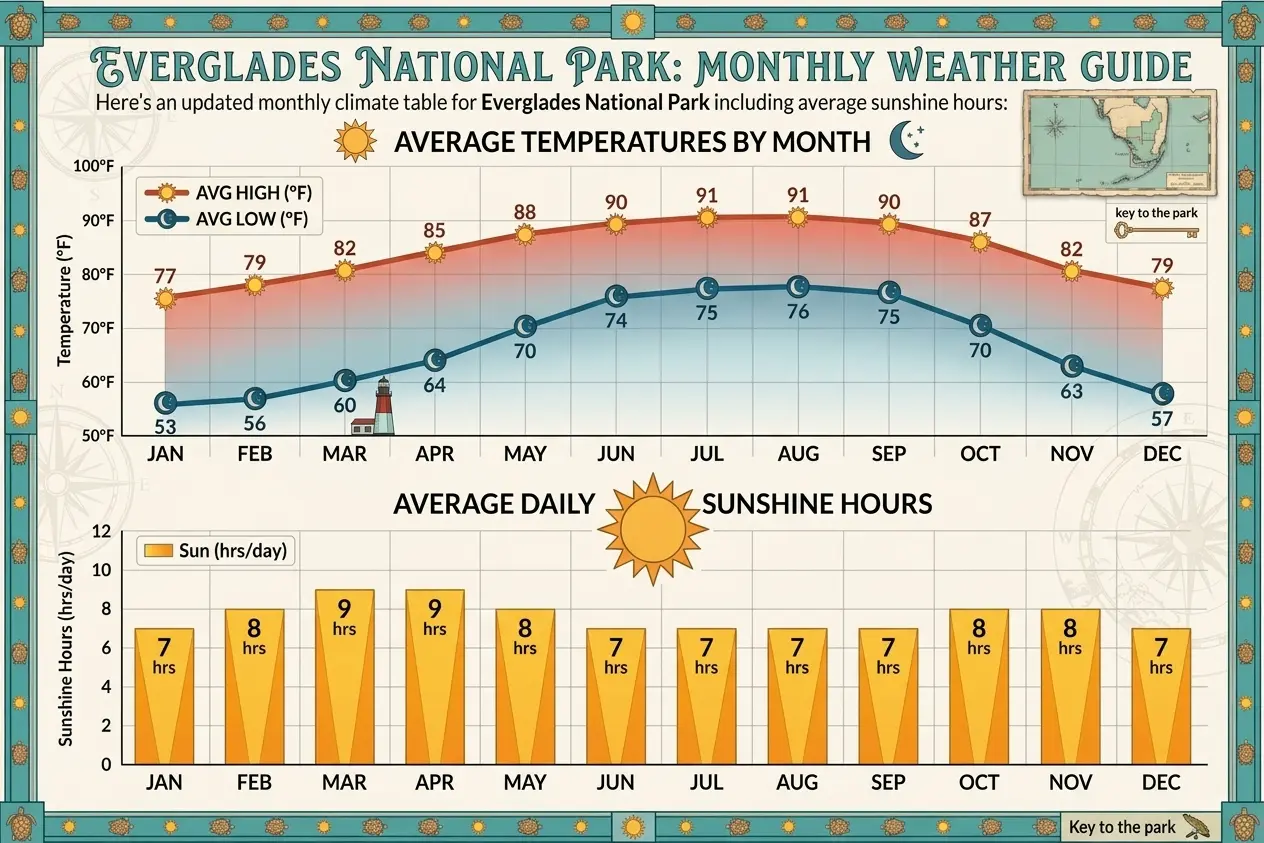
You can click the image below to view the full-size weather chart for Everglades National Park.
January
January is one of the coolest and most comfortable months.
- Average highs: ~25°C (77–78°F)
- Low humidity and little rainfall
- Cool mornings and evenings
Best for: Wildlife viewing, hiking, and photography.
February
Conditions remain similar to January but slightly warmer.
- Mild temperatures and dry air
- Clear skies dominate
Tip: One of the best months to visit overall.
March
March marks the transition toward warmer spring weather.
- Highs around 28°C (82°F)
- Still dry with minimal rain
Best for: Outdoor activities before summer heat begins.
April
April is the last full month of the dry season.
- Temperatures rise to ~29°C (85°F)
- Rainfall starts to increase slightly
Good to know: Crowds begin to thin out late in the month.
May
The wet season begins.
- Hotter temperatures (~31°C / 88°F)
- Humidity increases
- Rainfall jumps significantly
Expect: More mosquitoes and occasional storms.
June
June brings full summer conditions.
- Highs around 32°C (90°F)
- Frequent afternoon thunderstorms
- Start of hurricane season (June–November)
Advice: Plan activities early in the day.
July
Hot, humid, and rainy.
- Daily thunderstorms are common
- Temperatures stay above 30°C (90°F)
Note: Heat index can feel much hotter due to humidity.
August
Similar to July, but often wetter.
- One of the rainiest months
- High humidity and heat
Downside: Mosquitoes are at their peak.
September
Peak of the wet season.
- Heavy rainfall (~8–9 inches / 200+ mm)
- High risk of tropical storms
Tip: Travel plans may be affected by weather disruptions.
October
Conditions begin to improve.
- Rainfall decreases
- Temperatures remain warm (~31°C / 87°F)
Transition month: Moving toward the dry season.
November
Dry season returns gradually.
- Cooler temperatures (~28°C / 83°F)
- Less rain and humidity
Good time to visit: Fewer crowds than winter peak.
December
One of the most pleasant months of the year.
- Highs around 26°C (79°F)
- Lowest rainfall of the year (~1.6 inches)
Highlights: Comfortable weather and excellent wildlife activity.
Everglades National Park Weather by Month
| Month | Avg High (°F) | Avg Low (°F) | Rainfall (inches) | Sun (hrs/day) |
|---|---|---|---|---|
| January | 77 | 53 | 2.0 | 7 |
| February | 79 | 56 | 2.1 | 8 |
| March | 82 | 60 | 2.4 | 9 |
| April | 85 | 64 | 3.0 | 9 |
| May | 88 | 70 | 5.9 | 8 |
| June | 90 | 74 | 9.3 | 7 |
| July | 91 | 75 | 8.0 | 7 |
| August | 91 | 76 | 8.5 | 7 |
| September | 90 | 75 | 8.7 | 7 |
| October | 87 | 70 | 6.5 | 8 |
| November | 82 | 63 | 3.1 | 8 |
| December | 79 | 57 | 2.1 | 7 |
Summary: Best Time to Visit
- Best overall months: December to March (cool, dry, fewer bugs)
- Best for fewer crowds: April and November
- Avoid if possible: June to September (heat, storms, mosquitoes)
Here are 20 FAQs about the weather in Everglades National Park
1. What type of climate does Everglades National Park have?
It has a subtropical climate with distinct dry and wet seasons rather than four traditional seasons.
2. When is the dry season in the Everglades?
The dry season runs from December to April, bringing cooler temperatures and low humidity.
3. When is the wet season?
The wet season lasts from May to November, with heavy rain and high humidity.
4. What is the hottest month in the Everglades?
Typically July and August, with highs around 90–91°F (32–33°C).
5. What is the coldest month?
January is usually the coolest month, though still mild compared to most places.
6. Does it snow in Everglades National Park?
No, snowfall is virtually impossible due to the warm climate year-round.
7. How much rain does the Everglades get?
The park receives about 60 inches (1,500 mm) annually, mostly during the wet season.
8. What months have the most rainfall?
June through September are the rainiest months, often with daily thunderstorms.
9. Are hurricanes a concern?
Yes, hurricane season runs from June to November, with peak risk in August–October.
10. What is the best time to visit for good weather?
December to March offers the most comfortable conditions: cooler, drier, and less humid.
11. Is it humid year-round?
Humidity is low in winter but becomes very high in summer.
12. How hot does it feel in summer?
Due to humidity, the heat index can exceed 100°F (38°C).
13. Are thunderstorms common?
Yes, especially in summer, with short but intense afternoon storms.
14. What is the sunniest time of year?
Spring (March–April) typically has the most sunshine hours.
15. Does weather affect wildlife viewing?
Yes, the dry season is best, as animals gather around limited water sources.
16. Are mosquitoes worse at certain times?
Mosquitoes are worst during the wet season, especially June–September.
17. Is winter crowded because of good weather?
Yes, the pleasant weather makes winter the peak tourist season.
18. Can you visit during the wet season?
Yes, but expect heat, rain, and insects—it’s less comfortable but more lush and green.
19. What should I wear for Everglades weather?
- Winter: Light layers
- Summer: Breathable clothes, rain gear, insect repellent
20. Does the weather change quickly?
Yes, especially in summer—clear skies can turn into storms within hours.
Final Thoughts
Weather in Everglades National Park is predictable in a broad sense but can change quickly—especially during the wet season. If you prefer comfortable temperatures and clear skies, stick to winter and early spring. If you don’t mind heat and want lush scenery with fewer tourists, summer offers a different but more challenging experience.