How to Plan a Cross Country Road Trip: Routes, Driving Days and Park Stops
A cross country road trip sounds simple: point the car at the other ocean and keep going. In practice it usually means 2,500 to 3,000 miles, a week or more at the wheel, and a stack of decisions that are easier to make at the kitchen table than at a gas station in Nevada. Which corridor, how many hours a day, when do the high park roads open, and what changes if the trip is really a move? The notes below lean on road-trip guides, repeat cross-country drivers and the park service.
Start with the calendar and a short must-see list
Two things shape the rest: how many days you have and which places you refuse to skip. A family blogger who planned a 41-day loop with three kids put time off ahead of money, because vacation days are fixed while a budget stretches with camping and cooking.
A back-roads trip planner with a dozen cross-country trips behind him sorts stops into must see, would love to see, and bonus, then builds the route around the first list. A coast-to-coast drive, he argues, is a sampler, not a deep visit.

Choosing a route
Most guides split the crossing into northern, central and southern corridors, though the labels are loose: one blogger’s “northern” route follows I-80 through Cheyenne and Omaha, which others call central. A columnist answering a reader decades ago made the more useful point: parks such as Arches and Canyonlands aren’t rest stops on one highway, and reaching them can feel like driving out of your way for a small slice of scenery. He still thought the detours worth it.
Northern: I-90 and US-2
Seattle to New York is about 3,000 miles and 45 to 50 hours of pure driving in one guide; a magazine’s Boston-to-Seattle run on I-90 comes to 3,051. US-2, the Great Northern route, is longer, though sources differ: 3,351 miles from Seattle to Bar Harbor in a route-planning app, about 3,600 in an insurer’s blog, which calls two weeks the minimum and three better.
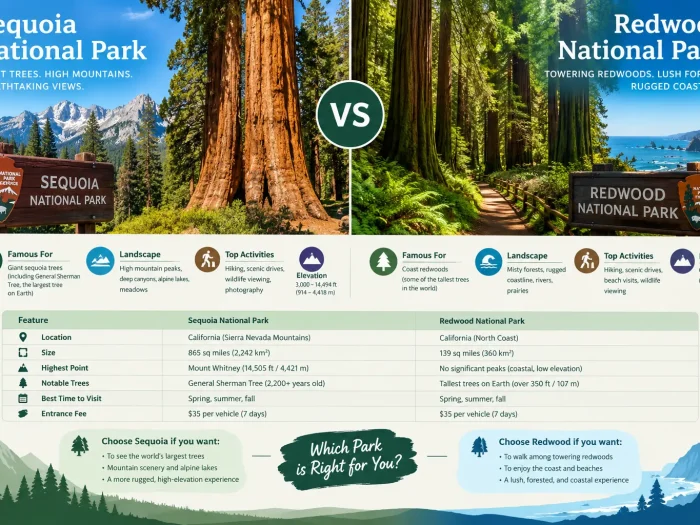
Badlands sits just off I-90, Yellowstone’s north entrance is about 80 minutes from Bozeman, and Grand Teton lies just south of the park. Glacier is a detour unless you take US-2, whose road-trip versions end at Acadia in Maine. A campervan outfit sells this corridor as the cooler summer option. The catch is snow up high: the park service says the alpine section of Going-to-the-Sun Road has no set opening date and has typically been fully open by early July.
Central: I-80, I-70 and US-50
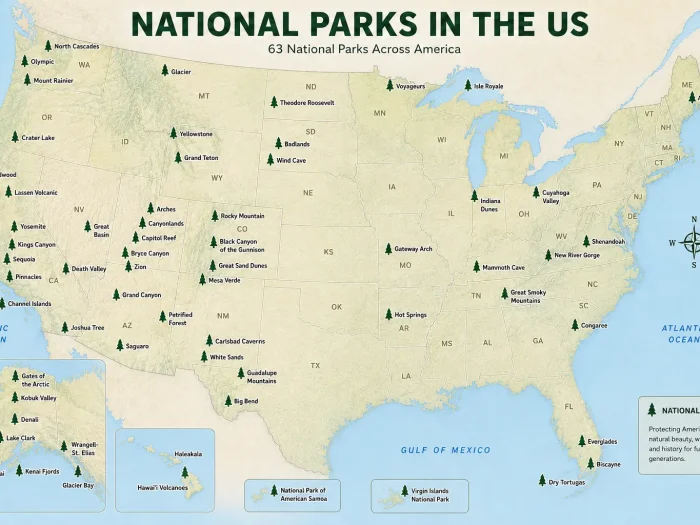
San Francisco to Washington, D.C., on I-80 and I-70 measures 2,915 miles in one magazine; another guide’s San Francisco to Virginia Beach is about 2,800 miles and 40 to 45 hours. That magazine bills this corridor as its national parks route. The stops, most of them detours, include Arches, Canyonlands, Capitol Reef, Bryce Canyon and Zion in Utah, Great Basin in Nevada, Rocky Mountain in Colorado (which that writer admits is “not exactly on the way”), Black Canyon of the Gunnison on US-50, then the Gateway Arch and Cuyahoga Valley farther east.
Starting in California, Yosemite fits too. But the park says Tioga Road usually opens to cars only in late May or June and closes sometime in November.
Southern: I-40, I-10 and US-80
Los Angeles to Charlottesville, mostly on I-40, is 2,696 miles; San Diego to Wilmington, North Carolina, about 2,900 miles and 40 hours. Sources disagree on US-80: about 3,000 miles and 35 hours of driving in one, 2,574 miles from San Diego to Tybee Island in a route-planning app.
Park stops include Joshua Tree, the Grand Canyon (about 90 minutes north of Flagstaff), Petrified Forest on old Route 66, Saguaro and White Sands off I-10, Carlsbad Caverns, Hot Springs and Great Smoky Mountains. Sources split on season: one blogger picks it for avoiding snow, one guide pitches it as a summer drive, and the back-roads planner says to skip the desert in summer heat.
How long does it take to drive cross country?
Roughly 2,500 miles is the shortest crossing, and nonstop driving on the main routes lands near 40 to 45 hours; the back-roads planner counts 60 to 65 hours on his slower routes. One guide converts the interstate figures into days for a solo driver:
- About 5 hours, or 300 miles, a day: 10 days for 3,000 miles
- About 8 hours, or 500 miles, a day: 6 days for 2,800 miles
- About 10 hours, or 600 miles, a day: 5 days for 3,000 miles
Most writers settle on 7 to 10 days one way. A blogger who grew up crossing the country with her family averaged about 8 hours a day and says a week works if you accept several 10-hour days. The back-roads planner suggests keeping most days to about 6 hours behind the wheel and wants at least 8 to 10 days each way and 20 or more for a round trip, partly because back roads average around 40 mph.
Two of his rules of thumb help. Add 30 to 60 minutes of stops per four hours of driving, so 8 hours at the wheel becomes 9 or 10 on the road. And match the day to the stop: under four hours of driving on must-see days, 6 to 8 for secondary ones, and the long days on stretches you’re content to see through the windshield.
Best time of year
Late spring and early fall get the most votes: the middle of May into early June, or mid-September through early October, for the back-roads planner; September or October for the blogger who grew up making the drive, when crowds have thinned and there’s still daylight to reach the hotel. Summer means school holidays and long days, but also packed parks, construction on northern and central highways, desert heat and fire season. The old columnist’s answer to crowds: visit parks midweek. Winter is hardest, since snow, ice and short days can add a day or two up north, and spring in the middle of the country can bring tornado warnings and flash storms.
High roads need their own check. Going-to-the-Sun Road usually stays fully open until the third Monday of October, weather permitting. Tioga Road opened May 15 in 2026, but after the record snow of 2023, crews couldn’t start plowing through its most dangerous avalanche zone until June 21. Camping high? Pack for below-freezing nights even in May or late August.
Budget: fuel, beds and park fees
Budgets swing more than any other number. The blogger who grew up making the drive figures about $200 a day for gas, food and extras, closer to $400 with hotels, and totals from about $3,000 for a couple to about $10,000 for a family of five. Gas alone runs $30 to $60 a day; another guide puts fuel for the whole crossing in an average sedan near $350, depending on prices. At the frugal end, the family on the 41-day loop tent-camped most nights on a starting budget of $4,500 and set aside $200 a week for flat tires, dead batteries and locked campgrounds. Don’t forget tolls, entrance fees and a pre-trip service.
If the route takes in several parks that charge entry, look at the federal annual pass, which covers the entrance fee for one private vehicle at national parks and other federal recreation lands. As of late 2026 the park service lists it at $80 for U.S. citizens and residents, $250 for non-residents, and $20 a year or $80 for life for citizens and residents 62 and up; check current prices before you buy.
Booking lodging and park reservations
Mixing bed types usually works best: motels, campgrounds, and friends or relatives along the way, if only for the laundry. Hunting for a room at 10 p.m. doesn’t. Book summer nights a couple of months ahead, call if you’ll arrive late, and leave the itinerary with someone at home. Camping has a hidden cost, too: you need daylight to pitch a site, which caps the day’s mileage.
Parks are the tight spot. The better lodges inside parks and hotels in gateway towns fill up early; a travel specialist says one hotel inside Glacier sells out a year ahead. Park campgrounds often need reservations too. Some parks run timed-entry systems for vehicles, usually releasing slots on a rolling basis, and the rules change from year to year: in 2026, for example, Glacier dropped vehicle reservations but piloted a ticketed shuttle and three-hour parking at Logan Pass. Some hikes, such as Angels Landing in Zion, need their own permits. Check each park’s site for the year you travel.
Car prep and packing
Service the car before leaving: tires and spare, oil, brakes, belts, fluids, alignment. Confirm your insurance covers other states and any co-driver, and add roadside assistance. Then pack for the gaps:
- Water for everyone for at least a day, and a cooler of groceries
- Jumper cables, a tire repair kit, an air pump, a flashlight, a first-aid kit and extra prescription medicine
- Layers for desert heat and freezing nights in the same week
- A phone mount, a charger and maps that work without a signal
- An overnight bag with two days of clothes, so the suitcases stay in the trunk
Safety on long stretches without services
The empty stretches are mostly western. In Nevada the next gas station can be 30 to 50 miles away or more, and on US-50, the so-called loneliest road in America, the back-roads planner counts no town of more than 500 residents for 250-plus miles west of Ely. Fill up whenever you can; Glacier doesn’t sell gasoline inside the park at all. Cell service vanishes in the same places, so download offline maps. Avoid long night drives, check the next day’s weather and closures before bed, stop often, swap drivers, and remember that time zone changes add fatigue. Wildfires and storms can close roads with little warning, so a spare day is cheap insurance.
One-way drives and relocations
Many cross-country drives are one way, which can mean a flight or a rental car at one end, and some are moves. The blogger who grew up making the drive prefers her own car partly because there’s nothing to return. A moving van takes 7 to 10 days at 300 to 400 miles a day in one guide’s estimate: it handles worse, stops for fuel more often, can’t use every road and is hard to park overnight. Towing a camper stretches the trip to 10 to 15 days at around 55 mph. Park roads add limits as well, with Going-to-the-Sun Road closed between Avalanche Creek and Rising Sun to vehicles or vehicle-and-trailer combinations longer than 21 feet or wider than 8 feet. Then there’s the date. A lease start or a first workday turns the itinerary into a countdown, and scenic detours get cut first.
One workaround is to ship the household separately and drive a light car that carries only what you need on the road. For a relocation out of Southern California, Green Moving, an Irvine-based moving company serving Los Angeles and Orange County, handles interstate moves; its page for cross country movers lists a dedicated move coordinator, binding estimates, climate-controlled trucks with real-time GPS tracking and a guaranteed delivery window. That window tells you when you need to reach the new place. Plan the route backward from it, and you’ll know early whether an extra night at Great Basin or Zion fits.
However the crossing ends, give it the days it needs.