Channel Islands National Park Weather by Month
Channel Islands National Park has a Mediterranean coastal climate, meaning mild temperatures year-round, cool ocean breezes, and relatively low rainfall. However, conditions can vary month by month—especially due to marine layers, winds, and ocean currents.
Here’s a detailed breakdown to help you plan your visit.
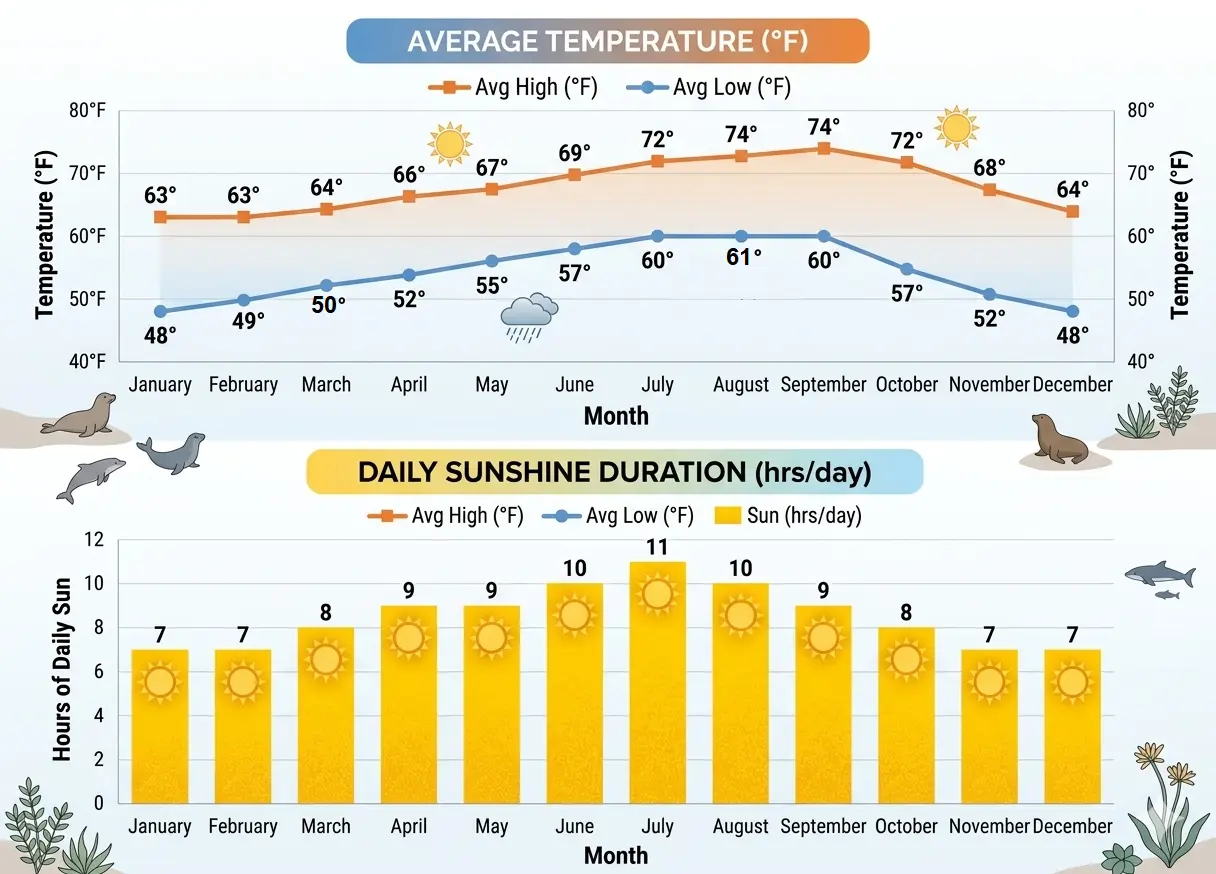
You can click the image below to view the full-size weather chart for Channel Islands National Park.
January
Winter is the wettest time of year. Expect cool temperatures (50–65°F / 10–18°C), occasional rain, and rough seas. Fog is common, and boat trips may be limited. However, the islands are lush and green after rainfall.
Best for: solitude, photography, winter landscapes
Watch out for: canceled ferries due to weather
February
Similar to January but slightly drier. Wildflowers may begin to bloom late in the month. Temperatures remain cool, and ocean conditions can still be unpredictable.
Best for: early wildflowers, quiet hiking
Conditions: cool, breezy, sometimes rainy
March
Spring begins to emerge. Rain decreases, and wildflowers bloom more widely. Temperatures range from 52–68°F (11–20°C).
Best for: wildflower viewing, hiking
Tip: bring layers—mornings can be foggy
April
One of the most beautiful months. Clearer skies, vibrant wildflowers, and mild temperatures (55–70°F / 13–21°C).
Best for: photography, kayaking, wildlife spotting
Conditions: pleasant, occasional coastal fog
May
Warmer and sunnier, though the marine layer (fog) often lingers in the mornings—this is known as “May Gray” in Southern California.
Best for: hiking, camping
Conditions: mild, foggy mornings, sunny afternoons
June
“June Gloom” continues with overcast mornings and sunny afternoons. Temperatures rise slightly (60–75°F / 16–24°C).
Best for: kayaking, snorkeling
Tip: mornings may be cloudy, but afternoons clear up
July
Summer brings warmer and drier weather. Expect highs around 65–80°F (18–27°C). Ocean conditions are calmer, making it a great time for water activities.
Best for: swimming, snorkeling, camping
Conditions: sunny, minimal fog compared to earlier months
August
One of the warmest months. Clear skies, calm seas, and excellent visibility underwater.
Best for: kayaking, diving, wildlife tours
Highlight: peak conditions for ocean activities
September
Often considered the best overall month. Warm temperatures, minimal fog, and fewer crowds after summer peak.
Best for: all activities
Conditions: warm, clear, calm
October
Still warm but gradually cooling. Clear skies and great visibility continue. Winds may start picking up late in the month.
Best for: hiking, photography
Conditions: mild, dry, slightly breezy
November
Cooling temperatures (55–70°F / 13–21°C) and increasing chances of rain. Fewer visitors and peaceful conditions.
Best for: quiet trips, wildlife spotting
Conditions: cooler, occasional storms
December
Winter returns with cooler weather and more frequent rain. Ocean conditions can be rough again.
Best for: solitude, dramatic coastal views
Watch out for: limited boat access
Channel Islands National Park Weather by Month Table
| Month | Avg High (°F / °C) | Avg Low (°F / °C) | Rainfall (inches) | Sun (hrs/day) |
|---|---|---|---|---|
| January | 63°F (17°C) | 48°F (9°C) | 3.1 | 7 |
| February | 63°F (17°C) | 49°F (9°C) | 3.0 | 7 |
| March | 64°F (18°C) | 50°F (10°C) | 2.5 | 8 |
| April | 66°F (19°C) | 52°F (11°C) | 1.0 | 9 |
| May | 67°F (19°C) | 55°F (13°C) | 0.3 | 9 |
| June | 69°F (21°C) | 57°F (14°C) | 0.1 | 10 |
| July | 72°F (22°C) | 60°F (16°C) | 0.0 | 11 |
| August | 73°F (23°C) | 61°F (16°C) | 0.0 | 10 |
| September | 74°F (23°C) | 60°F (16°C) | 0.1 | 9 |
| October | 72°F (22°C) | 57°F (14°C) | 0.5 | 8 |
| November | 68°F (20°C) | 52°F (11°C) | 1.3 | 7 |
| December | 64°F (18°C) | 48°F (9°C) | 2.5 | 7 |
Notes
- Sun (hrs/day) = average daily sunshine duration
- Summer months have the most sunshine, though mornings can be foggy
- Rainfall is heavily concentrated in winter (Dec–Mar)
- Temperatures remain mild year-round due to ocean influence
Quick Summary
- Best overall months: September, August, July
- Best for wildflowers: March–April
- Best for water activities: July–September
- Least crowded: Winter months (December–February)
Channel Islands National Park Weather FAQs
1. What type of climate does Channel Islands National Park have?
It has a Mediterranean coastal climate, with mild temperatures, dry summers, and wetter winters.
2. Does it ever snow in Channel Islands National Park?
No. Snowfall is virtually nonexistent due to the moderating effect of the Pacific Ocean.
3. What is the hottest month in Channel Islands National Park?
September is typically the warmest month, with average highs around 74°F (23°C).
4. What is the coldest month in Channel Islands National Park?
January is usually the coolest, with average lows around 48°F (9°C).
5. When is the rainy season?
Rainfall is concentrated between December and March.
6. What is the driest time of year?
Summer (June–August) is extremely dry, often with little to no rainfall.
7. Is summer always sunny in Channel Islands National Park?
Mostly, but mornings can be cloudy due to marine fog (“June Gloom”), especially in early summer.
8. What is “May Gray” and “June Gloom”?
These are local weather patterns where low clouds and fog dominate mornings in late spring and early summer.
9. How windy is the park?
It can be very windy year-round, especially on exposed cliffs and ridges.
10. Does the ocean affect the weather in Channel Islands National Park?
Yes, significantly. The ocean keeps temperatures mild and stable year-round.
11. What’s the best month for good weather?
September and October often offer the best mix of warm temperatures, clear skies, and calm seas.
12. Is it colder on the islands than the mainland?
Sometimes yes—especially when fog and ocean winds are present.
13. What should I wear?
Dress in layers. Even on warm days, wind and fog can make it feel cool.
14. Are mornings and evenings colder?
Yes. Temperatures can drop noticeably, especially with ocean breezes.
15. Is fog common?
Yes, especially in May, June, and July during morning hours.
16. Can weather affect ferry trips?
Absolutely. Rough seas and high winds may delay or cancel boats.
17. When is the best time for kayaking or snorkeling?
July through September, when seas are calmer and visibility is better.
18. How many sunny hours does the park get?
On average, 7–11 hours of sunshine per day, depending on the season.
19. Is winter a good time to visit Channel Islands National Park?
Yes, if you don’t mind cooler weather—winter offers lush landscapes and fewer crowds.
20. Does weather vary across the islands?
Slightly. Larger islands like Santa Cruz may have microclimates, but overall conditions are similar.