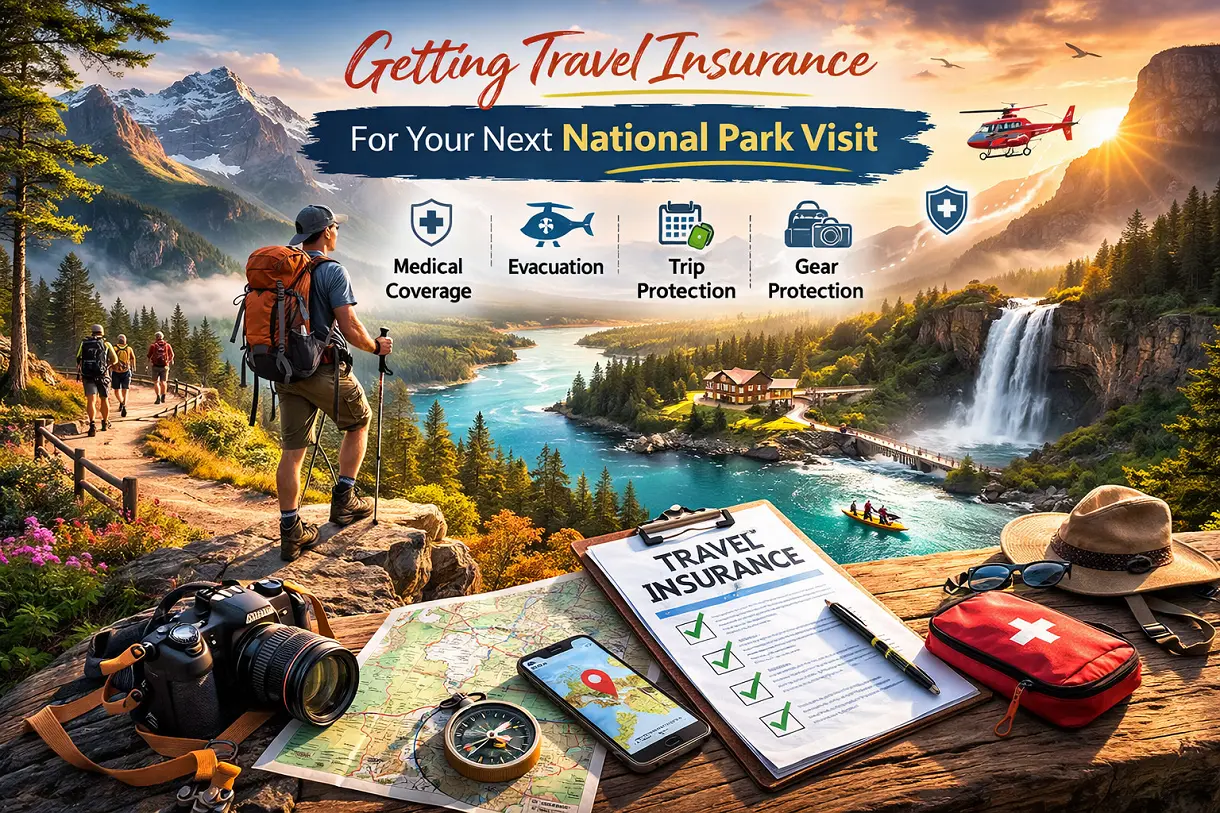
Getting Travel Insurance For Your Next National Park Visit
Planning a national park trip is exciting because it usually feels simple. Pick a park, map out a few trails, book some stays, and you’re ready. Still, national parks don’t behave like city destinations. Distances are longer, services can be limited, and conditions can change quickly. So the “right” travel insurance for a national park visit often looks slightly different from a standard policy you might buy for a shopping or beach trip.
A good policy for a park visit does two things well. First, it protects you if someone gets injured or sick during outdoor activities, especially when help is far away. Second, it helps you recover costs if your plans shift due to issues like closures, disruptions, or a trip that needs to be cut short. Parks can close roads, trails, or facilities due to weather, maintenance, or safety concerns, and that can affect your bookings and itinerary. This is why careful research and comparison of travel insurance is important prior to your visit.
The national-park specific risks that travel insurance should respond to
National parks come with a different risk profile than city travel. The risks are not just “you might lose your bag” or “your flight might be delayed.” They’re often tied to nature, distance, and access. So when you pick travel insurance for a park trip, you want to make sure the policy can actually respond to these situations.
Weather and sudden hazard shifts
Parks can switch moods quickly. A sunny morning can turn into storms by afternoon. Temperatures can swing hard between day and night, especially in desert or mountain regions. Then there are seasonal changes that affect access, like roads that close due to snow, heavy rain, or maintenance.
One of the best examples is slot canyon and river-wading style hikes. They can be perfectly safe in good conditions, and dangerous in the wrong ones. Flash floods can happen fast, and routes can be closed with little notice when alerts go up. If your itinerary depends on a specific trail window, weather can force you to pivot.
What to make sure your insurance can handle:
- Medical treatment if someone is hurt due to weather-driven hazards
- Emergency assistance and evacuation if you’re in a hard-to-reach area
- Trip interruption support if you need to leave early because of injury or serious illness
- Trip cancellation or changes for pre-paid bookings, where the policy terms allow it
Remoteness and connectivity
Many parks have limited infrastructure once you’re inside. In some areas, you can drive for long stretches with few services. Cell coverage can be weak or nonexistent. That changes what an emergency looks like. A minor injury in a city might mean a quick taxi ride. In a park, it could mean a long transfer, coordination with responders, and higher out-of-pocket costs before you even reach proper care.
This is why emergency medical evacuation matters so much for park travel. It’s also why 24/7 assistance matters. If you’re not able to call for help easily, you want a policy that clearly supports coordination, not just reimbursement after the fact.
What to make sure your insurance can handle:
- High enough medical limits for treatment away from home
- Strong emergency evacuation and repatriation benefits
- Clear emergency assistance support, including how to contact them if you’re offline for periods
Access rules, permits, and controlled activities
Parks often have access systems that can make or break your plan. Some experiences require permits. Some have timed entry. Some use shuttle systems that limit when and where you can go. Others restrict certain routes to guided-only experiences.
These rules matter because they create pre-paid, non-flexible pieces in your itinerary. If you miss a permit window due to travel delays, or if a route becomes restricted, you may need to rebook accommodations, tours, and transport. That is where trip interruption and rebooking costs can add up quickly.
What to make sure your insurance can handle:
- Trip delay and missed connection coverage, especially if you have timed plans
- Trip interruption coverage if your itinerary has to be reshuffled mid-trip
- Clarity on what documentation is needed for claims when plans change
Park closures and changing availability
Closures happen for many reasons. Weather, maintenance, wildlife activity, fire risk, or safety concerns can all lead to road or trail closures. Sometimes a closure affects just one area. Other times it changes the whole trip, especially if the park has limited alternative routes.
This is where expectations matter. Many travellers assume “park closure means I can claim.” In reality, coverage depends on the policy wording and the reason for the disruption. So, it’s less about assuming you’re covered and more about choosing a plan with trip disruption benefits that match the way you travel, then keeping good records.
What to make sure your insurance can handle:
- Trip cancellation or curtailment in scenarios the policy recognizes
- Trip interruption coverage when you need to change plans mid-trip
- A practical claims process, including what proof they require for disruptions
The must-have coverage areas for national park travel
National park trips are often active, remote, and schedule-sensitive. That combination changes what “good travel insurance” looks like. You can’t just pick the cheapest plan and hope for the best. Instead, you want coverage that holds up when someone gets hurt on a trail, when conditions force a sudden change, or when your gear becomes a problem.
Here are the coverage areas that matter most for national park travel, plus what to look for in each.
Medical expenses abroad and emergency assistance
If you’re travelling internationally, medical costs can be the biggest financial risk. Even a “small” incident like a sprained ankle can lead to X-rays, scans, and treatment. A bigger incident can escalate quickly.
What to look for:
- High enough medical limits that match the type of trip you’re taking. Outdoor trips tend to have higher medical exposure because injuries are more likely.
- 24/7 emergency assistance that can guide you to suitable clinics and coordinate care.
- Clear claim steps that explain what you should do in an emergency, what documents you need, and whether pre-approval is required for certain treatments.
Practical tip:
Before your trip, save the insurer’s emergency contact details offline. If you’re in a low-signal area, you don’t want to be searching for numbers.
Emergency evacuation and repatriation
This is the coverage area that becomes far more important in parks than in cities. In a city, getting to a hospital can be as simple as a taxi ride. In a national park, an injury can mean transport from a trail to a ranger station, then to a local clinic, then to a larger hospital. Sometimes it takes multiple legs to get appropriate care.
Practical examples:
- A hiker slips and can’t walk, so they need transport off the trail, then an ambulance to the nearest hospital.
- Someone has a severe allergic reaction far from services, and needs urgent transfer to a facility that can treat them.
- A traveller needs repatriation after stabilisation, because continuing treatment back home is safer or more practical.
What to look for:
- A strong evacuation benefit that clearly covers emergency transport from remote areas.
- Repatriation coverage that supports returning home when medically necessary.
- A policy that is clear about whether evacuation is arranged through the insurer’s assistance team, and what counts as a covered “medical necessity.”
Search and rescue support
This is where expectations often don’t match reality. Many travellers assume search and rescue is automatically covered because it feels like an emergency. However, policies can define rescue support in specific ways, and some will only cover rescue or emergency transport under certain conditions.
What people often assume:
- “If I get lost, rescue is covered.”
- “If rangers have to come get me, insurance will pay.”
What policies often do instead:
- Cover emergency transport related to a medical incident, but not necessarily a full search operation.
- Cover some rescue costs, but only when certain conditions are met, such as being injured, following park regulations, or using licensed operators.
What to look for in wording:
- References to rescue costs, search and rescue, or emergency transport.
- Whether it covers rescue from remote areas and whether that includes services like helicopter extraction, where applicable.
- Any conditions that limit coverage, such as negligence, ignoring warnings, or travelling outside permitted areas.
Practical tip:
If your trip includes backcountry routes or routes with known rescue risk, treat search and rescue wording as a key decision point, not a small detail.
Trip cancellation and trip interruption
National park itineraries often have multiple prepaid components: lodges near the park, timed-entry bookings, guided tours, shuttle-dependent schedules, and non-refundable transport segments. When something goes wrong, the cost isn’t just a lost day. It can be a domino effect.
Examples tailored to national parks:
- Trip cut short due to illness or injury mid-trip. You may need to leave early, cancel remaining accommodations, and rearrange transport.
- Closures that cause plan changes, where covered. Some closures force you to reroute or skip booked activities. Coverage depends heavily on policy terms and what the insurer recognises as a covered reason.
- Pre-paid tours or accommodation disruptions, where covered. If you miss a booking due to an insured event, you may be able to claim for unused portions or additional expenses, depending on the policy.
What to look for:
- Clear definitions of covered reasons for cancellation and interruption.
- Whether you’re covered for prepaid, non-refundable expenses.
- The documentation required, because insurers often need proof of the disruption and proof of payments.
Personal liability and accidental damage
This coverage is underrated for outdoor travel. It matters when your trip involves guides, rentals, shared spaces, or situations where you could accidentally injure someone or damage property.
Examples:
- You accidentally injure another hiker while using equipment.
- You damage a rented item, such as outdoor gear or a vehicle accessory.
- An accident causes property damage during a guided activity.
What to look for:
- Personal liability coverage that applies to common travel scenarios.
- Any exclusions around higher-risk activities, because liability may not apply if the activity itself is excluded.
Gear and valuables
National park trips often involve more gear than a typical holiday. Hiking equipment, camera gear, lenses, tripods, outdoor clothing, and sometimes rentals can become expensive problems if they’re lost, stolen, or damaged.
What to consider:
- Hiking and outdoor gear: boots, packs, poles, and specialty items.
- Photography equipment: cameras and lenses can exceed standard baggage limits quickly.
- Rental gear: understand whether rentals are covered and what proof is required if something happens.
What to look for:
- Baggage and personal effects limits that realistically match the value of what you’re bringing.
- Any special sub-limits for electronics or valuables.
- Whether sports or outdoor equipment needs separate coverage, or whether it is treated like normal baggage.
Practical tip:
Make a quick inventory before the trip. Photos and receipts help if you ever need to claim.
Outdoor activities coverage for national parks
National parks are built for outdoor exploration, so most trips include some kind of activity. The tricky part is that insurers don’t treat all activities equally. A gentle hike on a marked trail is not priced the same way as a high-altitude trek, and a casual snorkel is not the same as deeper scuba diving.
To keep your insurance decision simple, start with a reusable checklist. Then match your activity list to policy wording and look for the “covered only if…” conditions that often decide whether you’re protected.
Use this as a quick planning tool. Tick what applies to your trip, then check the policy terms for each item.
Hiking and trekking
- Day hikes vs multi-day trekking
- Easy trails vs steep or technical terrain
- Marked trails vs backcountry routes
- Guided vs unguided hikes
- Any altitude factors (mountain parks can change risk quickly)
What to pay attention to:
Policies may cover hiking broadly, but change their stance based on altitude, remoteness, and whether it’s considered an “expedition.”
Water activities
Depending on the park, this could include:
- Rafting (calm river floats vs white-water trips)
- Kayaking or canoeing
- Snorkelling
- Scuba diving
- Boat tours or water crossings that are part of the itinerary
What to pay attention to:
Water activities often come with conditions like depth limits, rafting grade limits, or requirements to go with a qualified operator.
Climbing and via ferrata style activities
- Indoor climbing walls near the park vs outdoor rock climbing
- Sport climbing, trad climbing, or any rope-based climbing
- Via ferrata routes or guided climbing experiences
What to pay attention to:
Climbing is frequently split by difficulty and equipment. Some policies are fine with low-risk versions but exclude rope climbing or technical mountaineering outright.
Snow season activities
Where relevant for your trip:
- Skiing and snowboarding
- Snowshoeing
- Sledding or similar winter activities
- Guided winter hikes
What to pay attention to:
Ski and snowboard cover often depends on whether you stay within official boundaries, and whether you’re on marked runs versus off-piste terrain.
Glacier or ice activities
- Guided glacier walks
- Ice trekking using crampons
- Boat approaches near ice fields or glaciers
- Any activity involving ice tools or technical gear
What to pay attention to:
Insurers may treat glacier and ice activities as higher-risk. Coverage often depends on being guided, using proper equipment, and staying within what the policy defines as “recreational.”
Common Limitations
Even when an activity is listed as covered, insurers commonly add conditions that must be met. These are the details that decide whether your claim gets paid.
Licensed operator or guide requirements
Many policies cover higher-risk outdoor activities only if you participate through a licensed operator, certified guide, or approved activity provider.
Common examples:
- White-water rafting only if run by a qualified rafting operator
- Guided climbs only if led by certified guides
- Glacier walks only if done as part of an organised tour
Why insurers do this:
A licensed operator implies safety protocols, appropriate equipment, and structured risk management.
What to do:
If your itinerary includes guided experiences, keep booking confirmations and operator details. It makes coverage easier to prove if something happens.
Certification requirements for certain water sports
For activities like scuba diving, insurers may require you to have an appropriate certification, and they may also limit coverage based on your certification level.
Common examples:
- Scuba only if you’re certified, or only if you’re diving under instruction
- Depth limits that apply regardless of skill
- Exclusions if you go beyond your certified depth or training scope
What to do:
Bring proof of certification and keep records of the dive operator and dive plan. If you’re doing a discovery dive, confirm whether “instructor-led” is sufficient under the policy.
Safety equipment requirements
Many policies expect you to use proper safety gear and follow local rules. If you don’t, an insurer may argue you didn’t take reasonable precautions.
Common examples:
- Helmets, harnesses, and proper climbing protection for climbing or via ferrata
- Approved life jackets for rafting and kayaking
- Safety gear for snow sports and winter conditions
- Proper footwear and equipment for trekking and glacier walks
What to do:
Use reputable operators, follow instructions, and don’t treat safety gear as optional. If the park requires certain gear or closes a route, respect that, because ignoring warnings can complicate coverage.
Watch for the three “silent deal breakers”
These are the lines that cause the most surprise later.
Limits that sound reasonable until you hit them
- Altitude caps for trekking
- Depth caps for scuba
- Rafting grade limits
- Boundaries for snow sports or restricted terrain
Definitions that change the category
- Trekking vs expedition
- Climbing vs mountaineering
- Recreational participation vs competition
Requirements that are easy to violate
- Must be with a licensed operator or certified guide
- Must follow park regulations and closures
- Must use proper safety equipment
Ask the insurer the right question when wording is unclear
When you contact an insurer, avoid asking “Is this covered?” because you’ll often get a vague answer. Instead, provide a short scenario and ask for the exact condition.
Use this format:
- “I will be doing [activity] at [basic conditions]. Is this covered under your policy, and what limits or requirements apply?”
Examples:
- “I will be hiking on marked trails, with one day reaching roughly [altitude]. Is hiking covered, and what altitude limit applies?”
- “I will be doing a guided rafting trip on a river rated around [grade/class]. Is rafting covered, and are there grade limits?”
- “I will be doing a guided glacier walk using crampons. Is this covered, and is a licensed operator required?”
- “I will be doing a via ferrata route with a certified guide and harness. Is via ferrata covered under your climbing definition?”
If they confirm, ask them to point you to the relevant clause name or section. You want something you can screenshot or save.