Acadia National Park Map: Your Complete Guide to Exploring Maine’s Coastal Treasure
A good Acadia National Park map is one of the most valuable tools you can bring when visiting one of America’s most beautiful national parks. Spread across Mount Desert Island, the Schoodic Peninsula, Isle au Haut, and dozens of smaller islands, Acadia National Park covers more than 49,000 acres of mountains, forests, lakes, and rugged Atlantic coastline.
Whether you’re planning to drive the famous Park Loop Road, hike to Cadillac Mountain, or explore the quieter Schoodic Peninsula, understanding the park’s layout will help you maximize your visit while avoiding unnecessary travel time.
Why You Need an Acadia National Park Map
Unlike many national parks that consist of one continuous landscape, Acadia is divided into three primary sections:
- Mount Desert Island – Home to approximately 90% of the park’s most popular attractions.
- Schoodic Peninsula – A quieter mainland section featuring dramatic rocky coastline.
- Isle au Haut – A remote island ideal for experienced hikers seeking solitude.
A detailed map helps visitors:
- Navigate scenic roads and hiking trails
- Locate visitor centers and parking areas
- Plan efficient sightseeing routes
- Find campgrounds and picnic areas
- Understand ferry connections
- Identify less crowded destinations
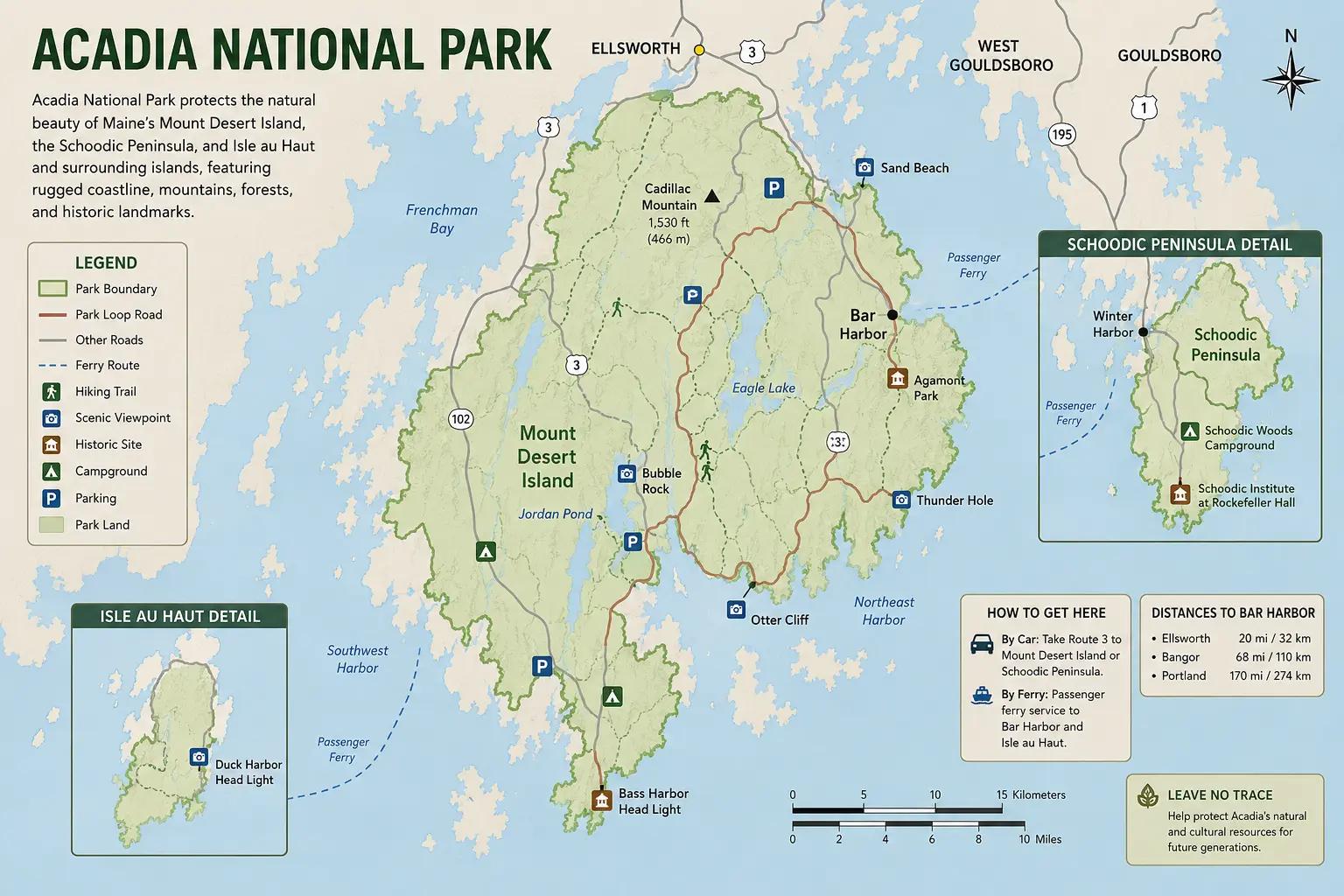
Acadia National Park Map
Click the image below to view the full-size Acadia National Park map.
If you want to download Acadia National Park map pdf file you click here
Overview of the Park Map
1. Mount Desert Island
Mount Desert Island is where most first-time visitors spend their time. This section contains many of Acadia’s iconic attractions, including:
- Cadillac Mountain
- Sand Beach
- Thunder Hole
- Jordan Pond
- Eagle Lake
- Bubble Rock
- Otter Cliff
- Bass Harbor Head Lighthouse
The island is connected by several roads, with the Park Loop Road serving as the main scenic route through the eastern side of the park.
Main Roads
- Park Loop Road (27 miles)
- Route 3
- Route 102
- Route 198
- Route 233
2. Schoodic Peninsula
Located about one hour northeast of Bar Harbor, the Schoodic Peninsula is the only mainland section of Acadia National Park.
Although smaller than Mount Desert Island, it offers:
- Spectacular ocean cliffs
- Powerful surf
- Scenic overlooks
- Cycling opportunities
- Schoodic Woods Campground
- Rockefeller Hall
- Quiet hiking trails
Visitors often overlook Schoodic, making it perfect for those seeking fewer crowds.
3. Isle au Haut
The smallest and most remote unit of Acadia National Park is Isle au Haut.
Accessible only by passenger ferry, this island offers:
- Primitive hiking trails
- Coastal cliffs
- Forest scenery
- Minimal development
- Peaceful backcountry experience
A map is especially important here because services are limited.
Click here to view larger map
Understanding the Park Loop Road
One of the most important features on any Acadia map is the Park Loop Road.
This scenic drive stretches approximately 27 miles (43 km) and connects many of the park’s most famous attractions.
Major stops include:
- Hulls Cove Visitor Center
- Cadillac Mountain Road
- Sieur de Monts Spring
- Sand Beach
- Thunder Hole
- Otter Cliff
- Jordan Pond
- Bubble Rock Trailhead
During peak season, portions of the road operate as one-way traffic, so reviewing the map before entering can save considerable time.
Visitor Centers on the Map
Several visitor centers provide maps, current trail information, and ranger assistance.
Hulls Cove Visitor Center
Located near the main entrance, this is the primary starting point for most visitors.
Services include:
- Official park maps
- Trip planning
- Park passes
- Restrooms
- Ranger information
Sieur de Monts Nature Center
Ideal for visitors interested in:
- Wildflowers
- Nature exhibits
- Short hiking trails
- Historic gardens
Schoodic Institute Visitor Center
Located on the Schoodic Peninsula, this visitor center provides:
- Area maps
- Educational exhibits
- Trail information
- Local history
Acadia National Park Entrances
Unlike many U.S. national parks, Acadia National Park does not have a single main entrance gate. Instead, visitors can access different areas of the park through several entrance points on Mount Desert Island and the Schoodic Peninsula.
1. Hulls Cove Visitor Center (Main Entrance)
The Hulls Cove Visitor Center is the primary gateway for most visitors.
- Location: ME-3, Bar Harbor, Maine
- Best for first-time visitors
- Pick up maps, park information, and trail recommendations
- Purchase or verify park passes
- Access the Park Loop Road
This is the busiest entrance and the starting point for many visitors exploring Cadillac Mountain, Jordan Pond, Sand Beach, and Thunder Hole.
2. Park Loop Road Entrance
Many visitors enter the park directly from Bar Harbor via the Park Loop Road.
This entrance provides quick access to:
- Sand Beach
- Thunder Hole
- Otter Cliff
- Cadillac Mountain
- The Beehive Trail
- Gorham Mountain Trail
During summer, traffic can become heavy, especially in the morning.
3. Southwest Harbor Entrance
Visitors staying in Southwest Harbor, Bass Harbor, or the quieter western side of Mount Desert Island can enter the park through roads leading to:
- Echo Lake
- Long Pond
- Acadia Mountain Trail
- Bass Harbor Head Lighthouse
This entrance is generally less crowded than the Bar Harbor side.
4. Schoodic Peninsula Entrance
The Schoodic Peninsula is the only part of Acadia National Park located on the mainland.
The entrance provides access to:
- Schoodic Point
- Scenic coastal overlooks
- Schoodic Loop Road
- Hiking and biking trails
This area receives far fewer visitors than Mount Desert Island and offers a quieter experience.
Entrance Fees
A valid park entrance pass is required for all park areas, regardless of which entrance you use.
Visitors can purchase passes online before arrival or at entrance stations and visitor centers.
Which Entrance Is Best?
| Entrance | Best For |
|---|---|
| Hulls Cove Visitor Center | First-time visitors, maps, visitor information |
| Park Loop Road | Sand Beach, Thunder Hole, Cadillac Mountain |
| Southwest Harbor | Echo Lake, Bass Harbor, quieter west side |
| Schoodic Peninsula | Scenic coastal drive, fewer crowds |
Tips
- Arrive before 8:00 AM during summer to avoid traffic.
- If visiting Cadillac Mountain Summit Road between late May and late October, you’ll also need a timed-entry vehicle reservation in addition to your park entrance pass.
- The Hulls Cove Visitor Center is the best place to start if it’s your first visit to Acadia National Park.
Popular Attractions on the Map
Cadillac Mountain
The highest point on the U.S. Atlantic coast at 1,530 feet (466 m).
Visitors use the map to locate:
- Summit road
- Hiking trails
- Sunrise viewing areas
- Parking reservations
Jordan Pond
Known for crystal-clear water and the famous Bubble Mountains.
Nearby attractions include:
- Jordan Pond House
- Shore Path
- Bubble Rock Trail
Sand Beach
A small sandy beach surrounded by granite cliffs.
Nearby map highlights include:
- Ocean Path
- Thunder Hole
- Great Head Trail
Thunder Hole
One of Acadia’s most photographed natural attractions.
High tide produces impressive waves and booming sounds inside the narrow sea cave.
Bass Harbor Head Lighthouse
Located on the southwest side of Mount Desert Island, this historic lighthouse is especially popular at sunset.
Hiking Trails on the Map
Acadia offers over 150 miles of hiking trails.
Popular routes include:
| Trail | Distance | Difficulty |
|---|---|---|
| Ocean Path | 4.4 miles | Easy |
| Jordan Pond Loop | 3.4 miles | Easy |
| Bubble Rock | 1 mile | Moderate |
| Beehive Trail | 1.5 miles | Difficult |
| Precipice Trail | 2.5 miles | Very Difficult |
| Cadillac Summit Trail | 4.4 miles | Moderate |
Trail maps indicate:
- Elevation gain
- Trail junctions
- Parking lots
- Scenic viewpoints
- Difficulty ratings
Campgrounds on the Map
Acadia has several developed campgrounds.
Blackwoods Campground
Closest to:
- Sand Beach
- Thunder Hole
- Ocean Path
Seawall Campground
Ideal for visitors exploring:
- Bass Harbor
- Western Mountain trails
- Quiet coastline
Schoodic Woods Campground
Located within the Schoodic Peninsula section.
Excellent for:
- Cyclists
- Families
- Ocean scenery
Transportation and Ferries
Maps also highlight ferry routes connecting different parts of the park.
Passenger Ferry
Seasonal passenger ferries operate between:
- Bar Harbor
- Winter Harbor
- Schoodic Peninsula
Isle au Haut Ferry
Departs from Stonington and provides access to Isle au Haut.
Visitors should check schedules before traveling.
Best Map for First-Time Visitors
If it’s your first visit, choose a map that includes:
- Park boundaries
- Scenic roads
- Hiking trails
- Visitor centers
- Parking areas
- Campgrounds
- Picnic areas
- Shuttle bus stops
- Ferry routes
- Elevation
An updated map is particularly useful during the busy summer season when road closures, construction, or parking restrictions may affect travel plans.
Tips for Using an Acadia National Park Map
- Download an offline map before arriving, as cell service is limited in some areas.
- Start your day early to secure parking at popular trailheads.
- Carry a paper map as a backup for hiking.
- Check for seasonal road closures before your visit.
- Use the map to combine nearby attractions into one efficient route.
- Allow extra travel time when visiting Schoodic Peninsula or Isle au Haut.
Frequently Asked Questions
Is Acadia National Park all on one island?
No. The park consists of Mount Desert Island, Schoodic Peninsula, Isle au Haut, and numerous smaller islands.
Which section should first-time visitors explore?
Mount Desert Island contains most of Acadia’s famous attractions and is the best starting point.
How long does it take to drive the Park Loop Road?
Without stopping, about one hour. Most visitors spend 3–6 hours enjoying scenic overlooks and short hikes.
Is the Schoodic Peninsula worth visiting?
Absolutely. It offers dramatic coastal scenery with significantly fewer crowds than Mount Desert Island.
Do I need a map if I use GPS?
Yes. Cell service can be unreliable in some parts of the park, and a paper or offline map provides a dependable backup.
Final Thoughts
An Acadia National Park map is much more than a navigation tool—it’s the key to understanding one of America’s most unique national parks. Because Acadia is divided into Mount Desert Island, the Schoodic Peninsula, and Isle au Haut, planning your route in advance helps you experience the park more efficiently.
Whether you’re driving the scenic Park Loop Road, hiking granite peaks, exploring remote coastal trails, or taking a ferry to one of the park’s quieter sections, a detailed map ensures you won’t miss the landscapes and landmarks that make Acadia one of the most memorable destinations in the National Park System.