

Niagara Falls is one of North America’s most iconic natural attractions, drawing millions of visitors each year with its breathtaking waterfalls, scenic parks, and year-round activities. However, the weather in Niagara Falls changes dramatically throughout the year, from snowy winters and colorful autumns to warm summers and blooming springs.
Understanding Niagara Falls weather by month can help travelers choose the best time to visit based on their interests, whether that means enjoying boat tours in the summer, photographing vibrant fall foliage, or experiencing the magical ice formations that appear during winter. Temperatures, rainfall, snowfall, and daylight hours all vary significantly from season to season, influencing everything from sightseeing conditions to available attractions.
Niagara Falls Weather by Month
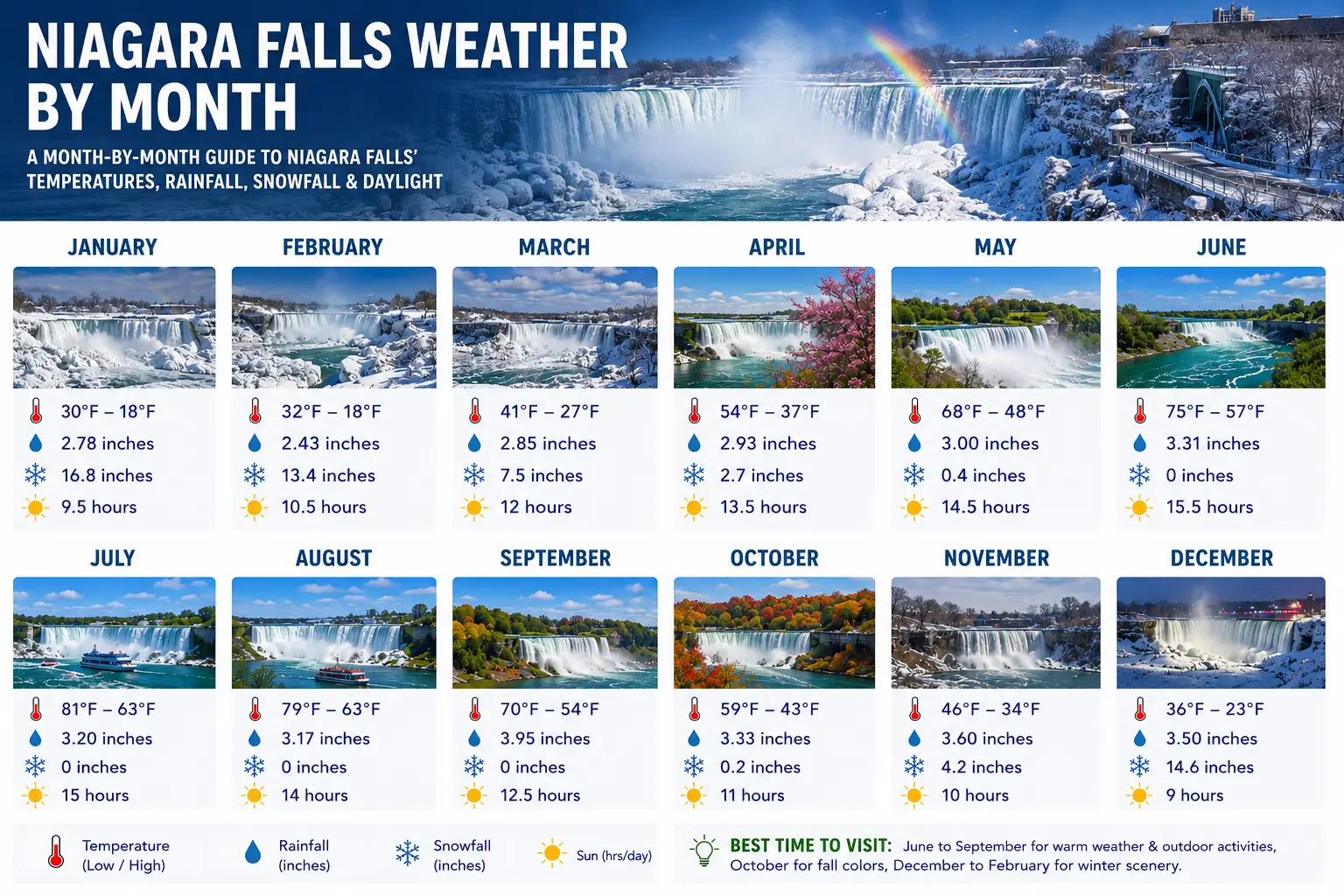
You can click the image below to view the full-size weather chart for Niagara Falls.
January – Deep Winter and Snow-Covered Landscapes
- Average high: 30°F (-1°C)
- Average low: 18°F (-8°C)
- Rainfall: 2.78 inches (70.5 mm)
- Rainy days: 12 days
- Snowfall: 16.8 inches (427.5 mm)
- Daylight: 9.5 hours
January is one of the coldest months in Niagara Falls. Temperatures remain below freezing for much of the month, and significant snowfall transforms the region into a winter wonderland. The falls often produce dramatic ice formations along the surrounding landscape.
Despite the cold, winter offers fewer crowds and unique photo opportunities around the frozen scenery.
Best for:
- Winter photography
- Snow-covered landscapes
- Ice formations near the falls
- Budget-friendly travel
February – Snowy but Slightly Brighter
- Average high: 32°F (0°C)
- Average low: 18°F (-8°C)
- Rainfall: 2.43 inches (61.8 mm)
- Rainy days: 9 days
- Snowfall: 13.4 inches (339.7 mm)
- Daylight: 10.5 hours
February remains cold, but daylight gradually increases. Snow is still common, and visitors can enjoy peaceful viewpoints with fewer tourists than during warmer seasons.
Winter festivals and indoor attractions provide plenty of activities when temperatures drop.
Best for:
- Winter sightseeing
- Photography
- Off-season travel deals
- Quiet experiences
March – Early Signs of Spring
- Average high: 41°F (5°C)
- Average low: 27°F (-3°C)
- Rainfall: 2.85 inches (72.4 mm)
- Rainy days: 10 days
- Snowfall: 7.5 inches (190.9 mm)
- Daylight: 12 hours
March marks the transition from winter to spring. Snowfall decreases noticeably, although winter weather can still occur. Temperatures begin to climb above freezing more consistently.
The changing season brings a mix of snowy and rainy days, making conditions somewhat unpredictable.
Best for:
- Lower crowds
- Early spring travel
- Scenic walks
- Seasonal photography
April – Mild Spring Weather Arrives
- Average high: 54°F (12°C)
- Average low: 37°F (3°C)
- Rainfall: 2.93 inches (74.4 mm)
- Rainy days: 10 days
- Snowfall: 2.7 inches (67.8 mm)
- Daylight: 13.5 hours
April brings noticeably milder temperatures and greener landscapes. Snow becomes rare, while spring flowers begin appearing throughout parks and gardens around Niagara Falls.
Outdoor activities become more enjoyable as temperatures continue to rise.
Best for:
- Spring scenery
- Walking trails
- Garden visits
- Comfortable sightseeing
May – Pleasant Spring Conditions
- Average high: 68°F (20°C)
- Average low: 48°F (9°C)
- Rainfall: 3.00 inches (76.2 mm)
- Rainy days: 9 days
- Snowfall: 0.4 inches (10.6 mm)
- Daylight: 14.5 hours
May is one of the most pleasant months to visit Niagara Falls. Warm afternoons, blooming gardens, and longer daylight hours create ideal sightseeing conditions.
Most attractions are fully operating, and outdoor activities become increasingly popular.
Best for:
- Sightseeing
- Nature walks
- Boat tours
- Photography
June – Warm Days and Peak Water Flow
- Average high: 75°F (24°C)
- Average low: 57°F (14°C)
- Rainfall: 3.31 inches (84.1 mm)
- Rainy days: 8 days
- Snowfall: 0 inches (0 mm)
- Daylight: 15.5 hours
June offers warm temperatures and the longest days of the year. The surrounding parks are lush and green, while the falls are particularly impressive from spring runoff.
Comfortable weather makes this one of the best months for outdoor adventures.
Best for:
- Boat cruises
- Hiking
- Family vacations
- Extended sightseeing
July – Warmest Month of the Year
- Average high: 81°F (27°C)
- Average low: 63°F (17°C)
- Rainfall: 3.20 inches (81.3 mm)
- Rainy days: 8 days
- Snowfall: 0 inches (0 mm)
- Daylight: 15 hours
July is typically the warmest month in Niagara Falls. Long sunny days and warm evenings create ideal conditions for enjoying outdoor attractions and waterfront activities.
This is also one of the busiest months, with visitors arriving from around the world.
Best for:
- Summer vacations
- Fireworks shows
- Outdoor dining
- Family activities
August – Warm and Comfortable
- Average high: 79°F (26°C)
- Average low: 63°F (17°C)
- Rainfall: 3.17 inches (80.5 mm)
- Rainy days: 8 days
- Snowfall: 0 inches (0 mm)
- Daylight: 14 hours
August remains warm and pleasant, though slightly less hot than July. Water-based attractions and evening events remain highly popular.
The weather is generally reliable for outdoor exploration.
Best for:
- Outdoor attractions
- Boat tours
- Summer festivals
- Scenic photography
September – Mild Temperatures and Fall Colors Begin
- Average high: 70°F (21°C)
- Average low: 54°F (12°C)
- Rainfall: 3.95 inches (100.4 mm)
- Rainy days: 9 days
- Snowfall: 0 inches (0 mm)
- Daylight: 12.5 hours
September combines comfortable temperatures with smaller crowds compared to summer. Early autumn colors start appearing toward the end of the month.
Many travelers consider this one of the best times to visit Niagara Falls.
Best for:
- Scenic drives
- Photography
- Outdoor recreation
- Fewer crowds
October – Beautiful Autumn Scenery
- Average high: 59°F (15°C)
- Average low: 43°F (6°C)
- Rainfall: 3.33 inches (84.5 mm)
- Rainy days: 9 days
- Snowfall: 0.2 inches (5.1 mm)
- Daylight: 11 hours
October is famous for vibrant fall foliage throughout the Niagara region. Cool temperatures and colorful landscapes create spectacular views around the falls and nearby parks.
The weather is generally comfortable for walking and sightseeing.
Best for:
- Fall colors
- Photography
- Hiking
- Scenic road trips
November – Chilly and Quiet
- Average high: 46°F (8°C)
- Average low: 34°F (1°C)
- Rainfall: 3.60 inches (91.5 mm)
- Rainy days: 11 days
- Snowfall: 4.2 inches (107.3 mm)
- Daylight: 10 hours
November signals the arrival of colder weather. Rain becomes frequent, and the first significant snowfalls may occur later in the month.
Crowds decline, creating a peaceful atmosphere around the falls.
Best for:
- Off-season travel
- Quiet sightseeing
- Photography
- Lower accommodation rates
December – Holiday Lights and Winter Magic
- Average high: 36°F (2°C)
- Average low: 23°F (-5°C)
- Rainfall: 3.50 inches (88.9 mm)
- Rainy days: 12 days
- Snowfall: 14.6 inches (371.6 mm)
- Daylight: 9 hours
December brings winter back to Niagara Falls. Snow-covered scenery, holiday decorations, and seasonal light displays create a festive atmosphere throughout the region.
The combination of winter landscapes and holiday events makes December a memorable time to visit.
Best for:
- Holiday festivals
- Winter photography
- Seasonal light displays
- Christmas travel
Niagara Falls Weather by Month Table
| Month | Avg High °F (°C) | Avg Low °F (°C) | Rainfall (inches) | Sun (hrs/day) | Snowfall (inches) |
|---|---|---|---|---|---|
| Jan | 30°F (-1°C) | 18°F (-8°C) | 2.78 | 9.5 | 16.8 |
| Feb | 32°F (0°C) | 18°F (-8°C) | 2.43 | 10.5 | 13.4 |
| Mar | 41°F (5°C) | 27°F (-3°C) | 2.85 | 12.0 | 7.5 |
| Apr | 54°F (12°C) | 37°F (3°C) | 2.93 | 13.5 | 2.7 |
| May | 68°F (20°C) | 48°F (9°C) | 3.00 | 14.5 | 0.4 |
| Jun | 75°F (24°C) | 57°F (14°C) | 3.31 | 15.5 | 0.0 |
| Jul | 81°F (27°C) | 63°F (17°C) | 3.20 | 15.0 | 0.0 |
| Aug | 79°F (26°C) | 63°F (17°C) | 3.17 | 14.0 | 0.0 |
| Sep | 70°F (21°C) | 54°F (12°C) | 3.95 | 12.5 | 0.0 |
| Oct | 59°F (15°C) | 43°F (6°C) | 3.33 | 11.0 | 0.2 |
| Nov | 46°F (8°C) | 34°F (1°C) | 3.60 | 10.0 | 4.2 |
| Dec | 36°F (2°C) | 23°F (-5°C) | 3.50 | 9.0 | 14.6 |
When Is the Best Time to Visit Niagara Falls?
- Best weather: June through September
- Best for fall colors: October
- Best for fewer crowds: April, May, and November
- Best for winter scenery: December through February
- Warmest month: July
- Snowiest month: January
- Longest daylight: June
- Rainiest month: September
20 FAQs About Niagara Falls Weather
1. What is the best month to visit Niagara Falls?
June through September are generally considered the best months to visit Niagara Falls, thanks to warm temperatures, long daylight hours, and full access to outdoor attractions and boat tours.
2. What is the warmest month in Niagara Falls?
July is typically the warmest month, with average highs around 81°F (27°C) and lows near 63°F (17°C).
3. What is the coldest month in Niagara Falls?
January is usually the coldest month, with average temperatures ranging from 18°F (-8°C) to 30°F (-1°C).
4. Does it snow in Niagara Falls?
Yes. Snow is common from November through April, with the heaviest snowfall occurring between December and February.
5. What is the snowiest month in Niagara Falls?
January is generally the snowiest month, averaging about 16.8 inches (427.5 mm) of snowfall.
6. Can Niagara Falls freeze in winter?
The waterfalls themselves do not completely freeze because of the enormous volume of moving water. However, ice can form along the edges, creating spectacular frozen scenery.
7. What is the rainiest month in Niagara Falls?
September is usually the wettest month, receiving approximately 3.95 inches (100.4 mm) of rainfall.
8. How much rain does Niagara Falls get each year?
Niagara Falls receives around 37 inches (940 mm) of precipitation annually, distributed fairly evenly throughout the year.
9. Is Niagara Falls crowded during summer?
Yes. July and August are the busiest months, attracting millions of visitors due to warm weather and school vacations.
10. What is Niagara Falls like in spring?
Spring brings milder temperatures, blooming flowers, and increasing daylight. March can still be chilly, while May often offers excellent sightseeing weather.
11. What is Niagara Falls like in autumn?
Autumn features comfortable temperatures and colorful foliage. September and October are especially popular for photography and scenic drives.
12. How many hours of daylight does Niagara Falls get in summer?
Daylight peaks in June at approximately 15.5 hours per day, providing plenty of time for outdoor activities.
13. What is the shortest day of the year in Niagara Falls?
December has the shortest days, with about 9 hours of daylight on average.
14. Is Niagara Falls humid in summer?
Summer can feel moderately humid, particularly during July and August, though the mist from the falls often helps cool nearby areas.
15. What should I wear when visiting Niagara Falls in winter?
Visitors should wear insulated jackets, waterproof boots, gloves, hats, and multiple layers to stay comfortable in cold temperatures and snowy conditions.
16. What should I pack for a summer trip to Niagara Falls?
Light clothing, comfortable walking shoes, sunscreen, sunglasses, and a rain jacket are recommended due to the falls’ constant mist.
17. Are boat tours available year-round?
No. Popular boat tours such as the Maid of the Mist typically operate from spring through late fall, depending on weather and ice conditions.
18. Does Niagara Falls experience severe weather?
Occasionally, thunderstorms can occur during summer, while winter may bring snowstorms and icy conditions.
19. Which season offers the fewest crowds?
Winter, particularly January and February, generally has the fewest visitors, making it ideal for travelers seeking a quieter experience.
20. Is Niagara Falls worth visiting in winter?
Absolutely. Winter offers unique frozen landscapes, ice formations, holiday light displays, lower hotel prices, and significantly smaller crowds than summer.
Read more: