

Gateway Arch National Park is located in the Midwestern United States and experiences a humid continental climate, with cold winters and hot, humid summers. Below is a corrected and data-consistent monthly weather guide, aligned with the table values provided earlier.
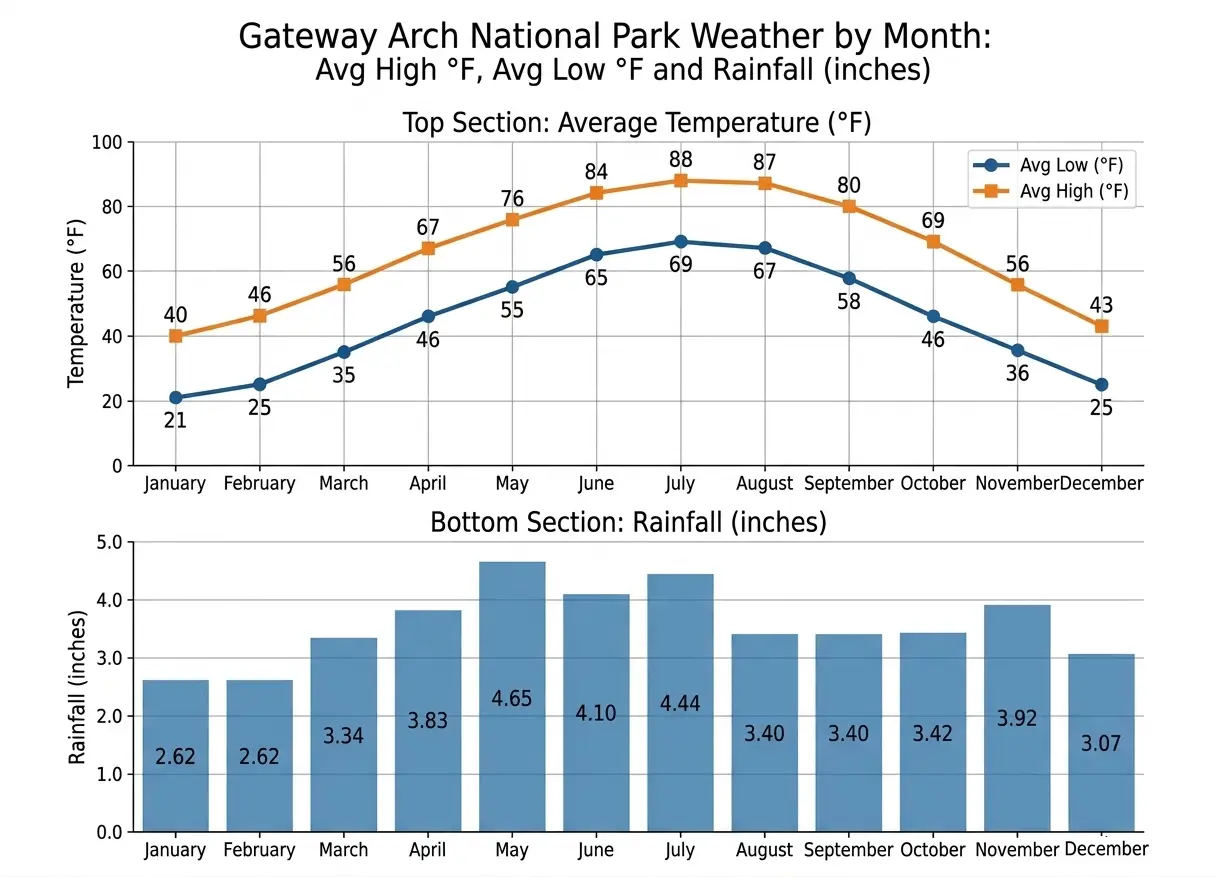
You can click the image below to view the full-size weather chart for Gateway Arch National Park.
January
January is the coldest month of the year, with average temperatures around 40°F (high) and 21°F (low). Snowfall averages 3.2 inches, and cold winds are common. It’s a quiet time to visit with fewer crowds.
February
Winter continues, though slightly milder, with temperatures at 46°F / 25°F. Snowfall decreases to about 2.8 inches, but chilly conditions remain.
March
Spring begins to emerge, bringing temperatures of 56°F / 35°F. Rain increases to 3.34 inches, and snowfall becomes rare.
April
A pleasant spring month with 67°F / 46°F. Rainfall averages 3.83 inches, and the park starts to bloom with greenery.
May
One of the best months to visit, with 76°F / 55°F. It is also the wettest month, receiving about 4.65 inches of rain, but the temperatures are ideal.
June
Summer begins, with warmer conditions at 84°F / 65°F. Rainfall remains relatively high at 4.10 inches, and humidity starts to increase.
July
The hottest month, with temperatures reaching 88°F / 69°F. Expect high humidity and occasional thunderstorms, with about 4.44 inches of rain.
August
Similar to July, August remains hot and humid, averaging 87°F / 67°F. Rainfall drops slightly to 3.40 inches.
September
Early fall brings relief from the heat, with temperatures around 80°F / 58°F. Lower humidity and moderate rainfall (3.40 inches) make it a great time to explore.
October
A favorite month for visitors, featuring mild temperatures of 69°F / 46°F. The weather is generally dry, and fall foliage enhances the scenery.
November
Late fall sees cooler temperatures at 56°F / 36°F. Rainfall averages 3.92 inches, and light snowfall (0.5 inches) may occur.
December
Winter returns with temperatures around 43°F / 25°F. Snowfall averages 2.1 inches, and the holiday atmosphere in nearby St. Louis adds charm to the visit.
Gateway Arch National Park Weather by Month
| Month | Avg High (°F) | Avg Low (°F) | Rainfall (inches) | Snowfall (inches) |
|---|---|---|---|---|
| January | 40 | 21 | 2.62 | 3.2 |
| February | 46 | 25 | 2.62 | 2.8 |
| March | 56 | 35 | 3.34 | 1.1 |
| April | 67 | 46 | 3.83 | 0.1 |
| May | 76 | 55 | 4.65 | 0.0 |
| June | 84 | 65 | 4.10 | 0.0 |
| July | 88 | 69 | 4.44 | 0.0 |
| August | 87 | 67 | 3.40 | 0.0 |
| September | 80 | 58 | 3.40 | 0.0 |
| October | 69 | 46 | 3.42 | 0.0 |
| November | 56 | 36 | 3.92 | 0.5 |
| December | 43 | 25 | 3.07 | 2.1 |
Summary:
- Hottest month: July (avg high ~88–89°F)
- Coldest month: January (avg low ~21°F)
- Wettest month: May (~4.6 inches of rain)
- Snowiest month: January (~3 inches)
Visitor Tips
Best time to visit: Late September through October offers the most comfortable temperatures, fall color, and thinner crowds.
Beat the heat: Summer mornings are cooler — arrive early and carry water. The underground museum stays air-conditioned.
Tram access: The iconic tram ride to the top may close during high winds, lightning, or heavy snow. Check ahead.
Flood awareness: The park sits along the Mississippi. Spring rain can flood riverfront areas — monitor NPS advisories.
Storm season: Severe thunderstorms are possible from spring through fall. Watch forecasts, especially in May–June.
Winter perks: Fewer visitors, lower hotel rates, and a dramatic icy view of the Arch from the riverfront.
Best Time to Visit
Based on the data:
- Best months: April, May, September, October
- Hottest months: July and August
- Coldest & least crowded: December through February
Gateway Arch National Park Weather FAQs
1. What is the weather like at Gateway Arch National Park?
The park has a humid continental climate with hot summers, cold winters, and moderate rainfall throughout the year.
2. What is the hottest month at Gateway Arch?
July is the hottest month at Gateway Arch, with average highs around 88°F (31°C).
3. What is the coldest month at Gateway Arch?
January is the coldest month, with average lows around 21°F (-6°C).
4. When is the best time to visit for good weather?
April, May, September, and October offer the most comfortable temperatures and pleasant conditions.
5. Does it snow at Gateway Arch National Park?
Yes, snowfall occurs mainly from December through February, with January being the snowiest month.
6. How much rain does the park get annually?
The park receives moderate rainfall year-round, averaging around 40–45 inches annually.
7. What is the wettest month?
May is typically the wettest month, with about 4.6 inches of rainfall.
8. Is summer a good time to visit?
Summer is popular but can be very hot and humid, especially in July and August.
9. How humid does it get in summer?
Humidity levels are high in summer, often making temperatures feel hotter than they actually are.
10. Does the park experience thunderstorms?
Yes, thunderstorms are common in late spring and summer, especially in May through July.
11. What should I wear in winter?
Dress in warm layers, including a coat, gloves, and hat, as temperatures can drop below freezing.
12. What should I wear in summer?
Lightweight, breathable clothing is best, along with sunscreen and plenty of water.
13. Is fall a good season to visit?
Yes, fall is one of the best seasons, with mild temperatures and beautiful foliage.
14. Is spring weather predictable?
Spring weather can be unpredictable, with a mix of warm days, rain, and occasional cool snaps.
15. Are there extreme weather events?
Occasionally, the area can experience heatwaves, heavy storms, or winter cold snaps.
16. What is the average temperature in spring?
Spring temperatures range from about 56°F to 76°F (13°C to 24°C).
17. What is the average temperature in fall?
Fall temperatures range from about 69°F to 80°F (21°C to 27°C) early in the season, cooling later.
18. Is it windy near the Gateway Arch?
Yes, winds can be noticeable due to the park’s location along the Mississippi River.
19. Can weather affect tram rides to the top of the Arch?
Severe weather, especially lightning or high winds, may temporarily affect tram operations.
20. How can I check current weather conditions before visiting?
You can check local forecasts for St. Louis to get the most accurate and up-to-date weather information.