

Gates of the Arctic National Park is located entirely above the Arctic Circle, giving it one of the harshest and most unpredictable climates in North America. The park experiences long, frigid winters, very short summers, and dramatic seasonal changes in daylight—from polar night to midnight sun.
Temperatures can range from below −50°F (−45°C) in winter to about 70°F (21°C) in summer, with snow possible in any month.
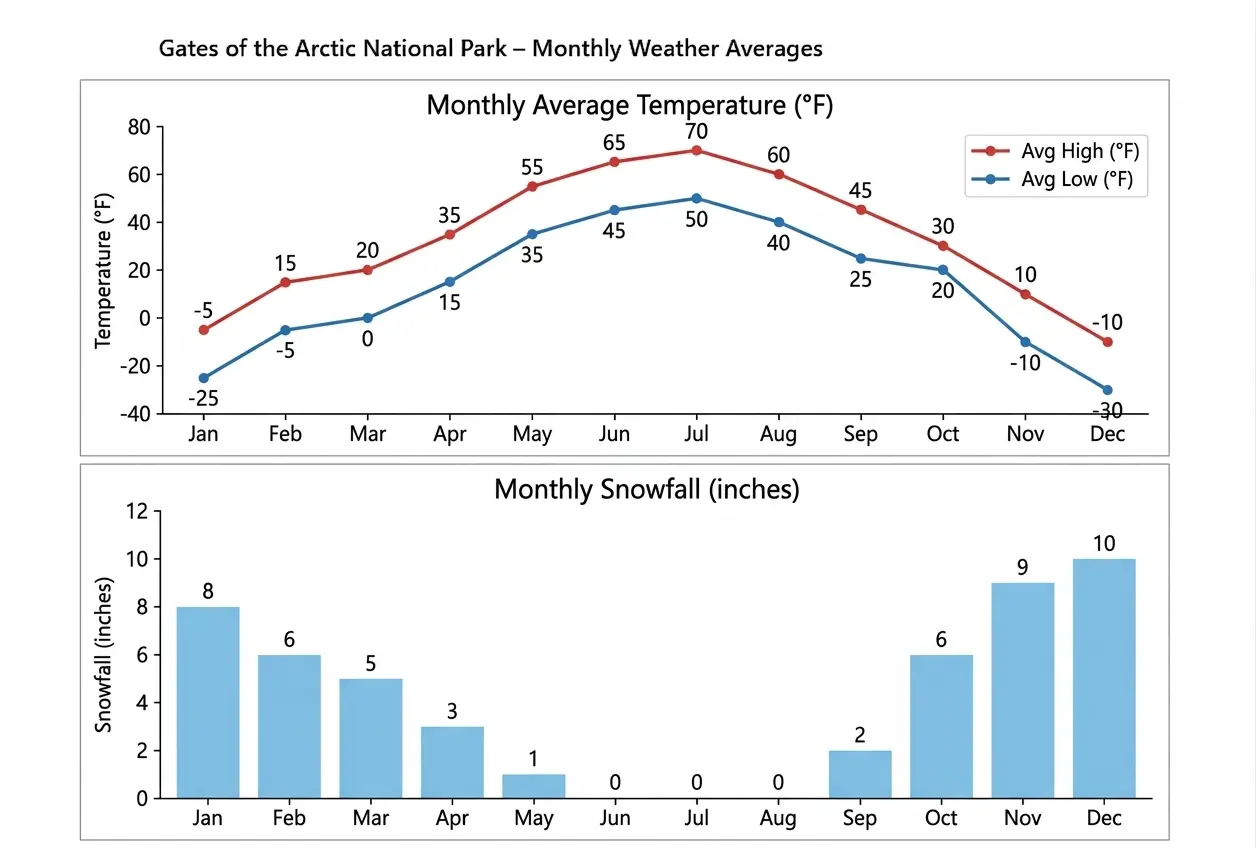
You can click the image below to view the full-size weather chart for Gates of the Arctic National Park.
January
January is deep winter in the Arctic.
- Average high: ~ -5°F (-20°C)
- Average low: ~ -25°F (-32°C)
- Nearly continuous darkness (polar night)
- Frequent snow and extreme cold snaps
This is one of the coldest months, with temperatures often plunging far below zero and very limited daylight.
February
Conditions remain severe but daylight slowly returns.
- High: ~ 15°F (-9°C)
- Low: ~ -5°F (-20°C)
- Increasing daylight hours
- Ideal for winter travel (skiing, dog sledding)
Late February marks the beginning of “spring travel season” in Arctic terms.
March
A transitional winter-to-spring month.
- High: ~ 20°F (-7°C)
- Low: ~ 0°F (-18°C)
- Longer days and clearer skies
- Still snow-covered landscape
March often has some of the clearest skies of the year.
April
Spring begins, but winter still dominates.
- High: ~ 35°F (2°C)
- Low: ~ 15°F (-9°C)
- Snow starts melting slowly
- Rivers remain frozen
Travel is still winter-based, but temperatures begin rising.
May
The “break-up” season.
- High: ~ 55°F (13°C)
- Low: ~ 35°F (2°C)
- Ice melts and rivers begin breaking apart
- Travel becomes difficult and dangerous
This is one of the least practical months to visit due to unstable conditions.
June
Early summer arrives.
- High: ~ 65°F (18°C)
- Low: ~ 45°F (7°C)
- Midnight sun begins (24-hour daylight)
- Snow mostly gone at lower elevations
However, conditions can still be wet and cold, and thunderstorms may occur.
July
The warmest and most stable month.
- High: ~ 70°F (21°C)
- Low: ~ 50°F (10°C)
- Peak hiking and rafting season
- Frequent rain and insects
July is typically the only month when snow is unlikely, making it the best time for visitors.
August
Late summer with increasing rain.
- High: ~ 60°F (15°C)
- Low: ~ 40°F (4°C)
- Wettest month of the year
- Bugs begin to decrease
Rainfall peaks in August, and temperatures start to cool toward the end of the month.
September
Short but colorful fall season.
- High: ~ 45°F (7°C)
- Low: ~ 25°F (-4°C)
- First snow returns
- Rivers begin freezing
Fall is brief but beautiful, with tundra colors and fewer insects.
October
Winter returns quickly.
- High: ~ 30°F (-1°C)
- Low: ~ 20°F (-7°C)
- Increasing snowfall
- Rapidly shortening days
Most access becomes difficult as conditions shift back to winter.
November
Darkness and cold intensify.
- High: ~ 10°F (-12°C)
- Low: ~ -10°F (-23°C)
- Snow cover deepens
- Very limited daylight
The long Arctic winter fully sets in again.
December
Extreme winter conditions.
- High: ~ -20°F (-29°C)
- Low: ~ -40°F (-40°C)
- Near-total darkness
- Frequent snow and severe cold
December is one of the harshest months, with minimal sunlight and extreme temperatures.
Gates of the Arctic National Park Weather by Month
| Month | Avg High (°F) | Avg Low (°F) | Rainfall (inches) | Snowfall (inches) |
|---|---|---|---|---|
| January | -5 | -25 | 0.3 | 8 |
| February | 15 | -5 | 0.3 | 6 |
| March | 20 | 0 | 0.2 | 5 |
| April | 35 | 15 | 0.2 | 3 |
| May | 55 | 35 | 0.5 | 1 |
| June | 65 | 45 | 1.2 | 0 |
| July | 70 | 50 | 2.0 | 0 |
| August | 60 | 40 | 2.5 | 0 |
| September | 45 | 25 | 1.5 | 2 |
| October | 30 | 20 | 0.8 | 6 |
| November | 10 | -10 | 0.5 | 9 |
| December | -10 | -30 | 0.4 | 10 |
Key Notes
- Wettest months: July–August (summer rains dominate)
- Snowiest months: November–January
- Snow possible: September through May
- Dry period: Late winter and early spring
Because Gates of the Arctic is so remote, these numbers are generalized from nearby Arctic Alaska climate data rather than a single fixed station.
Summary of Seasonal Weather
- Winter (Nov–Mar): Extremely cold, dark, and snowy
- Spring (Apr–May): Unstable thaw and dangerous river conditions
- Summer (Jun–Aug): Short, cool, wet, and bright (best time to visit)
- Fall (Sep–Oct): Brief, colorful, quickly turning cold
Overall, the park’s climate is defined by extremes and rapid changes, where even summer can bring freezing temperatures or snow.
Gates of the Arctic National Park Weather – FAQs
1. What is the weather like in Gates of the Arctic National Park?
The park has an Arctic climate with extremely cold winters, short cool summers, and rapid weather changes year-round.
2. How cold does it get in winter?
Winter temperatures can drop below -50°F (-45°C), especially in December through February.
3. What is the warmest month in in Gates of the Arctic National Park?
July is typically the warmest month, with highs around 65–70°F (18–21°C).
4. Does it snow year-round?
Snow is possible any month, but it is most common from September through May.
5. When is the best time to visit for good weather?
The best time is mid-June to mid-July, when temperatures are milder and there is continuous daylight.
6. What is the coldest month in Gates of the Arctic National Park?
January is usually the coldest month, with average lows near -25°F (-32°C) or colder.
7. How much daylight does the park get?
- Winter: Very little or no sunlight (polar night)
- Summer: 24 hours of daylight (midnight sun)
8. Does it rain a lot in summer?
Yes, July and August are the wettest months, with frequent rain showers.
9. Is the weather predictable?
No, weather is highly unpredictable, and conditions can change quickly—even within the same day.
10. What is the “midnight sun”?
It’s a summer phenomenon where the sun stays visible 24 hours a day, occurring from late May to July.
11. What is the “polar night”?
During winter, the sun does not rise for extended periods, resulting in near-total darkness.
12. Are there strong winds?
Yes, especially in winter and open tundra areas, which can make temperatures feel even colder.
13. What is spring weather like?
Spring (April–May) is a transition period, with melting snow, icy rivers, and unstable conditions.
14. Is fall a good time to visit Gates of the Arctic National Park?
Early September can be beautiful with fall colors, but temperatures drop quickly and snow may begin.
15. Are mosquitoes a problem in Gates of the Arctic National Park?
Yes, mosquitoes can be very intense in June and July, especially in wet areas.
16. Can temperatures drop below freezing in summer?
Yes, even in summer, temperatures can occasionally fall below 32°F (0°C).
17. How much snow falls annually?
The park receives moderate snowfall, but snow remains on the ground for much of the year due to cold temperatures.
18. Is climate change affecting the park’s weather?
Yes, Arctic regions are warming faster than average, leading to shorter winters and changing ecosystems.
19. What should I pack for the weather?
Layered clothing is essential:
- Insulated jacket
- Waterproof gear
- Thermal base layers
- Bug protection (summer)
20. Is it safe to visit in extreme weather?
It can be dangerous without preparation. Visitors should have wilderness survival skills and be ready for sudden weather changes.