

Located in south-central Utah, Capitol Reef National Park experiences a high-desert climate with four distinct seasons. Elevation changes across the park create noticeable variations in temperature and precipitation, but overall, visitors can expect hot summers, cool winters, and mild spring and fall seasons.
You can click the image below to view the full-size weather chart for Capitol Reef National Park by month.
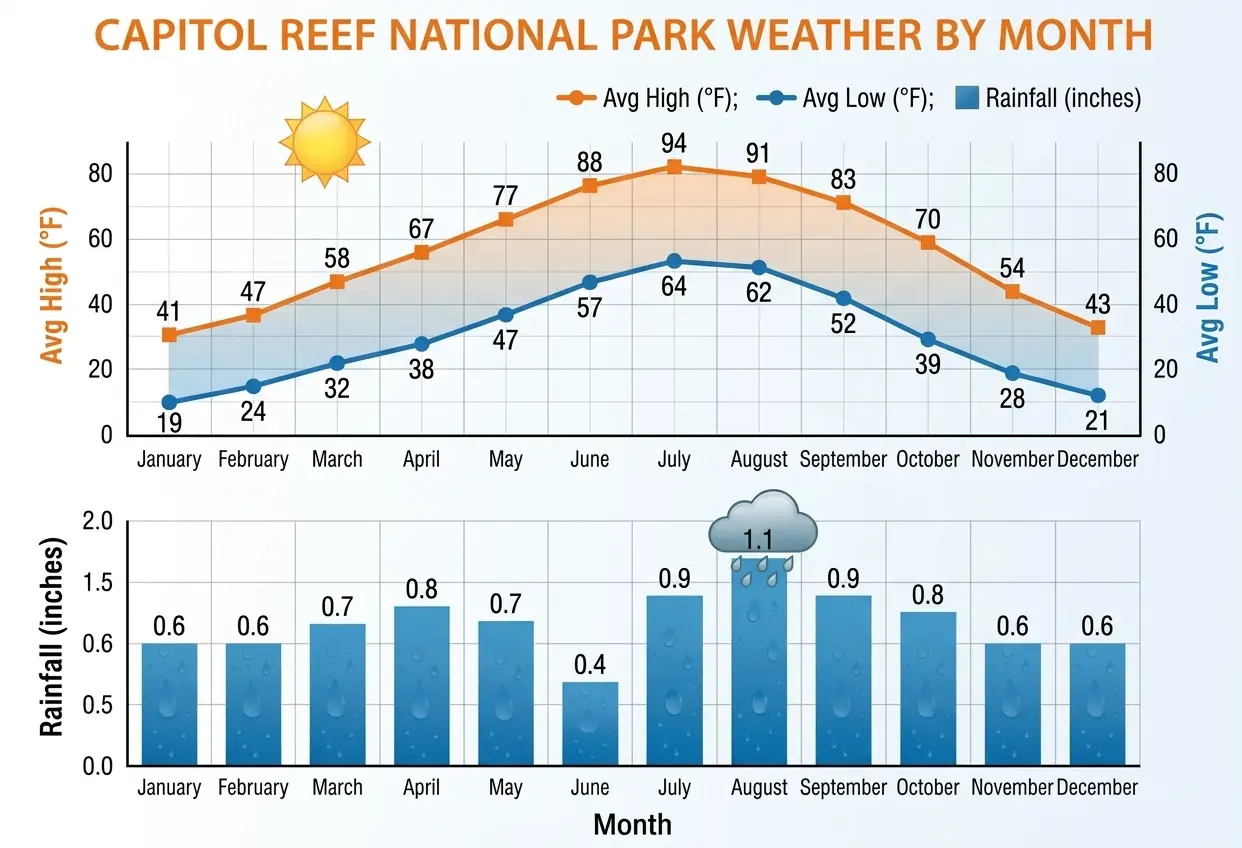
Here’s a detailed month-by-month breakdown to help you plan your trip:
January
- Average High: 41°F (5°C)
- Average Low: 19°F (-7°C)
- Conditions: Cold and quiet, with occasional snow.
- What to Expect: A peaceful park with few visitors. Snow may dust the red rock formations, creating stunning contrasts.
February
- Average High: 47°F (8°C)
- Average Low: 24°F (-4°C)
- Conditions: Slightly warmer but still wintery.
- What to Expect: Increasing daylight and occasional snow or rain. Good for solitude and photography.
March
- Average High: 58°F (14°C)
- Average Low: 32°F (0°C)
- Conditions: Early spring begins.
- What to Expect: Mild days and chilly nights. Wildflowers may start to appear late in the month.
April
- Average High: 67°F (19°C)
- Average Low: 38°F (3°C)
- Conditions: Pleasant and mild.
- What to Expect: One of the best months to visit. Orchards begin blooming in the historic Fruita district.
May
- Average High: 77°F (25°C)
- Average Low: 47°F (8°C)
- Conditions: Warm and comfortable.
- What to Expect: Ideal hiking weather. Crowds begin to increase as peak season approaches.
June
- Average High: 88°F (31°C)
- Average Low: 57°F (14°C)
- Conditions: Hot and dry.
- What to Expect: Early mornings and evenings are best for outdoor activities. Sun protection is essential.
July
- Average High: 94°F (34°C)
- Average Low: 64°F (18°C)
- Conditions: Hottest month; monsoon season begins.
- What to Expect: Afternoon thunderstorms are common. Flash flood risks increase in slot canyons.
August
- Average High: 91°F (33°C)
- Average Low: 62°F (17°C)
- Conditions: Hot with frequent storms.
- What to Expect: Similar to July, with dramatic skies and occasional heavy rain.
September
- Average High: 83°F (28°C)
- Average Low: 52°F (11°C)
- Conditions: Cooling down.
- What to Expect: Excellent weather returns. Fewer storms and fewer crowds than summer.
October
- Average High: 70°F (21°C)
- Average Low: 39°F (4°C)
- Conditions: Crisp and comfortable.
- What to Expect: Another peak month. Fall colors appear in the orchards and along the Fremont River.
November
- Average High: 54°F (12°C)
- Average Low: 28°F (-2°C)
- Conditions: Cooling rapidly.
- What to Expect: Quiet season begins. Occasional early snow and fewer visitors.
December
- Average High: 43°F (6°C)
- Average Low: 21°F (-6°C)
- Conditions: Cold winter weather.
- What to Expect: Snow is possible, especially at higher elevations.
Capitol Reef National Park Weather by Month
| Month | Avg High (°F / °C) | Avg Low (°F / °C) | Rainfall (inches) | Snowfall (inches) |
|---|---|---|---|---|
| January | 41 / 5 | 19 / -7 | 0.6 | 8.0 |
| February | 47 / 8 | 24 / -4 | 0.6 | 6.5 |
| March | 58 / 14 | 32 / 0 | 0.7 | 3.5 |
| April | 67 / 19 | 38 / 3 | 0.8 | 0.8 |
| May | 77 / 25 | 47 / 8 | 0.7 | 0.0 |
| June | 88 / 31 | 57 / 14 | 0.4 | 0.0 |
| July | 94 / 34 | 64 / 18 | 0.9 | 0.0 |
| August | 91 / 33 | 62 / 17 | 1.1 | 0.0 |
| September | 83 / 28 | 52 / 11 | 0.9 | 0.0 |
| October | 70 / 21 | 39 / 4 | 0.8 | 0.5 |
| November | 54 / 12 | 28 / -2 | 0.6 | 2.5 |
| December | 43 / 6 | 21 / -6 | 0.6 | 7.0 |
Notes:
- Rainfall is relatively low year-round, typical of a desert climate.
- Snowfall mainly occurs from November through March.
- July–September sees slightly higher rainfall due to monsoon storms.
Best Time to Visit
- Spring (April–May): Ideal temperatures, blooming orchards
- Fall (September–October): Comfortable weather and beautiful scenery
- Summer (June–August): Best for early/late day adventures but very hot
- Winter (December–February): uncrowded, but cold
Travel Tips
- Always check for flash flood warnings in summer.
- Bring layers—temperature swings between day and night can be significant.
- Stay hydrated year-round due to the dry desert climate.
20 helpful FAQs about weather in Capitol Reef National Park
1. What is the best time to visit Capitol Reef National Park for good weather?
Spring (April–May) and fall (September–October) offer the most comfortable temperatures and pleasant conditions.
2. How hot does it get in summer?
Summer highs (June–August) often reach 90–100°F (32–38°C), especially in July.
3. Is winter a good time to visit Capitol Reef National Park?
Yes, if you prefer fewer crowds. However, temperatures are cold, often below freezing at night.
4. Does it snow in Capitol Reef National Park?
Yes, snowfall occurs mainly from November through March, though it’s usually light at lower elevations.
5. When is the rainy season in Capitol Reef?
Late summer (July–September) brings monsoon storms with short but intense rainfall.
6. Are flash floods common?
Flash floods can occur during summer thunderstorms, especially in narrow canyons.
7. What should I wear in spring?
Layered clothing is best—days are mild, but mornings and evenings can be chilly.
8. How cold does Capitol Reef National Park get at night?
Even in summer, nighttime temperatures can drop significantly, sometimes by 30°F (15°C) or more.
9. Is fall weather predictable?
Fall is generally stable with mild days and cool nights, making it one of the most reliable seasons.
10. What is the driest month in Capitol Reef National Park?
June is typically the driest month with minimal rainfall.
11. What is the wettest month in Capitol Reef National Park?
August usually sees the most rainfall due to monsoon activity.
12. Is humidity high in the park?
No, the park has a dry desert climate with low humidity year-round.
13. Can weather vary within the park?
Yes, higher elevations are cooler and may receive more precipitation than lower areas.
14. Is it safe to hike in summer?
Yes, but only with precautions—start early, carry plenty of water, and avoid midday heat.
15. Are thunderstorms dangerous?
They can be, especially due to lightning and flash floods. Always check forecasts before hiking.
16. What is spring weather in Capitol Reef National Park like?
Spring brings mild temperatures, blooming orchards, and occasional rain.
17. Does wind affect travel plans?
Wind is usually not extreme but can occasionally be strong, especially in open desert areas.
18. Are roads affected by weather?
Yes, dirt roads can become impassable after heavy rain or snow.
19. Is Capitol Reef National Park open year-round despite weather?
Yes, Capitol Reef National Park is open all year, though some areas may be temporarily inaccessible.
20. Do I need to check weather forecasts before visiting Capitol Reef National Park?
Absolutely. Conditions can change quickly, especially during monsoon season or winter storms.